

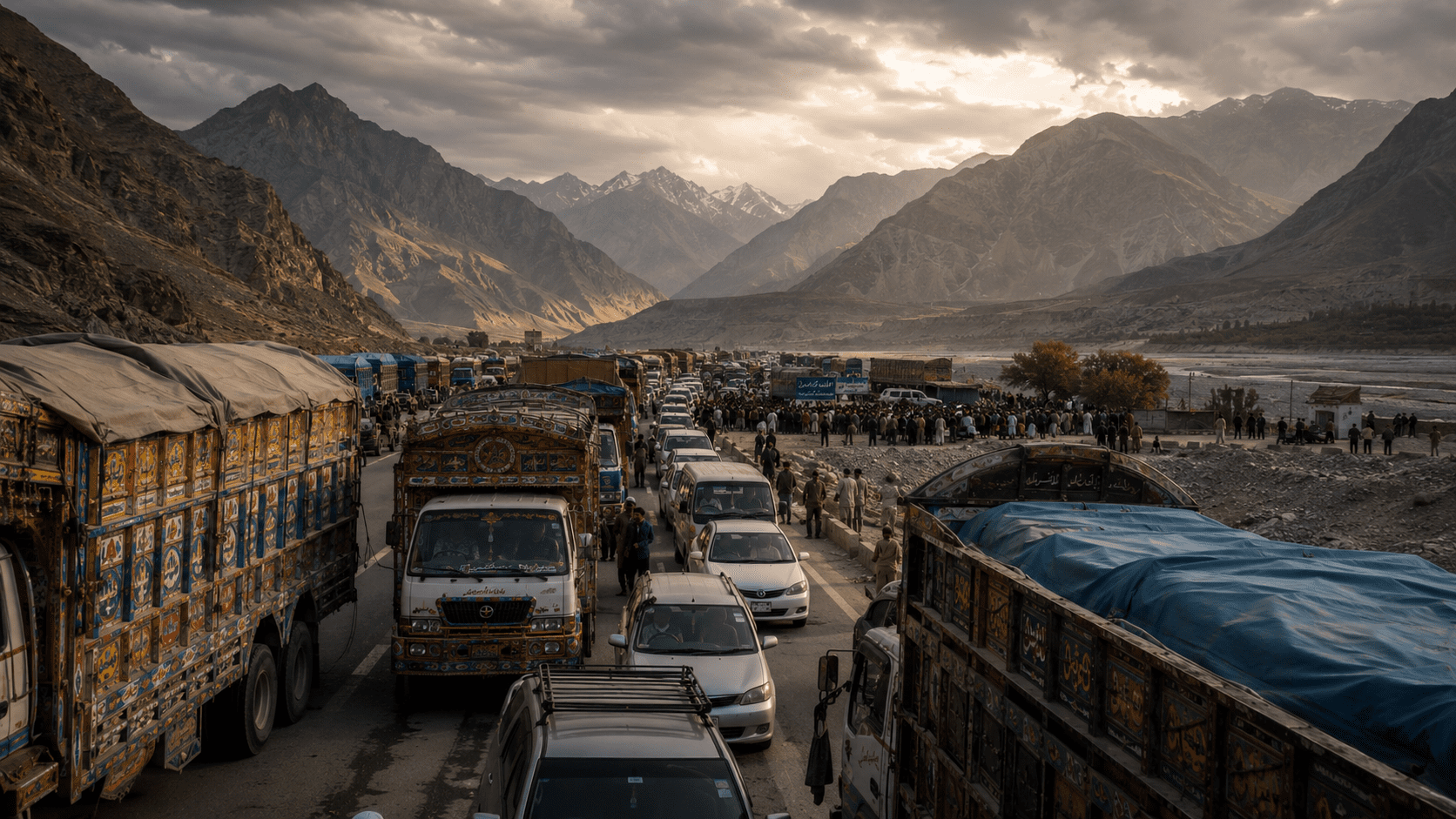
PESHAWAR / LANDI KOTAL — The Torkham Highway crisis has exploded into one of the most serious security and civil disruption emergencies on Pakistan’s western border in months. The Peshawar-Torkham Highway — Pakistan’s most critical land trade artery connecting the country to Afghanistan and Central Asia — has been repeatedly blocked, reopened, and threatened with fresh closure as a cascade of violent incidents, unresolved tribal grievances, and unimplemented Jirga decisions combine to push communities in the Khyber region to the edge of open confrontation.
Thank you for reading this post, don't forget to subscribe!The Torkham Highway crisis is not a single incident but an accumulating emergency — a convergence of multiple, interconnected crises that each individually would be serious but together represent a systemic breakdown of the security and governance framework that the communities along this vital route depend on. Understanding the Torkham Highway crisis requires examining each of these threads and how they have woven together into the dangerous situation that Pakistan’s security establishment, provincial government, and federal authorities are now urgently managing.
The Immediate Trigger: Targeted Attack Sparks Highway Shutdown
The most recent and most visible manifestation of the Torkham Highway crisis was the blocking of the Peshawar-Torkham Highway by tribal protesters following what has been described as a targeted attack in the area. Dawn correspondent Ibrahim Shinwari, one of Pakistan’s most experienced journalists covering the Khyber region, reported that the highway had been blocked in protest against the recent targeted killing — the kind of attack that has been occurring with disturbing regularity in the Khyber district and that tribal communities blame on security failures and the inadequate response of the state to repeated demands for protection.
The reopening of the Peshawar-Torkham Highway after the protest — reported 21 hours ago — brought relief to the thousands of truck drivers, traders, and travellers whose livelihoods depend on the free flow of traffic on this route. But the Torkham Highway crisis conditions that produced the blockade have not been resolved, and the risk of the highway being closed again remains high as long as the underlying security situation continues to deteriorate.
The pattern of the Torkham Highway crisis — protest, blockade, partial resolution, reopening, fresh incident, new blockade — reflects a deeply concerning cycle in which the highway itself has become the primary tool through which tribal communities express their frustration with the state’s failure to address their security and governance concerns. When conventional channels of political representation, legal redress, and administrative engagement are felt to be inadequate, closing the highway is the most powerful leverage that communities along the route possess.
Unimplemented Jirga Decisions: The Root Grievance
Beneath the immediate Torkham Highway crisis blockades lies a more fundamental grievance that has been building for months: the failure of authorities to implement decisions reached through the traditional Jirga dispute resolution mechanism that governs community relations across Pakistan’s tribal belt.
The Associated Press of Pakistan reported that protesters blocked the Pak-Afghan Highway specifically over “unimplemented Jirga decisions” — a formulation that encapsulates a profound crisis of governance legitimacy in the Khyber region. When communities bring their disputes to a Jirga and reach binding resolutions that are then ignored or not enforced by the relevant authorities, the message received is that neither the traditional governance system nor the formal state apparatus is capable of delivering justice.
The Torkham Highway crisis in this context is as much a governance crisis as a security one. The targeted killings and violence that have triggered the immediate highway blockades are symptoms of a deeper failure — the failure to implement the Jirga decisions that were supposed to resolve the underlying disputes driving the violence in the first place. Until those decisions are implemented and the grievances they were meant to address are genuinely resolved, the Torkham Highway crisis will continue to produce new incidents regardless of how many times the highway is temporarily reopened.
Landi Kotal: Double Killing Triggers Tribal Blockade
Among the specific incidents fuelling the Torkham Highway crisis, the double killing in Landi Kotal reported by Aaj English TV stands out as particularly significant. Landi Kotal — a major town and commercial hub in the Khyber district situated directly on the Peshawar-Torkham route — has been at the epicentre of the current crisis.
The double killing in Landi Kotal, which triggered a tribal blockade of the Pak-Afghan Highway, reflects the pattern of targeted violence that has been systematically eroding security in the Khyber region. Targeted killings — in which specific individuals are selected and killed by armed groups for reasons ranging from personal disputes and criminal activity to political and sectarian motivations — have become one of the most concerning security trends in KPK’s border districts.
For the Torkham Highway crisis, each targeted killing in Landi Kotal or the surrounding areas has a multiplier effect. The family and tribe of the victim exercise their customary right to demand justice and protection by blocking the highway — a measure that immediately attracts attention, creates economic pressure, and forces engagement with the state. The Torkham Highway crisis blockade cycle therefore has a direct relationship with the targeted killing cycle: more killings produce more blockades, and unresolved blockade grievances create the conditions for further violence.
Rising Violence in Khyber: Schools, Roads and Livelihoods Under Threat
The Torkham Highway crisis cannot be understood in isolation from the broader deterioration of security across the Khyber district that The News Pakistan’s correspondent Ashrafuddin Pirzada documented in a comprehensive report about rising violence in the area.
The threat to close schools — a measure that communities in conflict zones resort to when they feel the state is not protecting their children and families — is one of the most alarming indicators of how deeply the Torkham Highway crisis and the surrounding security environment are affecting ordinary life in the region. When parents feel it is unsafe to send children to school, when traders feel it is unsafe to open their shops, when truckers fear for their lives on the highway, the social and economic fabric of the region begins to unravel.
The threatened road blockade in Khyber carries direct implications for the Torkham Highway crisis because the Peshawar-Torkham Highway is not merely a road — it is the lifeline of the entire economy of the Khyber district. Every blockade costs local businesses, traders, and trucking families directly. The communities exercising their protest rights through blockades are simultaneously harming their own economic interests — a sign of how desperate and how serious their grievances have become.
According to Pakistan’s National Highway Authority (NHA), the Peshawar-Torkham Highway handles billions of rupees worth of trade annually and is a critical component of Pakistan’s Afghanistan trade relationship. Any sustained closure of the route as part of the Torkham Highway crisis would have immediate and serious economic consequences extending well beyond the Khyber region.
The Strategic Stakes: Torkham and Pakistan’s Trade Future
The Torkham Highway crisis is not merely a local security problem — it is a strategic national concern. The Peshawar-Torkham route is Pakistan’s primary land connection to Afghanistan and, through Afghanistan, to Central Asia. As Pakistan pursues its ambitions to become a regional trade and transit hub — connecting South Asia to Central Asia through Pakistani territory — the security and reliability of the Torkham corridor is foundational.
Every time the Torkham Highway crisis produces a blockade that closes the route, it damages Pakistan’s credibility as a reliable trade partner and transit corridor. Afghan traders, Central Asian exporters, and Pakistani businesses that depend on the Torkham route lose confidence in the route’s reliability. That confidence, once lost, is not easily regained — and competing routes through Iran or other corridors begin to look more attractive to regional traders.
The Torkham Highway crisis also has direct implications for Pakistan’s relationship with Afghanistan’s current government. Trade through Torkham is one of the most tangible and functional dimensions of Pakistan-Afghanistan economic engagement, and repeated disruptions caused by the Torkham Highway crisis make it harder for both governments to build the stable economic relationship that regional stability requires.
According to Pakistan’s Ministry of Commerce, Afghanistan remains one of Pakistan’s most important regional trading partners, with Torkham handling the majority of formal bilateral trade between the two countries. The Torkham Highway crisis therefore has implications that extend directly into Pakistan’s foreign economic policy.
Security Forces and Government Response
The Torkham Highway crisis has not gone unaddressed by Pakistan’s security and administrative establishment. Security forces have been deployed along the route, negotiations with protesting tribal communities have been conducted through local administrative channels, and KPK provincial government officials have engaged with Jirga elders to seek resolution of the underlying disputes.
However, the persistence and recurrence of the Torkham Highway crisis suggests that these responses, while tactically managing the immediate situation, have not yet addressed the structural conditions driving the crisis. The targeted killings continue. The Jirga decisions remain unimplemented. The governance gaps that allow armed groups to operate in the Khyber district with sufficient freedom to conduct targeted attacks have not been closed.
The KPK Home Department and Pakistan’s Ministry of Interior are the primary administrative bodies responsible for addressing the security dimensions of the Torkham Highway crisis. Their challenge is to simultaneously provide immediate security reassurance to affected communities, implement the Jirga decisions that form the basis of tribal trust, and address the structural conditions that make targeted violence possible in the first place.
Community Voices: What the People of Khyber Are Demanding
Behind the Torkham Highway crisis statistics and security briefings are the voices of the communities directly affected — the families of targeted killing victims, the tribal elders whose Jirga decisions have been ignored, the traders whose livelihoods depend on a safe and open highway, the parents whose children cannot safely go to school.
These communities are not simply protesting for the sake of disruption. They are demanding what every Pakistani citizen deserves: security for their lives and families, accountability for those who commit violence in their communities, and a state that honours the commitments it makes through formal and customary governance processes. The Torkham Highway crisis is, at its most fundamental level, a demand for the basic social contract between citizen and state to be honoured.
Read Also: PPP Wins GB Elections 2026: Emerges as Largest Party With Decisive 10-Seat Victory
Read Also: Diplomacy Key to Regional Peace, Says Bilawal Bhutto Zardari
Read Also: Bilawal Orders PPP Lahore Restructuring to Revive Party in Punjab
Conclusion
The Torkham Highway crisis is a complex, multi-layered emergency that demands both immediate security response and long-term governance reform. The cycle of targeted killings, tribal protests, highway blockades, and partial resolutions will continue — and likely intensify — unless the Pakistani state addresses the root causes: implementing Jirga decisions, closing the security gaps that allow targeted killings, and rebuilding the trust of communities who feel abandoned by the institutions meant to protect them.
Pakistan’s most vital western trade route cannot afford to remain a site of recurring crisis. The Torkham Highway crisis demands urgent, sustained, and comprehensive attention — not just to reopen the road today, but to ensure it remains safely open for the communities, traders, and nations that depend on it.
Pakkhabar.com will continue to monitor the Torkham Highway crisis, security developments in Khyber, and the government’s response as this situation evolves.