

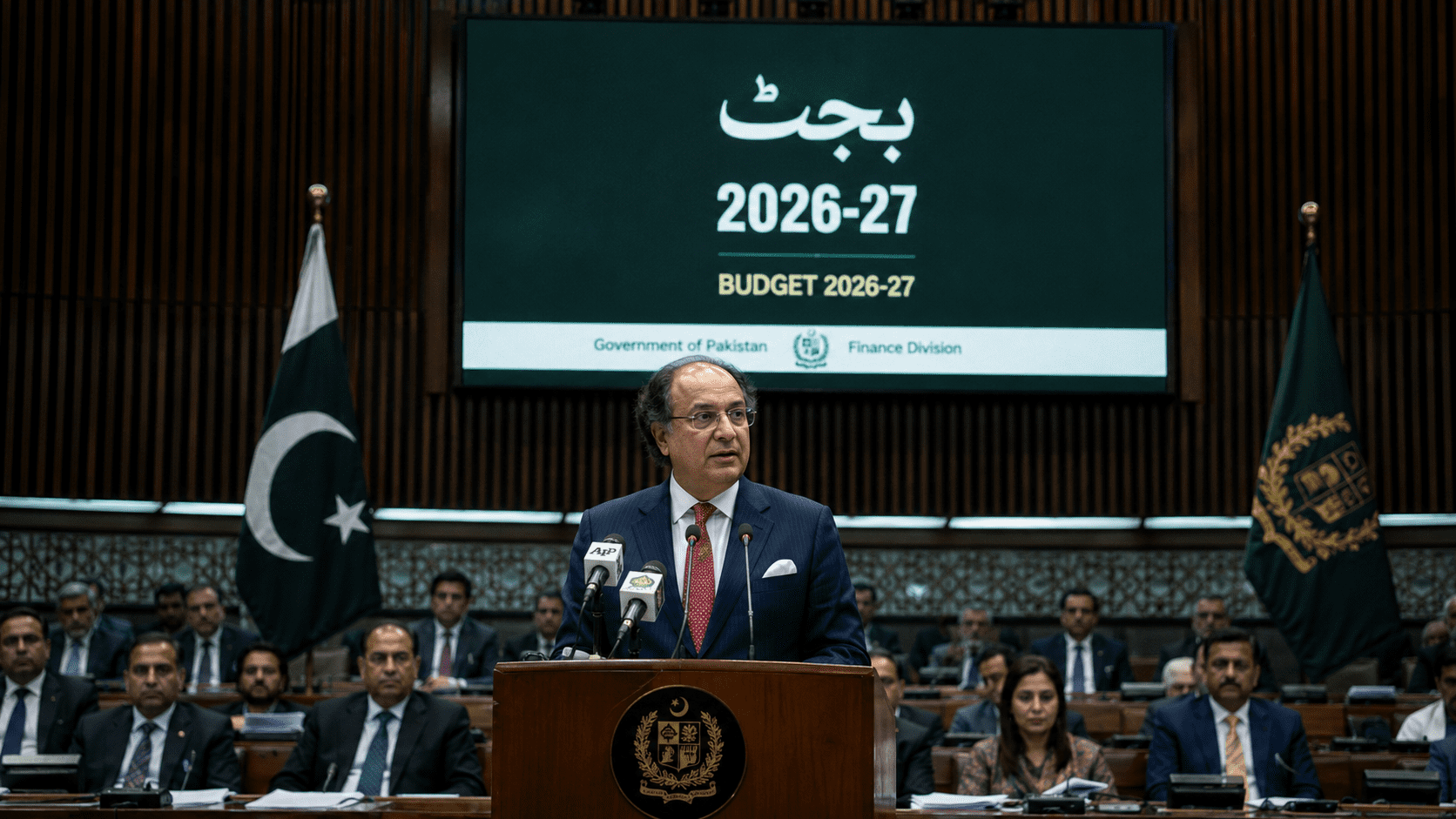
ISLAMABAD — In a budget that has redrawn Pakistan’s fiscal landscape, the federal government has raised its defence spending by nearly 18 percent to Rs3 trillion — approximately $11 billion — for the fiscal year 2026-27, with provincial governments contributing over Rs1 trillion in one-time grants to help bridge the Centre’s widening financing gap.
Thank you for reading this post, don't forget to subscribe!Finance Minister Muhammad Aurangzeb confirmed the extraordinary arrangement on Saturday at a post-budget press conference, stating that provincial contributions had been “partly reflected in next year’s defence budget” and that negotiations were already underway on a three-year framework for ongoing provincial support to the federal government.
The Pakistan defence budget 2026-27 marks the first time that military expenditure has crossed the Rs3 trillion threshold — a symbolic and substantive milestone that underlines the scale of the security challenges Pakistan now faces, both on its eastern and western frontiers.
The Numbers Behind the Record Budget
According to official budget documents presented in the National Assembly, the Pakistan defence budget 2026-27 of Rs3 trillion reflects an increase of Rs405 billion over the revised allocation of Rs2.595 trillion for the outgoing fiscal year 2025-26.
The breakdown by service branch is as follows:
- Pakistan Army: Rs1.284 trillion (up from Rs1.184 trillion in FY2025-26)
- Pakistan Air Force: Rs573 billion (up from Rs520 billion)
- Pakistan Navy: Rs293 billion (up from Rs273 billion)
In addition to the headline figure, the government has separately allocated Rs822 billion for military pensions and Rs319 billion for the Armed Forces Development Programme — expenditures that are not included in the headline defence figure but which significantly increase the overall financial commitment to national security.
Employee-related expenditures have been proposed at Rs967 billion, operational costs at Rs743 billion, and spending on weapons, ammunition, and equipment at Rs925 billion. Civil works and infrastructure received an allocation of Rs363 billion.
At its current scale, the Pakistan defence budget 2026-27 accounts for approximately 16% of total federal expenditure and around 2% of the country’s Gross Domestic Product — slightly higher than last year’s 1.97% of GDP.
The Provincial Grant: A Controversial but Constitutional Arrangement
Perhaps the most politically significant element of the 2026-27 budget is not the headline defence figure itself, but the mechanism by which it has been partially financed.
Finance Minister Muhammad Aurangzeb elaborated on the use of over Rs1 trillion in grants provided by the provinces to the Centre, enabling it to meet pressing financial needs that exceeded the available federal fiscal space. The Express Tribune
The arrangement came after weeks of tense negotiations between the federal government and the four provincial governments — Punjab, Sindh, Khyber-Pakhtunkhwa, and Balochistan — over how to share the burden of a security-driven spending surge that the Centre alone could not absorb within its existing fiscal constraints.
The federal government had demanded Rs1.2 trillion from the provinces for the next fiscal year 2026-27 to meet additional funding requirements of the defence and water sector projects. The Express Tribune
Prime Minister Shehbaz Sharif reportedly briefed IMF Managing Director Kristalina Georgieva about the new fiscal arrangement, with the Prime Minister’s office stating that Georgieva “was extremely appreciative of Pakistan’s sincere efforts” in maintaining fiscal discipline while meeting security requirements.
The contributions from each province were proportional to their respective shares under the National Finance Commission Award. Estimates suggested Punjab’s contribution could be approximately Rs650 billion, Sindh’s around Rs300 billion, Khyber-Pakhtunkhwa’s Rs180 billion, and Balochistan’s Rs110 billion.
Why Is Pakistan Raising Defence Spending So Sharply? Pakistan defence budget
The sharp increase in the Pakistan defence budget 2026-27 does not exist in a vacuum. It is the product of a convergence of security pressures that have intensified significantly over the past 18 months.
The India Factor: Pakistan’s relationship with India has remained deeply strained following Operation Sindoor — India’s cross-border military strikes in May 2025 — which pushed both nuclear-armed nations to the brink of their fifth armed conflict. India has allocated around $86 billion for defence in its 2026-27 budget, a 15% increase from the previous year. The widening spending gap remains a concern for Pakistani planners, who argue that maintaining credible deterrence is essential for strategic stability. The Express Tribune
The Western Front: The proposed increase follows a surge in terrorist violence, particularly in Khyber-Pakhtunkhwa and Balochistan, alongside strained relations with the Taliban-led government in Kabul. Islamabad has repeatedly accused Afghanistan of allowing militant groups to use its territory for attacks inside Pakistan, allegations Kabul denies, but which have fuelled cross-border incidents and diplomatic tension. The Express Tribune
Modernisation Priorities: Pakistan is expected to accelerate modernisation efforts, including interest in next-generation fighter aircraft, possible acquisition of Chinese fifth-generation platforms, and expansion of indigenous drone and cyber warfare capabilities. The Express Tribune
IMF Programme and the Fiscal Tightrope
The dramatic increase in defence spending comes as Pakistan remains deeply committed to its $7 billion Extended Fund Facility programme with the International Monetary Fund — a lifeline that saved the country from sovereign default in 2023.
Pakistan has agreed to maintain a primary budget surplus of 2% of GDP, excluding debt-service payments. That requirement severely limits the government’s ability to increase spending without matching revenue gains or structural adjustments — making the provincial grant mechanism a critical fiscal tool for the government in this budget cycle.
Finance Minister Aurangzeb has indicated that the arrangement with provinces is intended to be formalised over a three-year framework, signalling that this is not a one-time emergency measure but the beginning of a structural shift in how Pakistan finances its defence requirements.
Meanwhile, Pakistan’s Rs18.77 trillion total federal budget targets economic growth of 4.1% and average inflation of 8.4% for the coming fiscal year — ambitious figures given the fiscal compression required to satisfy both IMF conditionalities and security spending demands simultaneously.
Development Budget Takes the Hit
The prioritisation of the Pakistan defence budget 2026-27 has come at a direct cost to development spending across the federation.
The National Economic Council cut the federal and provincial development budget by one-fourth to Rs3.218 trillion for the next fiscal year, down from Rs4.264 trillion cleared by the Annual Plan Coordination Committee last week. Dawn
The combined annual development plans of the four provinces were slashed by almost one-third (29.3%) to Rs2.218 trillion — roughly their actual utilisation so far in the current fiscal year. Dawn
Planning Minister Ahsan Iqbal noted that no new development projects would be approved under the PSDP except for those within the interior and defence ministries — a clear statement of where the government’s priorities lie in this budget cycle.
The Pakistan defence budget 2026-27 also includes Rs10,902 million specifically allocated for the Defence Division under the Public Sector Development Programme 2026-27, according to figures confirmed by the Associated Press of Pakistan.
Political Fallout and Public Debate on Pakistan defence budget
Traditionally, defence allocations have triggered debate over whether resources should be directed toward development and social welfare. This year, however, such criticism has been relatively muted amid heightened security concerns and regional uncertainty. The Express Tribune
Nevertheless, opposition figures and fiscal analysts have raised concerns about the long-term implications of drawing on provincial development funds to meet federal security requirements — a practice that, if institutionalised over the proposed three-year framework, could significantly constrain provincial governments’ capacity to deliver health, education, and infrastructure projects.
Khyber-Pakhtunkhwa’s finance adviser was among the most vocal critics of the arrangement during pre-budget negotiations, arguing that the constitutional framework governing NFC shares did not provide a clear legal basis for the Centre’s approach. Despite those concerns, the budget was ultimately presented and passed amid opposition disruption in the National Assembly.
A Broader Strategic Message
The Pakistan defence budget 2026-27 sends a clear and deliberate message both domestically and internationally: that Islamabad views the current security environment as sufficiently serious to justify redirecting development resources toward military preparedness.
Finance Minister Aurangzeb noted that Pakistan’s defence sector had increasingly become a source of foreign exchange earnings — a reference to growing arms export ambitions and the commercialisation of defence industries — suggesting the government sees strategic investment in the sector as economically productive as well as militarily necessary.
Read Also: Pakistan UNSC Speech Exposes India’s Afghanistan Agenda and Vows Strong Action Against TTP
Read Also: WI vs SL 2nd T20I 2026: Explosive Caribbean Battle Decides Sri Lanka Tour Series Lead
Conclusion: A Defining Budget in a High-Stakes Year
The Pakistan defence budget 2026-27 is more than a set of numbers. It is a political, strategic, and economic statement made at one of the most consequential moments in the country’s recent history — a year after an armed confrontation with India, amid ongoing terrorism from the west, and under the watchful eye of the IMF.
Whether the provincial grant mechanism proves to be a pragmatic short-term solution or the beginning of a contentious long-term fiscal arrangement will depend on how events on Pakistan’s borders — and inside its economy — unfold in the months ahead. For now, the message from Islamabad is unambiguous: national security is the government’s paramount priority, and it is prepared to restructure the entire federal-provincial financial relationship to deliver on that commitment.