

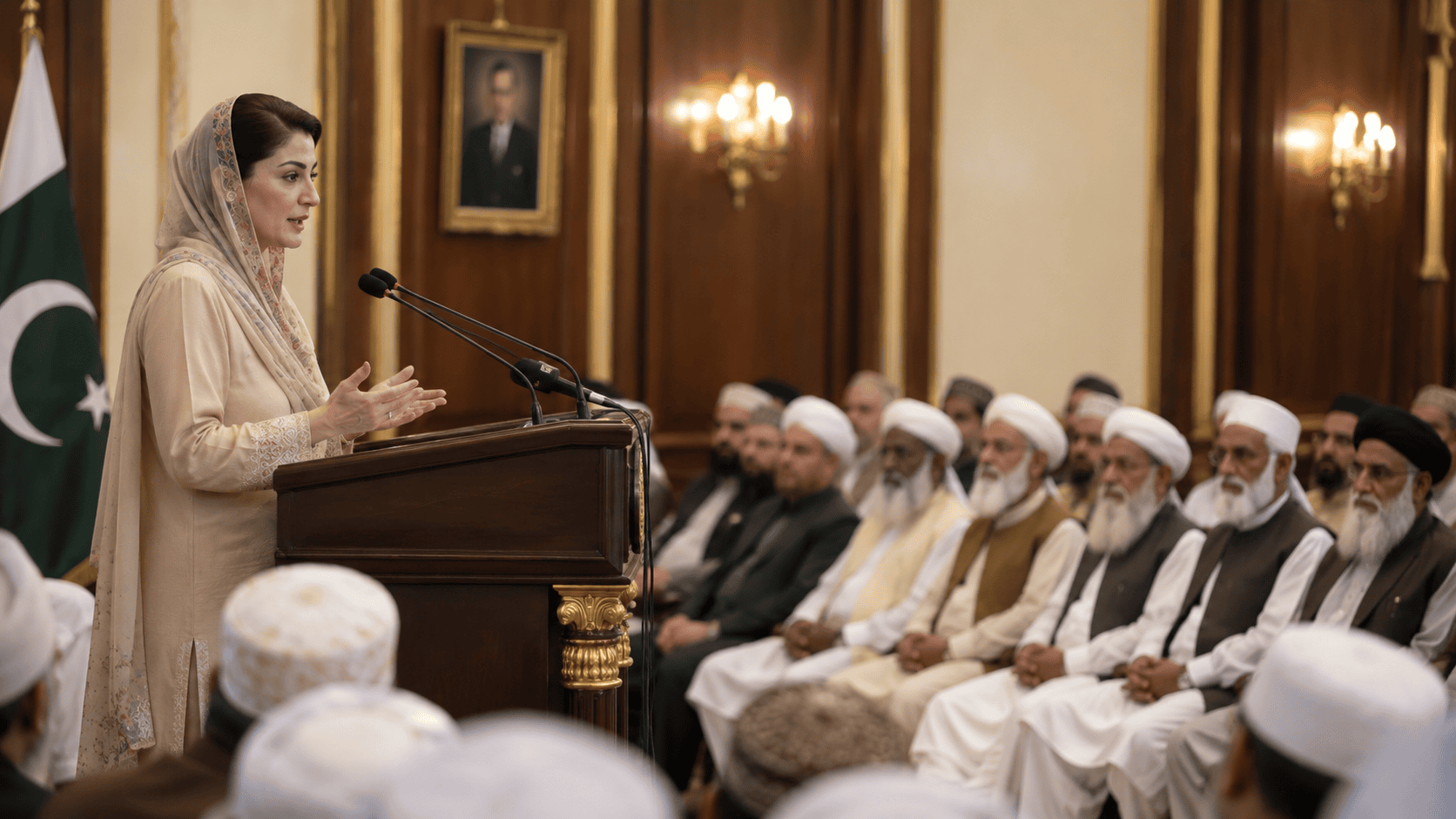
In a renewed appeal to the province’s religious community, CM Maryam urges religious scholars to take a more active role in eradicating crime, curbing extremism, and reforming society. Punjab Chief Minister Maryam Nawaz Sharif made the appeal while addressing scholars and community leaders, framing their involvement as essential to building a safer, more tolerant future for the province.
Thank you for reading this post, don't forget to subscribe!The statement comes at a moment when Punjab’s government has faced intense public scrutiny following a string of tragic incidents, adding weight to why CM Maryam urges religious scholars to step forward now as pillars of moral guidance and social stability.
Why CM Maryam Urges Religious Scholars to Act Now
According to statements shared by the Chief Minister’s office, CM Maryam urges that religious scholars hold a unique and trusted position within communities, one that gives them significant influence over public behavior and attitudes. She said their services remain essential for eradicating crime and building a better, more cohesive society.
Beyond general social reform, the chief minister specifically highlighted the need for scholars to help combat sectarianism, a persistent challenge in parts of Punjab. She also urged religious leaders to actively push back against hateful content circulating on social media platforms, warning that unchecked extremist rhetoric online continues to pose a serious threat to communal harmony.
This is not the first time CM Maryam urges religious scholars to take up such responsibilities. The Punjab government has previously convened committees bringing together scholars from multiple schools of thought alongside representatives of minority communities, aiming to build broader consensus around religious tolerance and interfaith cohesion across the province.
A Broader Pattern of Engagement With Religious Leaders
The latest appeal fits into a wider pattern of engagement between the Punjab government and the province’s religious community. Earlier this year, the chief minister chaired a meeting of the National Paigham-e-Aman Committee, which brought together prominent scholars and minority leaders to discuss countering terrorism and extremism. That meeting reaffirmed commitments toward promoting social harmony and religious tolerance, themes that echo strongly in this latest call for scholars to help reform society.
By consistently returning to this message, the CM Maryam urges appears intent on positioning religious leaders as key partners in addressing some of Punjab’s most pressing social challenges, rather than treating such engagement as a one-off gesture.
Context: A Province Grappling With Recent Tragedy
CM Maryam urges appeal for religious and moral leadership arrives against the backdrop of a difficult period for Punjab. In late June, a devastating roof collapse at a private tuition centre in Lahore’s Kahna area killed 14 children and injured several others, sparking widespread public grief and renewed scrutiny of building safety standards across the province.
The chief minister personally visited grieving families in Kahna, describing the tragedy as heartbreaking and announcing compensation of Rs2 million for each deceased child’s family, along with Rs500,000 for every injured child. She also ordered a province-wide safety audit of school buildings in densely populated areas and directed strict legal action against those found responsible for negligence.
Just days later, a second roof collapse in Lahore’s Baghbanpura area claimed the life of an eight-year-old child, further intensifying public concern over building safety and regulatory oversight in the city’s education sector.
While these tragedies are separate from the appeal for scholars’ involvement, they underscore the broader social and moral challenges the chief minister has referenced in recent public engagements, reinforcing why she continues to stress the importance of community-based leadership, including from religious figures, in addressing negligence, restoring public trust, and guiding social behavior.
Analysis: Why Religious Leadership Matters in Policy Messaging
Political observers note that when CM Maryam urges religious scholars to engage more actively, it reflects a recognition that government policy alone cannot address deep-rooted social issues like sectarianism, misinformation, and online extremism. Religious scholars often carry substantial credibility within their communities, credibility that formal institutions sometimes struggle to establish on their own.
CM Maryam urges By calling on scholars to help counter hateful content on social media, the chief minister is also acknowledging the growing challenge of digital misinformation and radicalization, an issue that increasingly requires trusted community voices rather than top-down regulation alone.
For broader context on interfaith cooperation and social cohesion efforts in Pakistan, resources from the United States Institute of Peace and the Pak Institute for Peace Studies offer useful background on how religious leadership has historically factored into national reconciliation and tolerance-building efforts.
Potential Impact of the Chief Minister’s Appeal
CM Maryam urges If religious scholars respond meaningfully to this call, the impact could extend well beyond symbolic gestures. Scholars have significant reach through mosque sermons, community gatherings, and increasingly through social media themselves, giving them channels to directly counter extremist narratives and promote messages of tolerance at a grassroots level.
However, translating this appeal into measurable outcomes will likely depend on sustained government engagement, including structured platforms for scholars to collaborate with law enforcement and civil society on issues like sectarian tension and online radicalization, rather than relying solely on periodic public appeals.
Read Also: FBR Misses IMF Tax Target Again as Pakistan’s Rs975bn Shortfall Raises Hard Questions
Conclusion
The renewed appeal shows how CM Maryam urges religious scholars to serve as active partners in the province’s broader social reform efforts, from countering sectarianism to pushing back against harmful content online. Coming at a time when Punjab continues to process recent tragedies and public safety concerns, the message reflects an ongoing effort to mobilize trusted community voices in service of a more tolerant and accountable society.