

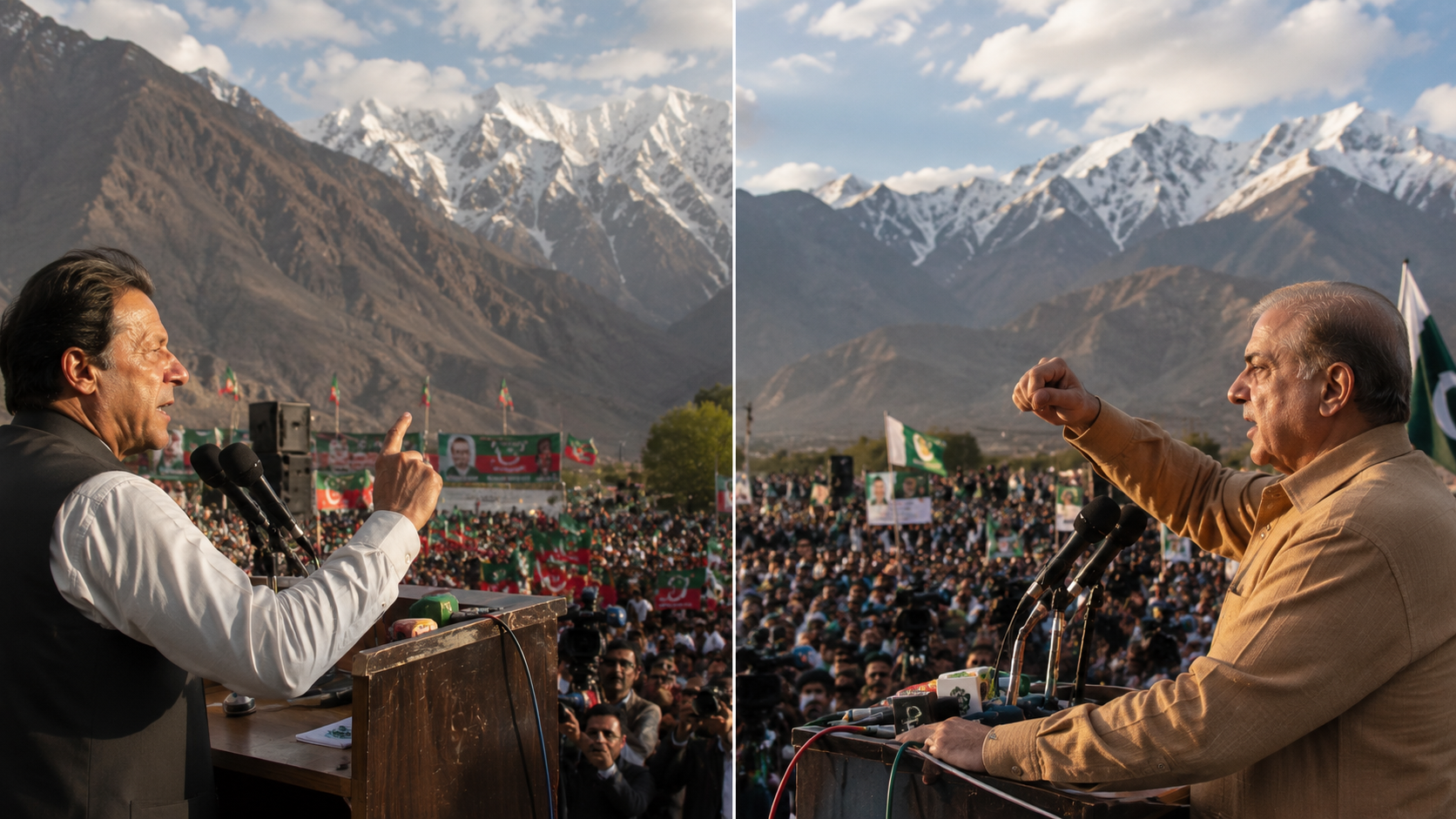
GILGIT — The mountains of northern Pakistan are reverberating with the sound of political campaigning. The Gilgit-Baltistan elections have officially entered their most intense phase, with Pakistan’s most powerful political leaders abandoning their offices in Islamabad, Lahore, and Karachi to personally lead campaign drives in one of the country’s most geographically remote yet strategically vital regions.
Thank you for reading this post, don't forget to subscribe!The Gilgit-Baltistan elections are drawing national attention for good reason. This is not merely a regional contest — it is a proxy battle for national political supremacy, a test of party strength ahead of future electoral cycles, and a vote that will shape the governance of a territory that sits at the crossroads of China, Afghanistan, India, and the broader Central Asian neighbourhood. Every major political force in Pakistan knows what is at stake, which is precisely why the biggest names have come to campaign in person.
Why the Gilgit-Baltistan Elections Matter So Much
To understand the intensity of the current campaign, one must first understand the unique significance of the Gilgit-Baltistan elections within Pakistan’s political and strategic framework.
Gilgit-Baltistan is Pakistan’s northernmost and largest administrative territory by area, sharing borders with China’s Xinjiang region, Afghanistan’s Wakhan Corridor, and the disputed Kashmir region. It is the gateway through which the China-Pakistan Economic Corridor (CPEC) runs — the multi-billion-dollar infrastructure programme that is Pakistan’s most important development initiative and China’s flagship Belt and Road project in South Asia.
Control of Gilgit-Baltistan therefore carries enormous implications not just for local governance but for the management of CPEC projects, relations with Beijing, and Pakistan’s overall geopolitical positioning. The federal government that commands the loyalty of GB’s elected representatives will have a significant advantage in shaping how CPEC’s next phase unfolds — making the Gilgit-Baltistan elections a genuinely high-stakes contest far beyond regional politics.
Additionally, the Gilgit-Baltistan elections serve as an important political barometer. With Pakistan’s national political landscape remaining deeply fragmented between PML-N, PPP, PTI, and a constellation of smaller forces, the GB results will be closely read as an indicator of which party holds the strongest grassroots support in a competitive environment.
The Political Heavyweights Arrive
The most visible sign of how seriously the national political establishment is treating the Gilgit-Baltistan elections is the personal presence of top-tier leaders on the campaign trail.
Senior PML-N leadership, including figures associated with former Prime Minister Nawaz Sharif’s political orbit, have been addressing large public gatherings across the territory, drawing on the party’s record in government and its association with infrastructure development — a message that resonates powerfully in a region where roads, bridges, and connectivity projects are visible daily realities rather than abstract policy promises.
PPP Chairman Bilawal Bhutto Zardari has also been active on the Gilgit-Baltistan elections campaign trail, bringing the energy and youth appeal that has made him one of Pakistan’s most dynamic political communicators. Bilawal’s presence in GB carries symbolic weight — the PPP has historically maintained a presence in the territory and views the Gilgit-Baltistan elections as an opportunity to reassert that footprint in a changed political environment.
The image captured in the Dawn news screenshot — showing two senior political figures at separate podiums, both mid-speech before audiences — encapsulates precisely this dynamic: the Gilgit-Baltistan elections are not being contested from a distance. The leaders have come to the people, in person, to make their case.
Key Issues Driving the Campaign
The Gilgit-Baltistan elections campaign has been shaped by several distinct issues that reflect both the specific concerns of the territory’s population and the broader national political context.
Constitutional Status and Rights
One of the most persistent and emotionally charged issues in Gilgit-Baltistan elections across multiple cycles has been the question of the territory’s constitutional status. GB residents have long sought full constitutional rights equivalent to those enjoyed by citizens of Pakistan’s four provinces — including representation in the Senate, the National Assembly, and full application of fundamental rights under the Constitution.
Political parties have made varying commitments on this question, with voters in the Gilgit-Baltistan elections watching carefully to see which parties make the most credible and concrete promises on constitutional reform. It is an issue that cuts across party lines and touches the deepest questions of identity, belonging, and civic equality for GB’s population.
CPEC Benefits and Local Development
A second major theme of the Gilgit-Baltistan elections campaign has been the question of who benefits from CPEC. While the corridor physically passes through GB and has brought significant construction activity and economic movement to the region, local communities have raised persistent concerns about whether they are receiving a fair share of the economic benefits — in terms of jobs, contracts, and infrastructure investment in areas beyond the main CPEC route.
All major parties contesting the Gilgit-Baltistan elections have been forced to address this question, with each offering its own narrative about how it will ensure GB residents benefit more directly from the corridor’s ongoing development.
Tourism, Environment, and Climate
Gilgit-Baltistan has emerged in recent years as one of Pakistan’s premier tourism destinations, drawing visitors to its spectacular mountain landscapes, including K2, the world’s second-highest peak, and the Hunza Valley. The Gilgit-Baltistan elections have seen candidates address questions about sustainable tourism development, environmental protection, and the management of the region’s extraordinary natural heritage.
Climate change is also a live issue in GB, where glacial retreat threatens water supplies and the risk of glacial lake outburst floods (GLOFs) poses a direct physical danger to communities. According to UNDP Pakistan, GB is among the most climate-vulnerable regions in the world, and voters are increasingly demanding that candidates for the Gilgit-Baltistan elections demonstrate understanding and commitment on climate resilience.
The Electoral Landscape: Who Are the Contenders?
The Gilgit-Baltistan elections field features a complex and competitive lineup of parties.
PML-N enters the Gilgit-Baltistan elections as one of the strongest organised forces in the territory, backed by the resources and network of a party that is part of the ruling federal coalition. PML-N’s association with CPEC development — the corridor was substantially advanced during Nawaz Sharif’s previous government — gives it a credible development narrative.
PPP brings its historical footprint in GB and the appeal of Bilawal Bhutto’s personal campaigning to the Gilgit-Baltistan elections. The party has been working to rebuild its grassroots organisation in the territory and sees a strong result here as important to its broader national positioning.
PTI, despite facing challenges at the federal level, retains a significant support base among younger voters in the Gilgit-Baltistan elections — a reflection of Imran Khan’s enduring popularity among Pakistan’s youth demographic, including in GB.
Independent candidates and local parties also play a meaningful role in the Gilgit-Baltistan elections, particularly in constituencies where local tribal, community, and sectarian dynamics shape voting patterns more than national party affiliations.
Security and Logistical Challenges
Conducting the Gilgit-Baltistan elections in a territory of this geographic complexity is itself a significant logistical and security undertaking. Many constituencies span vast mountain terrain with limited road access, requiring election officials, ballot materials, and security personnel to reach remote polling stations through challenging conditions.
Pakistan’s Election Commission of Pakistan (ECP) has been coordinating extensively with provincial and federal security agencies to ensure that the Gilgit-Baltistan elections are conducted in a free, fair, and secure environment. The deployment of security personnel is substantial, reflecting both the importance of the vote and the sensitivity of the region given its border geography.
National Implications of the GB Result
When the votes in the Gilgit-Baltistan elections are counted, the results will be read far beyond the territory itself. A strong performance by PML-N will be interpreted as a validation of the federal government’s governance record and its management of the economy and CPEC. A surprising result for PPP could signal renewed momentum for Bilawal Bhutto’s national political ambitions. Any significant PTI showing despite the party’s federal difficulties would be read as a sign of enduring grassroots resilience.
For Pakistan’s overall political trajectory, the Gilgit-Baltistan elections are one of the clearest available tests of where the country’s political winds are blowing — making them essential reading for anyone seeking to understand Pakistani politics in 2026.
Read Also: Infinix Note 30 Review: Surprisingly Powerful and an Unbeatable Budget Pick in 2026
Read Also: Nvidia RTX Spark AI Chip Unveiled — A Powerful Game Changer for Personal Computing
Read Also: Europe Furious as Israel’s Deepening Lebanon Incursion Draws Global Condemnation
Conclusion
The Gilgit-Baltistan elections of 2026 have become one of the most watched political contests in Pakistan. With the country’s biggest political names personally leading campaigns in the shadow of the Karakoram mountains, and with issues ranging from constitutional rights to CPEC benefits and climate resilience shaping voter concerns, these elections are far more than a regional vote.
They are a mirror held up to Pakistan’s national political soul — and the reflection will tell the country’s political forces, and its citizens, a great deal about where Pakistan is headed. The Gilgit-Baltistan elections deserve every bit of the national attention they are receiving.
Pakkhabar.com will provide live results coverage, candidate profiles, and in-depth analysis of the Gilgit-Baltistan elections as polling day approaches.