

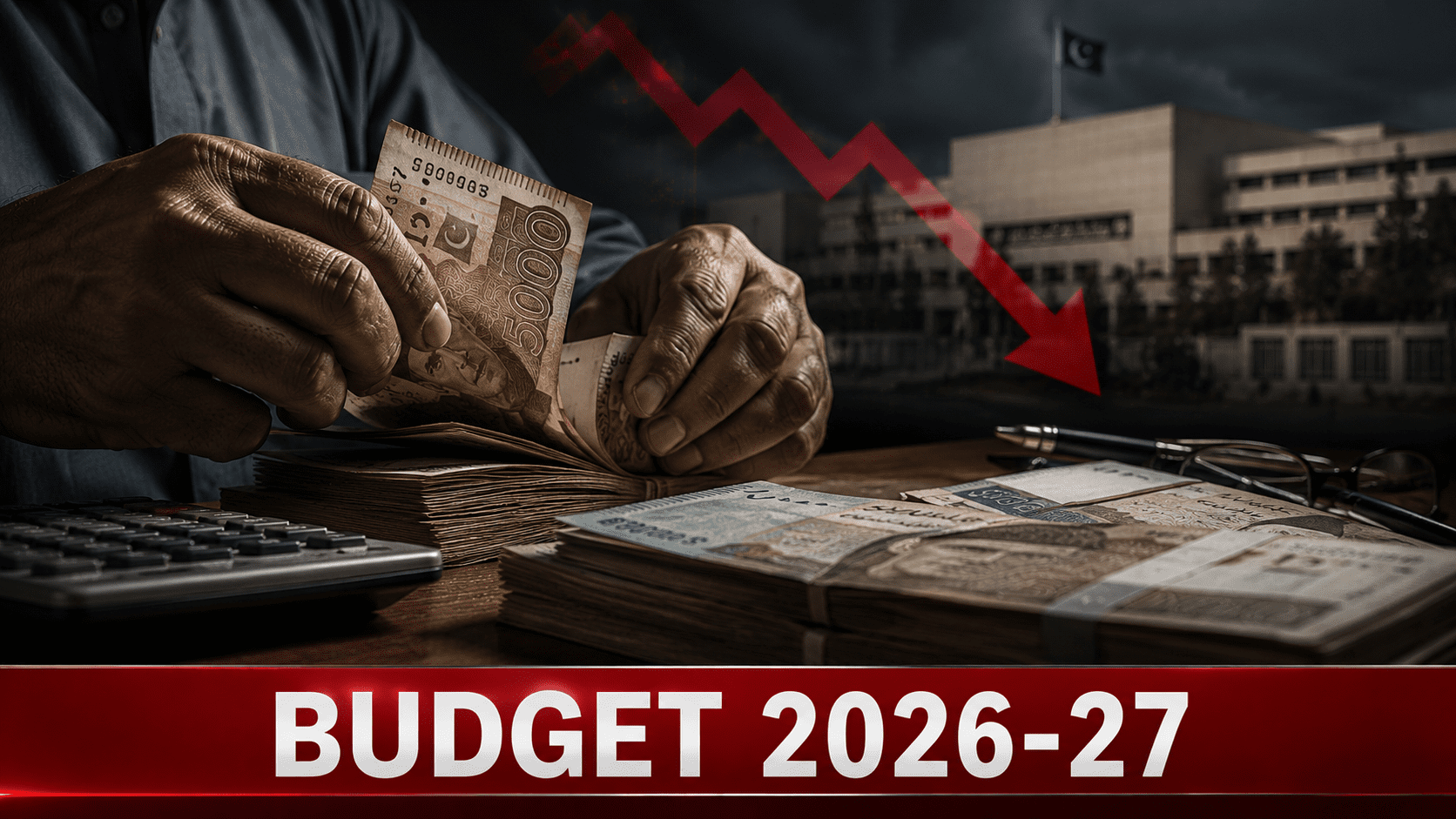
A trio of damaging reports has cast a shadow over Pakistan’s federal budget for the new fiscal year — revealing record overspending, a stark warning from a leading global credit rating agency, and growing government resistance to financial transparency.
Thank you for reading this post, don't forget to subscribe!Pakistan’s federal government is facing mounting criticism over its handling of public finances after multiple reports revealed serious inconsistencies between its stated fiscal goals and actual spending patterns. The Pakistan Budget 2026-27, which was presented with claims of fiscal discipline and austerity, is now under intense scrutiny following a damaging report of record overspending, a credit rating agency’s growth warning, and a parliamentary transparency controversy.
According to Dawn’s report by veteran economic journalist Khaleeq Kiani, the Pakistan Budget 2026-27 cycle has been marked by a record Rs3.6 trillion in overspending, a figure that directly undermines the government’s repeated claims of austerity and fiscal restraint.
Record Rs3.6 Trillion Overspending Revealed
The most striking revelation regarding the Pakistan Budget 2026-27 comes from Dawn’s investigation, which found that the federal government overspent by a record Rs3.6 trillion compared to its original budgeted targets. This figure is significant not just in scale, but in what it represents: a clear gap between the government’s public messaging on fiscal responsibility and the actual numbers reflected in official accounts.
Khaleeq Kiani’s reporting suggests that this overspending “belies the government’s austerity claims” — meaning that despite repeated public statements about tightening the federal belt, actual expenditure patterns tell a very different story. This kind of discrepancy is particularly important for a country like Pakistan, which has been under sustained pressure from international lenders, including the International Monetary Fund (IMF), to maintain strict fiscal discipline as part of ongoing loan program commitments.
For ordinary citizens already grappling with inflation and economic uncertainty, the Pakistan Budget 2026-27 overspending revelation raises uncomfortable questions about where exactly public funds are being allocated — and why austerity messaging hasn’t matched fiscal reality.
Fitch Warns Spending Cuts Could Hurt Growth
Adding another layer of complexity to the Pakistan Budget 2026-27 narrative, global credit rating agency Fitch has issued a warning that spending cuts could negatively impact Pakistan’s economic growth. This warning, also reported by Dawn through Khaleeq Kiani, places the government in a difficult position: caught between the need to control overspending (as revealed by the Rs3.6 trillion figure) and the risk that aggressive spending cuts could choke off the very growth Pakistan desperately needs.
Fitch’s assessment is particularly significant given the agency’s influence over Pakistan’s international credit standing. A negative outlook or warning from a major rating agency can affect:
- Foreign investor confidence in Pakistan’s economy
- Borrowing costs on international debt markets
- IMF program negotiations, where rating agency assessments often factor into broader credit risk evaluations
- Currency stability, as rating warnings can influence market sentiment toward the Pakistani rupee
This creates a genuine policy dilemma for the Pakistan Budget 2026-27: how does the government simultaneously rein in the kind of overspending Dawn uncovered, while avoiding the growth-damaging effects that Fitch has warned about?
Finance Minister Presents Federal Budget for FY 2026-27
According to Radio Pakistan, the Finance Minister formally presented the Federal Budget for FY 2026-27, setting out the government’s fiscal roadmap for the year ahead. While the official presentation outlined the government’s priorities and revenue targets, the subsequent reporting from Dawn and The Express Tribune suggests that the implementation and transparency around this budget have become significant points of contention.
Budget presentations in Pakistan typically include announcements on tax policy, development allocations, subsidy programs, and debt servicing plans. However, as the Pakistan Budget 2026-27 has moved from announcement to scrutiny, the gap between stated intentions and reported outcomes has become a central story in itself.
Government Refuses to Share Cost of Tax Relief With Parliament
In a development that has raised serious transparency concerns, The Express Tribune — in a report by Shahbaz Rana — revealed that the government has refused to share the cost of tax relief measures with Parliament. This refusal strikes at the heart of legislative oversight, a fundamental pillar of democratic budget processes.
Tax relief measures, while often popular with specific segments of the population or business community, carry direct fiscal costs that reduce government revenue. Parliament’s ability to scrutinize these costs is essential for:
- Ensuring transparency in how tax policy decisions are made and who benefits from them
- Maintaining checks and balances between the executive branch and the legislature
- Allowing informed debate on whether specific tax relief measures represent good value for the public exchequer
- Building public trust in the overall budget-making process
The government’s reluctance to disclose this information related to the Pakistan Budget 2026-27 has already drawn criticism from opposition lawmakers and transparency advocates, who argue that withholding such cost estimates undermines Parliament’s constitutional oversight role.
Connecting the Dots: A Pattern of Fiscal Opacity?
When viewed together, these three developments — record overspending, a credit rating agency’s growth warning, and resistance to sharing tax relief costs — paint a complex picture of the Pakistan Budget 2026-27 process. Critics argue this reflects a broader pattern of fiscal opacity, where:
- Public messaging emphasizes austerity, while actual spending patterns show significant overruns
- International credit agencies raise concerns about the growth implications of fiscal tightening
- Parliament itself struggles to access basic cost information needed for effective oversight
This combination creates a credibility challenge for the government as it seeks both domestic political support and international financial confidence for its fiscal management of the Pakistan Budget 2026-27.
What This Means for Pakistan’s Economy
The implications of these developments extend well beyond budget documents and parliamentary debates:
For IMF Program Compliance
Pakistan’s ongoing engagement with the IMF requires demonstrated fiscal discipline. A Rs3.6 trillion overspending revelation tied to the Pakistan Budget 2026-27 could complicate future program reviews, even as the government insists on its commitment to agreed targets.
For Investor Confidence
Fitch’s warning about growth risks from spending cuts adds uncertainty for both domestic and foreign investors trying to assess Pakistan’s economic trajectory over the coming fiscal year.
For Public Trust
The refusal to share tax relief costs with Parliament — set against the backdrop of revealed overspending — risks deepening public skepticism about whether the Pakistan Budget 2026-27 truly reflects sound, transparent fiscal management.
What Happens Next?
Several developments are likely in the coming weeks as the Pakistan Budget 2026-27 controversy continues to unfold:
- Parliamentary pressure may intensify for the government to disclose the cost of tax relief measures
- IMF discussions could address the overspending figures as part of ongoing program reviews
- Fitch and other rating agencies may issue follow-up assessments based on how the government responds to these concerns
- Public and media scrutiny is expected to continue, particularly from financial journalists tracking budget implementation
Read Also: https://pakkhabar.com/punjab-budget-2026-27-tax-increase-development-cut/
Conclusion: A Budget Under the Microscope
The Pakistan Budget 2026-27 has quickly become a case study in the gap between fiscal rhetoric and fiscal reality. A record Rs3.6 trillion overspending figure, a credit rating agency’s growth warning, and a parliamentary transparency dispute have together placed the government’s economic management under intense public and institutional scrutiny.
As Pakistan navigates these competing pressures — fiscal discipline demanded by international lenders, growth concerns flagged by rating agencies, and transparency demanded by its own Parliament — the coming months will reveal whether genuine course correction is possible, or whether these patterns will persist into the next fiscal cycle.
Pakkhabar.com will continue to track developments related to the Pakistan Budget 2026-27, including parliamentary proceedings and any IMF or rating agency responses.