

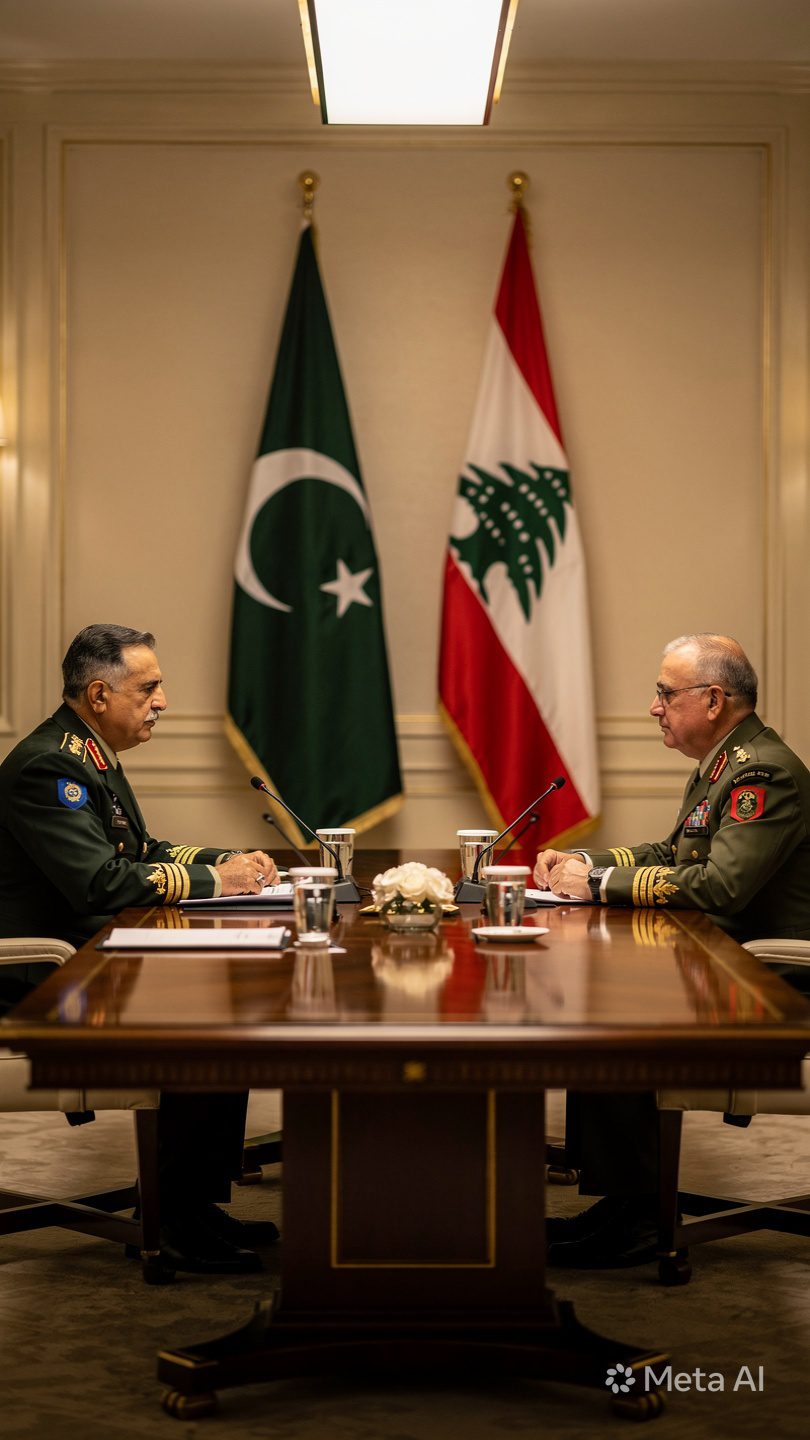
ISLAMABAD / RAWALPINDI — Pakistan Lebanon military alliance — a partnership that has historically been characterised by quiet solidarity and limited formal engagement — has taken a dramatic and significant step forward. Pakistan’s Chief of Defence Forces (CDF) General Syed Asim Munir has held substantive high-level talks with the Lebanese Army Commander in a meeting that marks one of the most meaningful direct engagements between the two countries’ military establishments in recent memory. The Pakistan Lebanon military alliance talks, coming at a moment when Lebanon is under sustained Israeli military assault and the broader Middle East is in the grip of its most dangerous crisis in decades, carry enormous strategic and symbolic significance.
Thank you for reading this post, don't forget to subscribe!The Pakistan Lebanon military alliance meeting was confirmed by multiple credible news outlets simultaneously — Arab News, Dawn, The Express Tribune, and Anadolu Ajansı all reporting the talks with consistent core details — underscoring the importance both governments attach to this military-to-military engagement. Anadolu Ajansı specifically framed the talks as Pakistani and Lebanese military chiefs discussing “regional security amid Israeli attacks on Lebanon” — language that captures precisely the urgency and strategic weight of the Pakistan Lebanon military alliance discussions.
What Was Discussed: Regional Security at the Centre
The Pakistan Lebanon military alliance talks centred on what both sides described as the regional security environment — a formulation that, in the current context, refers primarily and unmistakably to the ongoing Israeli military operations in Lebanon that have been causing devastating civilian casualties and infrastructure destruction.
For Lebanon’s Army Commander, the visit to Pakistan represents an important act of military diplomacy — reaching out to one of the Muslim world’s most militarily capable states at a moment when Lebanon’s armed forces are under enormous pressure from the consequences of the Israeli campaign. The Lebanese Army, which operates as a conventional national military distinct from Hezbollah, has been working to maintain its own operational capacity and institutional coherence under extremely challenging conditions.
The Pakistan Lebanon military alliance discussions on regional security reflect a shared assessment between Islamabad and Beirut that the current Middle East crisis requires engagement at the military-to-military level — not just government-to-government or through multilateral forums. When army commanders meet directly to discuss the security environment, it signals a depth of commitment and seriousness of engagement that diplomatic communiqués alone cannot convey.
Pakistan’s CDF General Munir brought to the Pakistan Lebanon military alliance talks a perspective shaped by Pakistan’s unique position in the broader Muslim world — a nuclear-armed state with one of the largest and most battle-experienced armies in the world, with deep relationships across the Arab world, and with a consistent foreign policy commitment to the Palestinian cause and to the sovereignty and territorial integrity of Lebanon.
Pakistan’s Strategic Position: Why This Alliance Matters Now
Understanding the significance of the Pakistan Lebanon military alliance meeting requires understanding Pakistan’s evolving role in Middle East security dynamics and why Islamabad’s military engagement with Beirut matters at this particular moment.
Pakistan has consistently maintained that it stands in solidarity with Lebanon’s people and government against external military aggression — a position rooted in both principled foreign policy commitments and Pakistan’s self-interest in a stable Middle East that does not generate the kind of regional war that would directly harm Pakistani energy imports, remittances, and economic interests.
The Pakistan Lebanon military alliance engagement also reflects Pakistan’s positioning as a constructive diplomatic actor in the Muslim world. By maintaining active military-to-military contact with Lebanon’s armed forces even as the country comes under sustained attack, Pakistan is demonstrating that its solidarity is not merely rhetorical — it is backed by concrete institutional engagement at the highest military levels.
Pakistan’s army chief has been particularly active in military diplomacy across the region. The Pakistan Lebanon military alliance talks are part of a broader pattern of CDF Munir’s direct engagement with regional military counterparts on the evolving security situation — a pattern that reflects Pakistan’s assessment that the current Middle East crisis requires active Pakistani diplomatic and military engagement rather than passive observation.
According to Pakistan’s Inter-Services Public Relations (ISPR), military diplomacy of this kind — direct engagement between army chiefs on shared security concerns — is one of the most effective tools available for building the kind of trust and understanding that can, over time, contribute to conflict prevention and crisis management.
Lebanon’s Army in Crisis: Why Pakistan’s Support Matters
For Lebanon, the Pakistan Lebanon military alliance meeting with CDF Munir carries particular significance given the extraordinarily difficult situation the Lebanese Armed Forces currently face.
Lebanon’s military is a professional, conventionally organised army that operates within the Lebanese state’s constitutional framework. Unlike Hezbollah, which operates as a parallel armed organisation with its own command structure and political agenda, the Lebanese Armed Forces answer to Lebanon’s elected government and are the institution that Lebanon’s constitutional order depends on for its physical security and sovereignty.
The Lebanese Army has been under enormous institutional stress during the current crisis. Operating in a country experiencing simultaneous economic collapse, political paralysis, and active military conflict, the Lebanese Armed Forces must maintain their operational capacity, their institutional morale, and their constitutional mandate — all while navigating the complex political dynamics of a country in which multiple armed actors operate and in which the relationship between the state military and non-state forces is complicated and contested.
The Pakistan Lebanon military alliance engagement at the army chief level sends a crucial message of support to the Lebanese Armed Forces at this moment of institutional stress: that Lebanon’s military is recognised by Pakistan as the legitimate, constitutionally grounded security institution of the Lebanese state, and that Pakistan stands ready to engage with it as a partner.
The United Nations Interim Force in Lebanon (UNIFIL) — the multinational peacekeeping force that operates in southern Lebanon — has consistently emphasised the importance of the Lebanese Armed Forces’ role in the country’s security architecture. Pakistan’s deepening of the Pakistan Lebanon military alliance through direct army chief engagement reinforces UNIFIL’s own working relationship with the Lebanese Army and strengthens the multilateral security framework in which Lebanon’s institutional military operates.
The Broader Context: Pakistan’s Middle East Military Diplomacy
The Pakistan Lebanon military alliance talks are part of a broader and highly active pattern of Pakistani military diplomacy in the Middle East that has intensified significantly as the regional crisis has deepened.
Pakistan’s army has relationships across the Arab world — including with Saudi Arabia, the UAE, Jordan, and other GCC and Levant states — that have been built over decades through training programmes, joint exercises, officer exchanges, and high-level military-to-military visits. These relationships give Pakistan a unique ability to engage constructively across the fault lines of the current Middle East crisis in ways that few other non-Arab Muslim states can match.
The Pakistan Lebanon military alliance meeting fits within this pattern of active military diplomacy. Pakistan is not a passive bystander to the regional crisis — it is an engaged actor using its military relationships to build understanding, share assessments, and signal solidarity with states under pressure. This approach reflects a deliberate Pakistani strategic choice: that military diplomacy is a distinct and valuable tool in Pakistan’s foreign policy toolkit, separate from but complementary to diplomatic and economic engagement.
The Pakistan Army’s engagement with Lebanon’s armed forces also carries a message to the broader international community: that Pakistan views Lebanon’s institutional military as a key partner in any eventual stabilisation and reconstruction process — and that Pakistan’s solidarity with Lebanon is not conditional on the resolution of the current conflict but represents a long-term strategic commitment.
Significance for Pakistan-Arab World Relations
Beyond the immediate bilateral significance, the Pakistan Lebanon military alliance talks carry important implications for Pakistan’s broader relationships across the Arab world. Pakistan’s consistent and active engagement with Lebanon’s military establishment — even at the height of the conflict — will be noted by Arab governments and publics watching to see which Muslim states offer concrete support to Lebanon in its hour of need.
This matters for Pakistan’s standing in the Organisation of Islamic Cooperation (OIC) and in its bilateral relationships with Arab states. Countries that demonstrate active solidarity with Lebanon through concrete engagement — rather than merely issuing statements — earn credibility and goodwill that has long-term diplomatic value.
The Pakistan Lebanon military alliance deepening also sends a signal to Western governments and multilateral organisations about Pakistan’s role in the region. Pakistan is positioning itself not as a passive recipient of external security guarantees but as an active contributor to regional stability — a posture that supports Islamabad’s broader ambition to be recognised as a responsible, constructive, and capable actor in international security affairs.
According to Anadolu Ajansı, Turkey’s state news agency which reported extensively on the Pakistan Lebanon military alliance talks, the meeting represents a significant development in South Asian-Middle Eastern military cooperation at a moment when the international community is struggling to find effective responses to the Lebanon crisis.
What Comes Next: Military Cooperation and Beyond
The Pakistan Lebanon military alliance talks between CDF Munir and the Lebanese Army Commander are expected to produce concrete follow-up engagement — whether through training exchanges, equipment discussions, intelligence sharing frameworks, or joint assessments of the regional security environment.
For Lebanon, any practical military cooperation that emerges from the Pakistan Lebanon military alliance framework — however modest in initial scope — represents a meaningful expansion of the support available to the Lebanese Armed Forces from friendly Muslim states. Pakistan’s experience in counterterrorism, border management, and operating effectively in complex security environments could offer valuable lessons for Lebanon’s military as it navigates the current crisis.
For Pakistan, the Pakistan Lebanon military alliance deepening offers an opportunity to translate its rhetorical solidarity with Lebanon into a concrete institutional relationship that can be built upon as the current crisis eventually moves toward resolution — positioning Pakistan as a natural partner in Lebanon’s future security architecture.
Read Also: AJK Protest Spirals: Four Police Officers Martyred in Violent Clashes
Read Also: PPP Wins GB Elections 2026: Emerges as Largest Party With Decisive 10-Seat Victory
Conclusion
The Pakistan Lebanon military alliance talks between CDF General Munir and the Lebanese Army Commander represent far more than a routine diplomatic meeting. They are a concrete expression of Pakistan’s commitment to Lebanon’s sovereignty, an acknowledgement of the Lebanese Armed Forces as the legitimate pillar of the Lebanese state’s security architecture, and a signal to the region and the world that Pakistan’s solidarity with Lebanon is backed by institutional engagement at the highest military levels.
As Lebanon navigates one of the most dangerous periods in its modern history, the Pakistan Lebanon military alliance deepening provides a measure of strategic reassurance — the knowledge that one of the Muslim world’s most capable military establishments stands ready to engage, support, and partner with Lebanon’s armed forces in the difficult days ahead.
Pakkhabar.com will continue to monitor the Pakistan Lebanon military alliance, CDF Munir’s diplomatic engagements, and the broader regional security developments as the Middle East crisis evolves.