
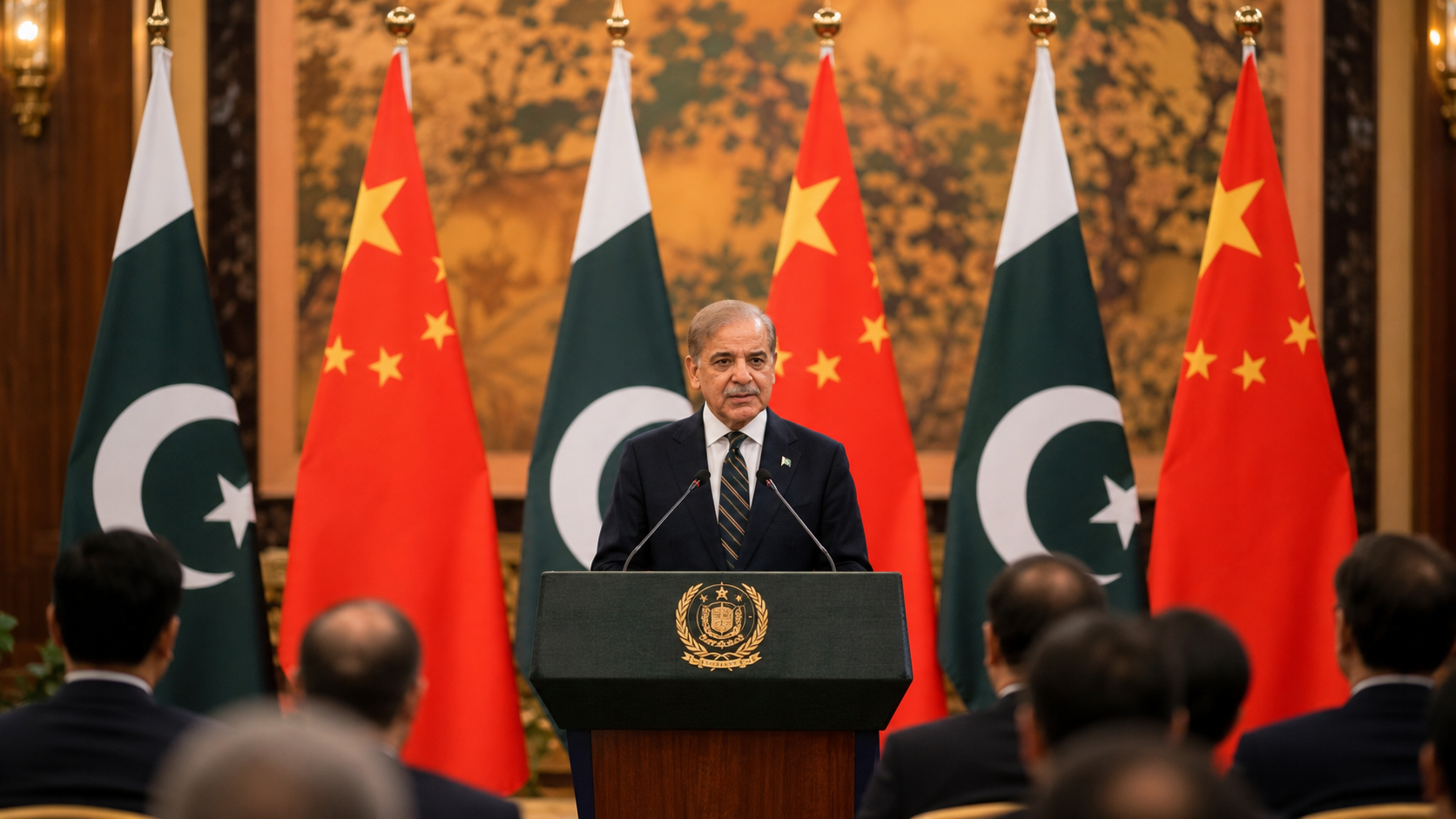
ISLAMABAD / BEIJING — Pakistan’s Prime Minister Shehbaz Sharif has delivered a powerful message of solidarity with China, declaring that the Pak-China friendship has reached its “finest hour” — a statement that signals the strengthening of one of Asia’s most consequential bilateral relationships at a time of shifting global dynamics.
Speaking at a high-profile diplomatic gathering, Prime Minister Shehbaz praised the enduring partnership between the two nations, emphasizing that the bond between Pakistan and China goes far beyond political agreements. It is, he said, a relationship rooted in mutual trust, shared history, and a common vision for regional stability and prosperity.
A Relationship That Has Stood the Test of Time
The Pak-China friendship is one of the most celebrated diplomatic partnerships in the developing world. Often described as “higher than the mountains and deeper than the oceans,” it spans over seven decades of consistent cooperation across virtually every domain — from trade and infrastructure to defence and cultural exchange.
Prime Minister Shehbaz’s declaration that the relationship is now at its “finest hour” is not merely ceremonial. It comes at a moment when both countries are navigating a complex international environment, including global economic pressures, regional security challenges, and the ongoing evolution of the China-US rivalry. Against this backdrop, Islamabad’s reaffirmation of its strategic alignment with Beijing carries significant geopolitical weight.
Pakistan and China’s comprehensive strategic cooperative partnership, formalised over years of diplomatic engagement, has deepened considerably in recent years, with trade, people-to-people contacts, and joint development projects all expanding at a notable pace.
CPEC: The Backbone of Pak-China Cooperation
At the heart of the Pak-China friendship lies the China-Pakistan Economic Corridor (CPEC), a multi-billion-dollar infrastructure and investment initiative that forms Pakistan’s most significant development programme. CPEC, a flagship component of China’s broader Belt and Road Initiative, has transformed Pakistan’s energy capacity, road networks, and industrial zones since its launch.
With CPEC Phase 2 now underway, the two governments are shifting focus toward agriculture modernisation, digital infrastructure, special economic zones, and industrial cooperation — moving beyond bricks and mortar toward a more knowledge-driven partnership. PM Shehbaz has been a consistent champion of this next chapter, viewing it as essential to Pakistan’s long-term economic growth.
The Prime Minister’s remarks signal that Pakistan remains fully committed to CPEC implementation despite the domestic challenges the country has faced in recent years, including economic instability and political transitions. For Beijing, this commitment from Islamabad is an important assurance that one of its flagship global initiatives remains on track.
Diplomatic Symbolism and Strategic Messaging ( Pak-China friendship)
Words matter in diplomacy, and PM Shehbaz’s choice of language — “finest hour” — is deliberate and loaded with meaning. It borrows from the vocabulary of historical triumph, suggesting not just that the Pak-China friendship is strong, but that it is at a peak, a defining moment in its trajectory.
This kind of language is particularly significant given the current global context Pak-China friendship. As Western nations continue to scrutinise China’s international engagements and as Pakistan navigates its own complex relationships with the United States, the International Monetary Fund, and Gulf partners, Islamabad’s vocal celebration of its ties with Beijing serves as a clear signal of where its core strategic priorities lie.
According to Reuters, Pakistan and China have been expanding defence cooperation alongside economic ties, a trend that has drawn attention from regional observers and international analysts alike.
Regional Stability and Shared Interests
Beyond bilateral interests, both Pakistan and China share a stake in regional stability. Both countries border Afghanistan and have an interest in preventing spillover of instability from that country. Both are also engaged in managing complex relationships with India, though from different strategic positions.
PM Shehbaz’s emphasis on the Pak-China friendship also sends a message to the broader region: Pakistan sees its future as closely tied to a rising China, and it intends to play a constructive role in the evolving Asian order that Beijing envisions. This includes alignment on multilateral platforms such as the Shanghai Cooperation Organisation (SCO), where both nations are active members.
The SCO, which now includes major economies across Asia, has become an increasingly important platform for Pak-China diplomatic coordination on issues ranging from counter-terrorism to economic connectivity.
Public Sentiment and Domestic Implications
Inside Pakistan, the Pak-China friendship enjoys broad public and institutional support. China is viewed by many Pakistanis as a reliable, all-weather partner — one that has provided economic assistance, diplomatic backing at the United Nations, and military cooperation without attaching the kind of political conditions that some Western partners have historically demanded.
For PM Shehbaz and his government, championing this relationship also carries domestic political value. As Pakistan works to stabilise its economy and restore investor confidence, pointing to CPEC’s progress and China’s continued engagement provides a tangible development narrative that the government can take to the public.
What Comes Next ( Pak-China friendship):
Following PM Shehbaz’s remarks, diplomatic observers will be watching closely for concrete outcomes — whether in the form of new agreements, accelerated CPEC projects, or expanded trade frameworks. The “finest hour” framing raises expectations that this moment in the Pak-China friendship will be accompanied by substantive deliverables, not just warm rhetoric.
For Pakistan, the stakes are high. The country needs investment, economic partnerships, and diplomatic support as it charts its path forward. For China, a stable, engaged Pakistan is a strategic asset in South Asia. Both sides, it appears, understand what this moment demands.
Read Also: Strategic Push: PM China Digital Economy Cooperation 2026 Talks
Read Also: Pak Interior Minister Meets Iranian Foreign Minister for 2nd Time in Tehran
Read Also: IMF $1.32 Billion Pakistan 2026: Board Approves Key Tranches
Conclusion
Prime Minister Shehbaz Sharif’s declaration that the Pak-China friendship has reached its “finest hour” is more than a diplomatic pleasantry. It is a strategic statement — one that reaffirms Pakistan’s foreign policy alignment, signals confidence in CPEC’s future, and positions Islamabad as a committed partner in China’s regional vision. As both nations navigate an increasingly multipolar world, the strength and direction of this partnership will have implications that extend well beyond their shared border.
Pakkhabar.com will continue to provide in-depth coverage of Pakistan’s diplomatic engagements and foreign policy developments.
Pakistan Ministry of Foreign Affairs — China RelationsReuters — Pakistan-China CoverageAl Jazeera — South Asia NewsBelt and Road Initiative Official PortalShanghai Cooperation Organisation
Recent News
- AJK Election Results Trigger Coalition Rift as PPP Alleges Rigging, PML-N Claims Sweeping Win NEW
- AJK Police Say Banned JAAC Has Become an Armed Group Attacking Police and Security Forces NEW
- AJK Protest Spirals: Four Police Officers Martyred in Violent Clashes NEW
- AJK Security Forces Request Signals Deepening Unrest Ahead of Elections NEW
- Allama Nasir Madni Heart Attack Rumours Denied: What Really Happened NEW
- Apna Ghar Scheme 2026: Pakistan’s Biggest Housing Dream Is Finally Being Unlocked for Millions NEW
- Armed Forces Committed to Eradicating All Forms of Terrorism: Field Marshal NEW
- Asim Munir Turkey Visit Strengthens Pakistan-Turkiye Defence Partnership NEW
- Ashura 2026 Pakistan Confirmed for June 26 — Moon Not Sighted, KP Declares Holiday NEW
- Avengers Doomsday Trailer Sends Marvel Fans Into a Frenzy NEW