

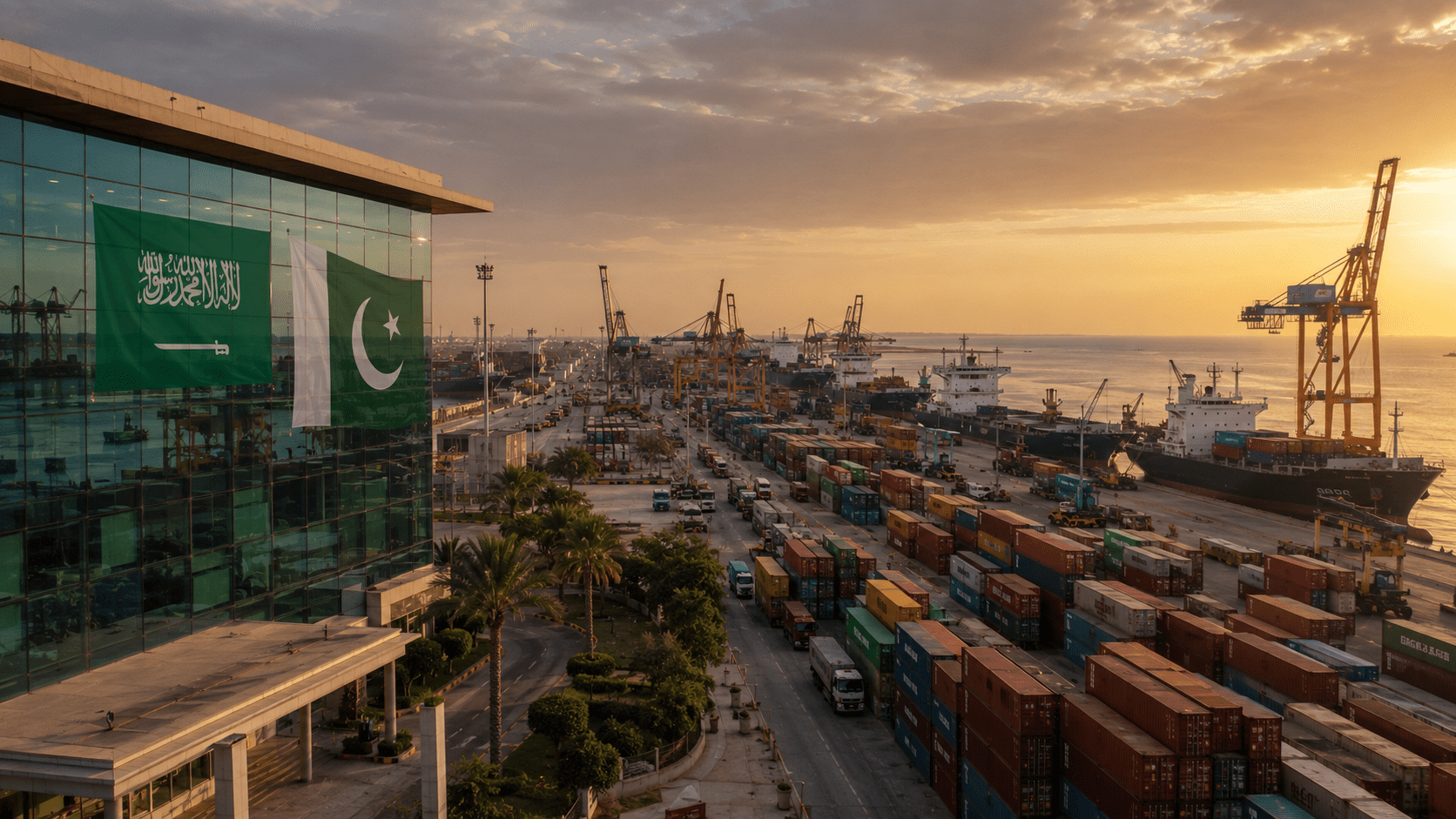
ISLAMABAD / RIYADH — The Saudi Arabia Pakistan deal pipeline has become one of the most exciting and consequential economic stories in Pakistan’s recent history — and it keeps getting bigger. What began as conversations about Saudi investment interest in Pakistani assets has now expanded into a sprawling, multi-sector engagement covering maritime infrastructure, energy refining, road networks, and the cutting edge of digital finance. The Saudi Arabia Pakistan deal in its current form represents nothing less than the most ambitious Gulf investment push into Pakistan’s economy in the country’s history — and if even a fraction of the announced and proposed initiatives materialise, the economic impact on jobs, trade, and Pakistan’s long-term development trajectory will be transformative.
Thank you for reading this post, don't forget to subscribe!The Saudi Arabia Pakistan deal story is being tracked across Pakistan’s most credible business and economic media simultaneously — Semafor’s Dominic Dudley broke the port deal story, Dawn’s Syed Irfan Raza reported Pakistan’s motorway pitches to Saudi investors, The Express Tribune’s Zaffar Bhutta covered the Gwadar refinery request, and Pakistan Today reported on the Saudi-backed crypto and blockchain zone for Karachi. The convergence of these four distinct but interconnected stories tells us something important: the Saudi Arabia Pakistan deal is not a single transaction but a comprehensive strategic economic engagement across multiple sectors simultaneously.
The Port Deal: Saudi Eyes on Pakistan’s Maritime Gateway
The headline element of the Saudi Arabia Pakistan deal — as reported by Semafor — is Saudi investor interest in a Pakistani port deal. The specific contours of which port or ports are under discussion, and on what terms, remain subject to ongoing negotiation, but the strategic logic of Saudi interest in Pakistani maritime infrastructure is immediately apparent.
Pakistan’s ports — primarily Karachi Port, Port Qasim, and the developing Gwadar Port — sit at the intersection of some of the world’s most important trade routes. Karachi and Port Qasim handle the vast majority of Pakistan’s import and export cargo, making them critical national infrastructure assets. Gwadar, as the anchor of CPEC, has even greater strategic significance as a potential deep-sea port that could connect Pakistan and China to the Arabian Sea and Indian Ocean trade network.
Saudi interest in the Saudi Arabia Pakistan deal port component reflects Riyadh’s broader strategy of internationalising its sovereign wealth fund and state enterprise investments as part of Vision 2030 — the economic diversification programme that is transforming Saudi Arabia from an oil-dependent economy into a diversified investment and trade hub. For Saudi Arabia, acquiring or developing a major stake in Pakistani port infrastructure provides access to one of the world’s fastest-growing consumer markets and a strategic position on the China-to-Gulf trade corridor.
For Pakistan, the Saudi Arabia Pakistan deal port investment offers something the country desperately needs: patient, long-term capital from a partner that understands the regional context, has its own strategic interest in Pakistani stability, and can bring with it the trade flows, shipping connections, and logistics expertise that would accelerate the ports’ development into genuine regional hubs.
Gwadar Refinery: Energy Security Meets Strategic Vision
The second major pillar of the Saudi Arabia Pakistan deal is the proposal — reported by The Express Tribune’s Zaffar Bhutta — for Riyadh to set up an oil refinery at Gwadar. This is not a new idea — Pakistan has been pitching the Gwadar refinery concept to Gulf investors for years — but the renewed urgency with which Islamabad is making this request reflects both the strategic opportunity that Saudi Arabia’s Vision 2030 represents and Pakistan’s acute domestic energy needs.
Pakistan currently has limited domestic refining capacity relative to its consumption needs, making it dependent on expensive refined product imports that worsen the current account and expose the country to global oil price volatility. A major refinery at Gwadar — particularly one linked to Saudi crude supply — would transform Pakistan’s energy security position, create thousands of direct and indirect jobs in Balochistan, and generate substantial fiscal revenues through taxes and tariffs.
The Saudi Arabia Pakistan deal Gwadar refinery component also has a CPEC dimension. Gwadar has been developed as a special economic zone under CPEC, and a major Saudi refinery investment there would add an important Gulf Arab dimension to what has been primarily a China-Pakistan project — potentially broadening the strategic ownership of Gwadar’s development and reducing any single-partner dependency risks.
For Saudi Aramco — the world’s largest oil company — a refinery stake in Gwadar as part of the Saudi Arabia Pakistan deal would provide a downstream outlet for Saudi crude, a foothold in Pakistan’s growing energy market, and a strategically positioned asset on the Arabian Sea that fits with Aramco’s broader international expansion strategy.
Motorways: Infrastructure Investment at Scale
Pakistan’s pitch to Saudi investors on motorways — reported by Dawn’s Syed Irfan Raza — is the third dimension of the Saudi Arabia Pakistan deal and one that reflects Pakistan’s enormous infrastructure financing needs and the attractive investment returns that properly structured infrastructure projects can offer.
Pakistan has built an impressive motorway network over the past three decades, but large sections of the country — particularly in Balochistan, southern Punjab, and interior Sindh — remain poorly connected to the national highway grid. The Saudi Arabia Pakistan deal motorway component envisions Saudi investment in new motorway construction or existing motorway management, either through direct investment, public-private partnership structures, or toll concession arrangements.
The economic case for the Saudi Arabia Pakistan deal motorway investment is compelling on its own terms: Pakistan’s road-based freight sector carries the overwhelming majority of domestic cargo, and improved connectivity directly increases the productivity of every sector of the economy that depends on efficient logistics. For Saudi investors, toll-based motorway concessions offer stable, long-term, inflation-linked returns backed by the Pakistani state — an attractive risk-return profile for patient Gulf capital.
The motorway dimension of the Saudi Arabia Pakistan deal also connects to the broader CPEC infrastructure framework, since improved Pakistani motorway connectivity enhances the utility and economic returns of the Chinese-invested corridor that runs through the country.
Karachi Crypto Zone: Pakistan’s Digital Economy Leap
Perhaps the most surprising and forward-looking element of the Saudi Arabia Pakistan deal is the proposal for a Saudi-backed crypto and blockchain zone in Karachi — reported by Pakistan Today as part of the broader investment package under discussion.
This proposal reflects a genuine global trend: several Gulf states, led by the UAE’s Dubai and Abu Dhabi, have positioned themselves as major hubs for digital asset and blockchain industry, attracting crypto exchanges, blockchain developers, and digital finance companies from around the world by offering regulatory clarity, tax incentives, and world-class infrastructure.
The Saudi Arabia Pakistan deal crypto zone for Karachi would represent Pakistan’s most serious attempt yet to capture a share of this rapidly growing global industry. Karachi — Pakistan’s financial capital and largest city — has the existing financial services infrastructure, human capital in technology and finance, and geographic connectivity to make a credible digital assets hub if the right regulatory and infrastructure framework is established.
For Saudi investors, backing a Saudi Arabia Pakistan deal crypto zone in Karachi offers exposure to one of the world’s most digitally active and rapidly growing young populations. Pakistan has tens of millions of smartphone users, a large and financially underserved population that is actively adopting digital financial services, and a rapidly growing technology sector that could benefit enormously from the kind of blockchain and digital finance ecosystem that a Karachi crypto zone would create.
According to Pakistan’s Board of Investment, the country has been actively developing a framework for digital asset regulation that would provide the legal certainty needed to attract serious institutional investment in the crypto and blockchain sector — making the Saudi Arabia Pakistan deal crypto zone proposal a natural fit with Pakistan’s emerging digital economy strategy.
Why Saudi Arabia Is Betting on Pakistan
The breadth and ambition of the Saudi Arabia Pakistan deal across ports, energy, infrastructure, and digital finance raises a natural question: why is Saudi Arabia making such a comprehensive bet on Pakistan right now?
Several factors converge to explain the timing and scale of Saudi interest. First, Saudi Arabia’s Vision 2030 economic transformation requires the kingdom to deploy its enormous sovereign wealth into productive international investments — and Pakistan, as a large, young-population market with significant infrastructure gaps and strong historical ties to Saudi Arabia, represents exactly the kind of opportunity that Vision 2030 capital seeks.
Second, the Saudi Arabia Pakistan deal reflects a deepening of the strategic relationship between Riyadh and Islamabad that goes beyond economics. Pakistan and Saudi Arabia have one of the longest and most multidimensional bilateral relationships in the Muslim world — religious, cultural, labour migration, military cooperation, and diplomatic solidarity have all bound the two countries together for decades. Economic investment of the scale now being discussed deepens that relationship further and gives Riyadh a direct stake in Pakistan’s economic success.
Third, the Saudi Arabia Pakistan deal timing reflects Saudi Arabia’s assessment of Pakistan’s current trajectory. After years of economic crisis, Pakistan has been implementing an IMF-backed stabilisation programme that has restored a degree of macroeconomic credibility. For long-term investors like Saudi sovereign wealth funds, this stabilisation creates a window of opportunity — entering a large market at a moment of economic recovery offers better terms and greater upside potential than waiting until the recovery is fully priced in.
What Pakistan Must Do to Close These Deals
The Saudi Arabia Pakistan deal pipeline is impressive — but promises and pitches are not yet signed contracts. Pakistan faces real challenges in converting Saudi investment interest into delivered projects, and addressing those challenges is essential if the Saudi Arabia Pakistan deal is to move from headline to reality.
Regulatory clarity, contract enforcement, protection of investor rights, and efficient project approval processes are all areas where Pakistan’s investment environment has historically fallen short of what international investors require. The Saudi Arabia Pakistan deal will test whether the current government’s reform commitments have produced structural improvements in these areas — or whether the same bureaucratic and legal obstacles that have frustrated previous investment pushes remain in place.
Read Also: PPP Wins GB Elections 2026: Emerges as Largest Party With Decisive 10-Seat Victory
Read Also: AJK Protest Spirals: Four Police Officers Martyred in Violent Clashes
Conclusion
The Saudi Arabia Pakistan deal — spanning ports, a Gwadar refinery, motorways, and a Karachi crypto zone — represents the most comprehensive and potentially transformative foreign investment engagement in Pakistan’s economic history. If delivered, it could create hundreds of thousands of jobs, transform Pakistan’s energy security, modernise its infrastructure, and position Karachi as a regional digital finance hub.
The Saudi Arabia Pakistan deal is a genuine economic opportunity of historic proportions. Whether Pakistan seizes it will depend on the quality of its governance, the consistency of its reform effort, and the determination of its leadership to create the conditions that turn Saudi investment interest into signed, sealed, and implemented projects.
Pakkhabar.com will continue to track the Saudi Arabia Pakistan deal across all sectors and bring you the latest updates on timelines, terms, and implementation progress.