

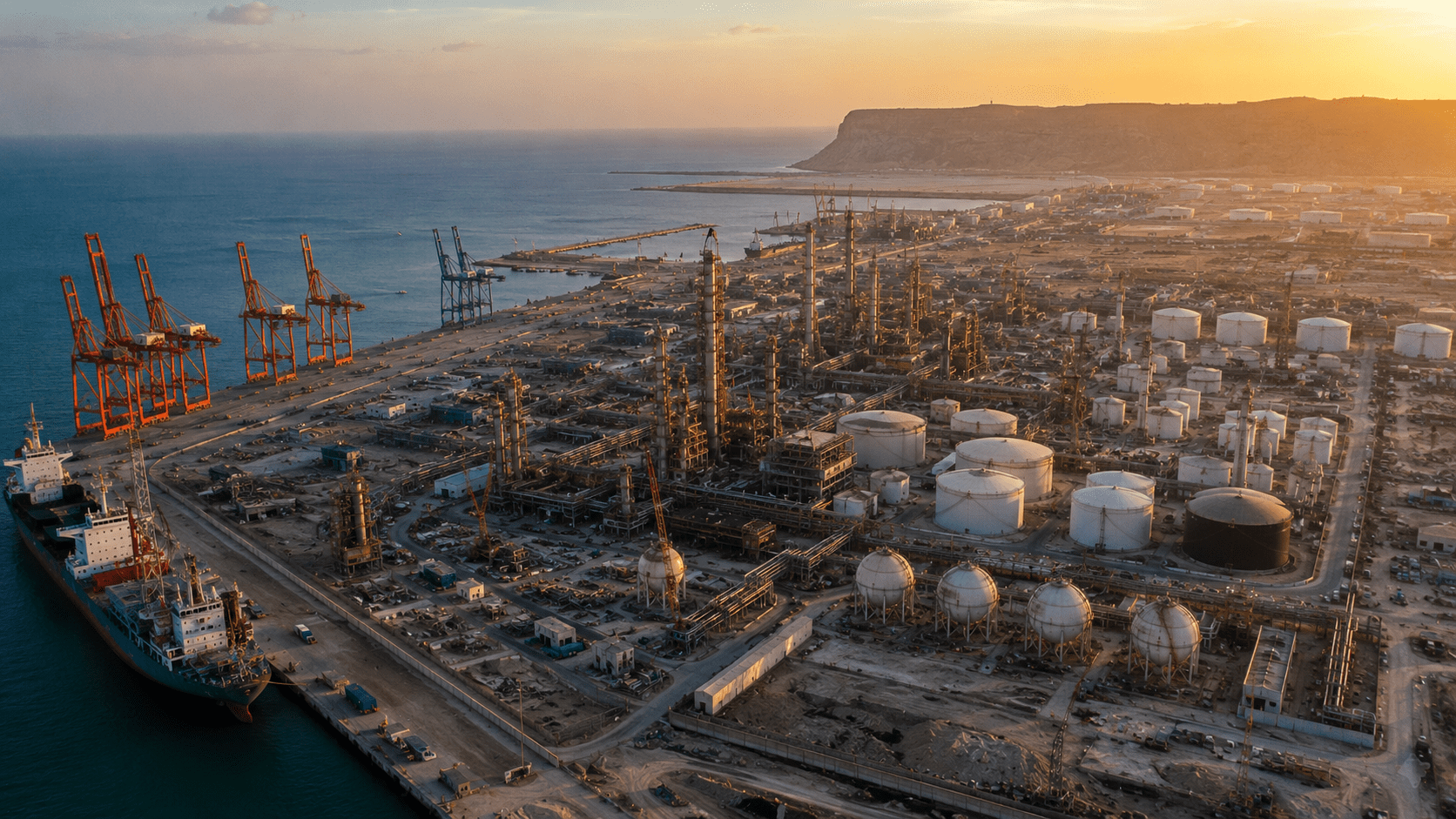
ISLAMABAD / GWADAR — Gwadar Saudi refinery — four words that represent Pakistan’s most ambitious and consequential energy investment ask in its entire history. Pakistan has once again formally renewed its push for Saudi Arabia to build a major oil refinery at Gwadar — a project that has been circulating in bilateral discussions for years but is now being pursued with a new intensity and urgency that reflects both Pakistan’s acute energy security needs and the transformed landscape of Saudi-Pakistani economic engagement that is reshaping the two countries’ relationship in 2026.
Thank you for reading this post, don't forget to subscribe!The Gwadar Saudi refinery proposal is not a new idea — it has been on the agenda of Pakistani and Saudi energy officials through multiple government cycles and bilateral summits. But the current push, reported by Pakistan Today as Islamabad’s most recent and direct approach to Riyadh on this critical project, reflects a specific convergence of factors that makes now the most promising window of opportunity for the Gwadar Saudi refinery to move from proposal to reality that Pakistan has yet seen.
Why the Gwadar Saudi Refinery Matters So Much
To understand why Pakistan is pressing so hard for the Gwadar Saudi refinery and why this project is treated as a national priority of the highest order, it is necessary to understand the fundamental energy security vulnerabilities that make domestic refining capacity so critical for Pakistan.
Pakistan is a country of over 230 million people with a rapidly growing economy, expanding motorisation, and industrial energy needs that are increasing year by year. Yet Pakistan’s domestic oil refining capacity — the infrastructure that processes crude oil into the refined petroleum products that run its vehicles, factories, and power plants — is severely limited relative to consumption needs. Pakistan imports a significant portion of its refined petroleum products — petrol, diesel, jet fuel, and furnace oil — at substantial foreign exchange cost that places a persistent and serious burden on the country’s current account and reserves.
A Gwadar Saudi refinery of sufficient scale would dramatically change this equation. By refining crude oil domestically — particularly Saudi crude, which Pakistan already imports — the Gwadar Saudi refinery would capture the value-added margin of the refining process within Pakistan rather than exporting it to foreign refiners, generate thousands of direct and downstream employment opportunities, and reduce Pakistan’s dependence on expensive refined product imports.
The numbers involved in a major Gwadar Saudi refinery project are significant. A world-scale refinery capable of processing 400,000 to 500,000 barrels per day — the scale that would justify the infrastructure investment — would represent capital expenditure in the range of $10 to $15 billion, making it one of the single largest industrial investments ever made in Pakistan’s history. The fiscal revenues, employment, and downstream industrial development that such a facility would generate would be transformative not just for Gwadar and Balochistan but for Pakistan’s national economic accounts.
Gwadar: The Perfect Location for a Saudi Refinery
The strategic logic of locating the Gwadar Saudi refinery specifically at Gwadar rather than at Pakistan’s existing coastal industrial centres is compelling and reflects the unique combination of natural and strategic assets that Gwadar offers.
Gwadar sits on Pakistan’s Makran coast at the mouth of the Persian Gulf — just 400 kilometres from the Strait of Hormuz through which Saudi crude oil transits on its way to world markets. This proximity makes Gwadar the ideal landing point for a Saudi crude supply pipeline or tanker route feeding a Gwadar Saudi refinery — minimising transportation costs and transit risk compared to shipping crude all the way to Karachi.
The deep-water port at Gwadar — developed under CPEC with Chinese expertise and capital — already has the berthing capacity to handle very large crude carriers, the fundamental prerequisite for a viable Gwadar Saudi refinery supply chain. Expanding the port’s oil terminal facilities to accommodate refinery-scale crude imports is an achievable and relatively straightforward enhancement of existing infrastructure rather than a project built from scratch.
The CPEC infrastructure corridor that runs from Gwadar north through Pakistan to the Chinese border provides the Gwadar Saudi refinery with a ready-made distribution network — petroleum products refined at Gwadar can move efficiently to domestic consumption centres in Balochistan, Punjab, and KPK, while excess production can potentially be exported north to China or east to India if regional trade conditions allow.
According to the Gwadar Port Authority, the port’s strategic master plan has always included the development of oil and petrochemical industrial facilities as a core component of Gwadar’s long-term economic vision — making the Gwadar Saudi refinery proposal a natural fit with the planned trajectory of the port’s development.
The Saudi Side: Why Aramco Should Be Interested
The Gwadar Saudi refinery pitch is not a one-sided request — it represents a genuinely attractive business proposition for Saudi Arabia’s energy sector, and understanding why helps explain why Pakistan is confident enough to keep pushing for it.
Saudi Aramco — the world’s largest oil company and one of the world’s most profitable corporations — has been pursuing an aggressive downstream internationalisation strategy as part of Saudi Arabia’s Vision 2030 economic transformation. Aramco is actively seeking to expand its refining and petrochemical presence in key growth markets — particularly in Asia — to lock in long-term crude supply relationships and capture more of the value chain from wellhead to consumer.
A Gwadar Saudi refinery stake would give Aramco exactly what its international expansion strategy requires: a major refining asset in a large, growing South Asian market, secured crude throughput for Saudi production, and a strategic position at one of the world’s most important new port development sites. Pakistan’s 230-million-person domestic market, combined with the potential to export refined products through CPEC to China or to Gulf markets, creates a compelling business case for Aramco’s investment.
The Gwadar Saudi refinery would also deepen the strategic dimension of Saudi Arabia’s relationship with Pakistan in a way that goes beyond financial returns. Energy infrastructure of this scale and interdependence creates a long-term strategic alignment between the two countries — Saudi Arabia would have a direct economic stake in Pakistan’s stability and growth, and Pakistan would have a powerful incentive to maintain the political and security conditions that protect the refinery investment.
According to Saudi Aramco’s official corporate strategy, downstream international expansion — particularly in Asia — is one of the company’s highest strategic priorities, making the Gwadar Saudi refinery opportunity directly aligned with where Aramco wants to invest.
Balochistan’s Transformation: Jobs, Development and Dignity
Beyond the national energy security and macroeconomic dimensions, the Gwadar Saudi refinery carries profound significance for Balochistan specifically — Pakistan’s largest but most economically marginalised province.
Balochistan has long been at the centre of Pakistan’s most difficult governance and security challenges. The province is rich in natural resources — natural gas, minerals, fisheries, and strategic geography — but its population has historically felt excluded from the economic benefits of those resources and of the CPEC development that is transforming Gwadar’s physical infrastructure.
The Gwadar Saudi refinery would change this dynamic in a direct and tangible way. A world-scale oil refinery requires thousands of direct employees — engineers, technicians, operators, maintenance workers, logistics personnel — and creates many more indirect jobs in services, supply chains, and downstream industries. Prioritising the employment of local Baloch workers in the Gwadar Saudi refinery project would represent the most direct and substantial economic inclusion of Balochistan’s population in the CPEC era’s benefits that has yet been proposed.
The developmental ripple effects of the Gwadar Saudi refinery for Balochistan extend far beyond direct employment. The power generation, water supply, road connectivity, and social infrastructure needed to support a major industrial facility would accelerate Gwadar’s transformation from a port town into a genuine industrial city — creating the conditions for broader economic diversification and human development that Balochistan urgently needs.
The Balochistan government’s official development portal has consistently identified energy and industrial development as the province’s highest economic priorities — priorities that the Gwadar Saudi refinery directly and powerfully addresses.
The History of the Proposal: Why It Hasn’t Happened Yet
The Gwadar Saudi refinery proposal has been on the bilateral agenda for a considerable time — so a natural question is why it hasn’t been built yet, and what is different about the current push that makes success more likely.
Previous discussions about the Gwadar Saudi refinery have stalled for several reasons that are worth understanding. First, Pakistan’s political instability — with frequent government changes and inconsistent policy commitments — has made long-term foreign investors cautious about committing the enormous capital a refinery requires. Second, the regulatory and tax framework for refinery investment in Pakistan has historically been unclear and subject to change, creating uncertainty about the returns investors could expect. Third, the security situation in Balochistan — while significantly improved in recent years — has been a concern for any investor contemplating a multi-billion-dollar asset in the province.
The current Gwadar Saudi refinery push comes in a context where several of these obstacles have been at least partially addressed. Pakistan’s current government has demonstrated unusual policy continuity and a genuine commitment to structural economic reform. The regulatory environment for energy investment has been clarified through CPEC-related legislation. And the security situation in Gwadar specifically has improved substantially with the development of the port and its associated infrastructure.
Read Also: Saudi Arabia Pakistan Deal Explodes: Ports, Gwadar Refinery, Motorways and a Karachi Crypto Boom
Read Also: Saudi Condemns Pakistan Car Bomb 2026: Attack on Northwest Checkpoint
Read Also: Hormuz Tensions US Iran Explode: Gulf Erupts as Missiles Hit Kuwait and Bahrain
Conclusion
The Gwadar Saudi refinery is not just an energy project — it is a symbol of Pakistan’s economic ambition, Balochistan’s development aspirations, and the depth of the Saudi-Pakistani strategic partnership. Pakistan’s renewed push for Riyadh to commit to this transformative project reflects the government’s confidence that the conditions for success have never been better aligned.
If the Gwadar Saudi refinery moves from proposal to groundbreaking, it will stand as one of the most consequential bilateral investment decisions in the history of South Asian economic development — a project that delivers energy security, employment, provincial development, and strategic alignment simultaneously.
Pakkhabar.com will track every development in the Gwadar Saudi refinery negotiations and bring you the latest updates as this landmark project moves toward reality.