

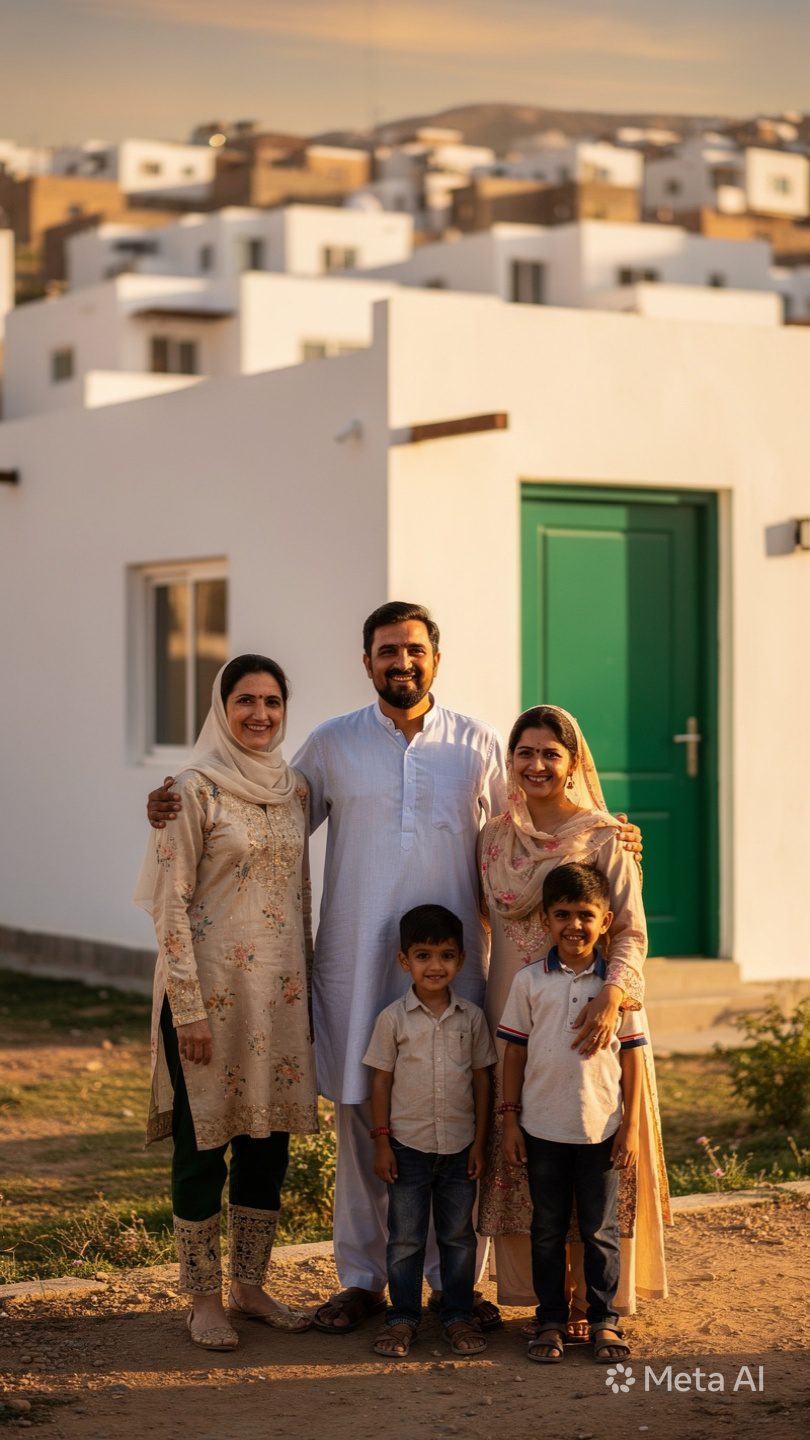
ISLAMABAD — Apna Ghar Scheme — Pakistan’s most ambitious affordable housing initiative — has entered its most active and consequential phase yet. A convergence of powerful developments is simultaneously accelerating the programme’s pace, expanding its reach, and deepening its financial foundations in ways that could genuinely transform Pakistan’s housing landscape and deliver on the long-held dream of homeownership for millions of Pakistani families who have never been able to afford a home of their own.
Thank you for reading this post, don't forget to subscribe!The Apna Ghar Scheme momentum has been building across multiple fronts simultaneously. Prime Minister Shehbaz Sharif has personally stepped in to direct faster processing of applications — a direct intervention from the country’s top executive that sends an unmistakable signal of political priority and urgency. Rs11 billion has already been disbursed to beneficiaries under the Apna Ghar Scheme, demonstrating that the programme has moved beyond the announcement stage into real, tangible financial delivery.
The World Bank has committed $100 million to inject into Punjab’s housing programme — providing international financial credibility and scale to what was initially a domestic policy initiative. And in a game-changing policy modification, the government has announced that families can now pool their combined incomes to qualify for Apna Ghar Scheme home loans — a reform that dramatically expands the programme’s accessibility and eligibility base.
What Is the Apna Ghar Scheme?
The Apna Ghar Scheme — which translates directly as “My Own Home Scheme” — is Pakistan’s national affordable housing programme designed to make home ownership financially accessible for the millions of low and middle-income Pakistani families who have been priced out of the property market by rising real estate costs, high mortgage rates, and stringent bank lending criteria.
The Apna Ghar Scheme operates by providing government-backed concessionary home loans — at subsidised interest rates significantly below commercial market rates — to eligible applicants who meet defined income and asset criteria. By reducing the cost of borrowing for home purchase or construction, the Apna Ghar Scheme brings the monthly loan repayment within reach of families whose incomes would not qualify them for conventional commercial mortgages.
The housing shortage in Pakistan is one of the country’s most pressing social and economic challenges. Pakistan faces a documented deficit of millions of housing units, with the gap between supply and demand growing every year as the population expands and urbanisation accelerates. The Apna Ghar Scheme represents the government’s direct response to this crisis — a programmatic attempt to use public subsidy and concessionary financing to stimulate housing supply and enable demand among the population segments most in need of affordable shelter.
PM Shehbaz’s Intervention: Faster Processing Ordered
The most immediate and politically significant development in the Apna Ghar Scheme story is Prime Minister Shehbaz Sharif’s personal direction to government functionaries to process applications faster. Business Recorder reported this intervention — and its significance should not be understated.
When a Prime Minister personally intervenes in the administrative processing of a social programme, it signals several things simultaneously. It signals that the Apna Ghar Scheme is a top political priority for the government — not just a paper commitment but a programme the PM is actively monitoring and driving. It signals that the pace of processing had been identified as a bottleneck — an administrative constraint preventing eligible families from accessing the Apna Ghar Scheme benefits they were entitled to. And it signals to the bureaucratic machinery responsible for implementing the programme that delays and inefficiencies will not be tolerated.
The Apna Ghar Scheme application processing challenge is not unusual for large-scale social programmes. When millions of applications are received simultaneously, the administrative systems for verifying eligibility, conducting credit assessments, processing documentation, and disbursing funds are put under enormous strain. PM Shehbaz’s intervention is an attempt to cut through that strain and ensure the programme delivers for applicants as quickly as possible.
Rs11 Billion Disbursed: Real Money for Real Families
The Apna Ghar Scheme disbursement figure — Rs11 billion already delivered to beneficiaries as reported by The Express Tribune — is one of the most important data points in the programme’s story. It is the number that distinguishes the Apna Ghar Scheme from the many housing schemes that have been announced in Pakistan over the years but never materialised into actual housing.
Rs11 billion in Apna Ghar Scheme disbursements represents real home loans delivered to real Pakistani families — families who are using that financing to build or buy homes that will provide their children with stability, security, and a fixed address for the first time. The social and psychological significance of homeownership for Pakistani families — many of whom have spent decades renting at the mercy of landlords and market conditions — cannot be overstated.
At an average Apna Ghar Scheme loan size, Rs11 billion in disbursements translates into thousands of individual family home purchases or constructions — a tangible housing supply impact that is beginning to make a real difference to Pakistan’s housing shortage statistics. Every rupee disbursed through the Apna Ghar Scheme is not just a financial transaction — it is a family’s future being secured.
World Bank $100 Million: International Validation and Scale
The World Bank’s commitment to inject $100 million into Punjab’s housing scheme — reported by Mettis Global — is one of the most significant developments in the Apna Ghar Scheme story and deserves particular attention because of what it represents beyond the financial figure itself.
The World Bank does not commit $100 million to programmes lightly. Before approving such an investment, World Bank analysts conduct rigorous assessments of programme design, governance frameworks, financial management systems, environmental and social safeguards, and the overall probability that the programme will achieve its stated development objectives. The fact that the World Bank has committed to Pakistan’s housing programme — overlapping with and supporting the Apna Ghar Scheme — means that these assessments have been conducted and the programme has been judged credible, well-designed, and capable of delivering results.
The $100 million World Bank investment in the Apna Ghar Scheme framework also unlocks additional benefits beyond the immediate capital injection. It brings World Bank technical assistance, international best practice in housing finance programme design, and monitoring and evaluation frameworks that improve the programme’s effectiveness. It also signals to other international development finance institutions that Pakistan’s housing programme is a credible investment proposition — potentially attracting additional multilateral and bilateral financing.
For Pakistan, the World Bank’s involvement in the Apna Ghar Scheme provides important credibility at a time when the government is working to restore international investor confidence in the country’s economic management. A major World Bank housing finance commitment is a visible demonstration that Pakistan’s social and economic programmes can meet international standards.
Family Income Pooling: The Game-Changing Policy Reform
Perhaps the most practically impactful reform in the recent Apna Ghar Scheme developments is the government’s decision to allow families to pool their combined incomes when applying for the scheme — reported by ProPakistani.
Under previous Apna Ghar Scheme eligibility rules, loan qualification was assessed primarily on the basis of the primary applicant’s individual income — a criterion that excluded many deserving families where no single earner met the income threshold but where the combined household income would comfortably support mortgage repayments.
The Apna Ghar Scheme family income pooling reform addresses this exclusion directly. Now, a household where both husband and wife work — or where adult children contribute to the family income — can combine those earnings to meet the eligibility threshold. This reform is not merely a technical adjustment to programme rules; it is a recognition of the economic reality of how Pakistani households actually function, where multiple earners pooling resources is the norm rather than the exception for families in the income brackets the scheme targets.
The impact of the Apna Ghar Scheme family income pooling reform on eligibility numbers could be substantial. Economists and housing policy analysts estimate that the percentage of Pakistani households that qualify for the scheme increases significantly when combined household income is the eligibility metric — potentially bringing millions of previously excluded families into the Apna Ghar Scheme eligible pool.
This reform also has a specific gender empowerment dimension. By allowing women’s incomes to be included in the household eligibility calculation, the Apna Ghar Scheme family income pooling policy recognises and values women’s economic contribution to Pakistani households — an important step toward more inclusive and gender-sensitive housing policy.
Pakistan’s Housing Crisis: The Scale of the Challenge
To fully appreciate the significance of the Apna Ghar Scheme and its recent acceleration, it is important to understand the scale of Pakistan’s housing deficit that the programme is attempting to address.
Pakistan faces a housing shortage estimated at over 10 million units nationally — one of the largest absolute housing deficits of any country in the world. This deficit is growing, not shrinking, as Pakistan’s population of over 230 million continues to expand and the pace of urbanisation accelerates. The shortage is most acute for low and middle-income families in major urban centres — Karachi, Lahore, Islamabad, Faisalabad, and other cities where migration has driven demand far beyond the capacity of the housing market to supply affordable units.
According to Pakistan’s State Bank, mortgage financing penetration in Pakistan has historically been among the lowest in the developing world — a result of high lending rates, stringent collateral requirements, and the limited formalisation of property markets. The Apna Ghar Scheme addresses this structural market failure by using government subsidy to make the economics of mortgage lending work for income groups that commercial banks have historically been unable to serve profitably.
Who Can Apply for the Apna Ghar Scheme?
For Pakkhabar.com readers interested in whether they or their families might qualify for the Apna Ghar Scheme, the key eligibility criteria — subject to official confirmation through government channels — typically include Pakistani citizenship, income within defined limits, no existing owned property, and the purpose of constructing or purchasing a first home.
With the new family income pooling rule in place, Apna Ghar Scheme applicants should ensure they provide documentation of all household members’ incomes when applying — as this combined figure will now be used to assess eligibility and determine the loan amount available.
For the most current and accurate Apna Ghar Scheme eligibility requirements, application procedures, and documentation requirements, applicants should check the official Pakistan Housing Authority Foundation and National Bank of Pakistan channels, which are the primary administrative and disbursement institutions for the programme.
Read Also: https://pakkhabar.com/womens-t20-world-cup-2026-schedule-fixtures-guide/
Read Also: https://pakkhabar.com/sri-lanka-vs-west-indies-scorecard-match-analysis/
Read Also: PPP Wins GB Elections 2026: Emerges as Largest Party With Decisive 10-Seat Victory
Conclusion
The Apna Ghar Scheme has crossed a critical threshold in 2026 — moving from a well-intentioned policy announcement into a functioning, funded, and accelerating programme that is already delivering homes for Pakistani families. With PM Shehbaz personally driving faster processing, Rs11 billion disbursed, $100 million from the World Bank supporting Punjab’s housing push, and the game-changing family income pooling reform expanding eligibility, the Apna Ghar Scheme is closer to fulfilling its promise than at any point in its history.
For the millions of Pakistani families who dream of owning their home — who have watched property prices rise beyond their reach year after year — the Apna Ghar Scheme acceleration represents genuine hope backed by real government commitment and international financial support. That combination is rare in Pakistan’s development history. It deserves to succeed — and right now, all the signals suggest it is on track to do so.
Pakkhabar.com will continue tracking the Apna Ghar Scheme, disbursement updates, application portal developments, and beneficiary stories as Pakistan’s housing transformation continues.