

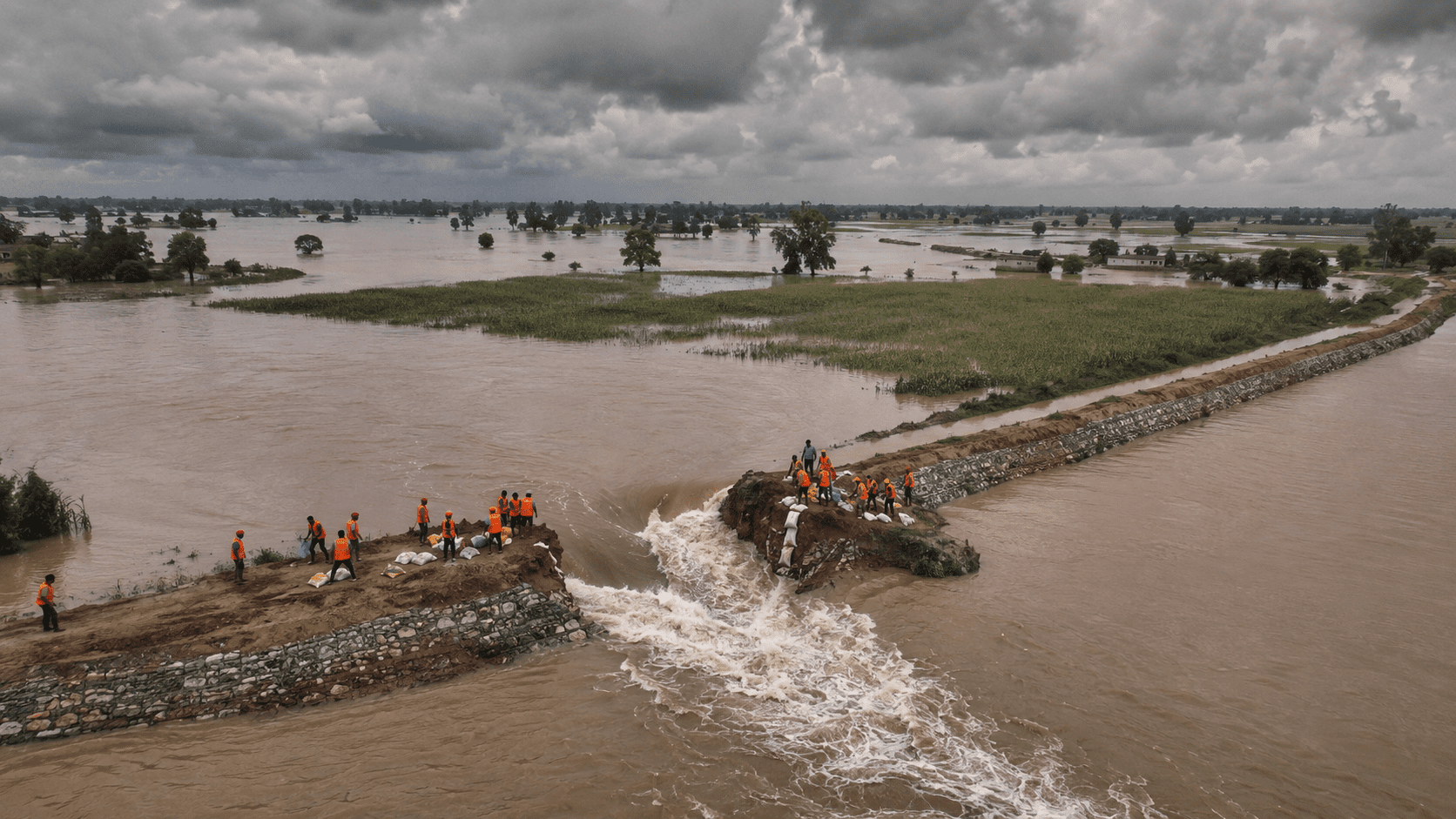
CHANDIGARH / LUDHIANA — The Punjab flood crisis is no longer a warning — it is a reality that is unfolding across one of South Asia’s most agriculturally critical states with a speed and severity that has overwhelmed local response capacity and triggered urgent calls for emergency intervention. Canals have burst their banks at three locations, flooding farmland that represents the economic lifeline of thousands of farming families.
Thank you for reading this post, don't forget to subscribe!Rainfall has caused 35 separate breaches in the state’s water channel network — a figure that speaks to the scale and geographic spread of the Punjab flood crisis and the enormous strain that intense monsoon rainfall is placing on ageing irrigation infrastructure. And Ludhiana — Punjab’s largest city and industrial hub — has reeled under a 14-hour power outage that the Punjab State Power Corporation Limited (PSPCL) estimates has inflicted losses of nearly ₹2 crore on the electricity distribution system.
The Punjab flood crisis arrives at a moment of particular vulnerability. Indian Punjab’s farmers are navigating challenging economic conditions even before the floods — input cost pressures, market price volatility, and the ongoing agricultural reform environment have all created baseline stress in the farming community. The Punjab flood crisis adds the most brutal of natural catastrophes to that pre-existing pressure — destroying standing crops, flooding fields that will take weeks to drain and recover, and damaging the irrigation infrastructure that the next growing season will depend upon.
Canal Breaches at Three Locations: Farmlands Under Water
The most immediately devastating element of the Punjab flood crisis is the breach of canals at three separate locations — an event that Babushahi.com reported as causing direct flooding of surrounding agricultural land. Canal breaches in the context of the Punjab flood crisis are not simply a water management problem — they are an agricultural catastrophe in slow motion.
When a canal embankment gives way under the pressure of excessive rainfall and high water levels, the water does not merely flood roads and residential areas — it inundates the fields that line Punjab’s canal network, submerging crops, destroying soil structure, damaging irrigation infrastructure, and leaving behind sediment deposits that reduce field productivity for months after the water recedes.
The three-location canal breach pattern in the Punjab flood crisis suggests that the problem is not localised to a single weak point in the infrastructure but is systemic — spread across multiple sections of Punjab’s canal network that are all under similar pressure from the same rainfall event. This systemic character of the Punjab flood crisis makes the response more challenging because it requires simultaneous interventions at multiple breach points rather than the concentration of resources at a single location.
The agricultural impact of the Punjab flood crisis canal breaches cannot be measured in simple acreage terms — it must be understood in terms of the farming families whose entire annual income is tied to the crop that is now underwater. For small and marginal farmers who may have taken loans to finance their input costs for the current crop, the Punjab flood crisis flooding represents not just the loss of this season’s harvest but the accumulation of debt with no income to repay it.
35 Channel Breaches: Infrastructure Under Extreme Stress
The Tribune reported that rainfall during the current Punjab flood crisis event has caused 35 separate breaches in water channels across the state. Thirty-five is not a number that can be attributed to isolated infrastructure weakness or localised extreme weather — it is a number that reflects systemic pressure across Punjab’s entire irrigation network.
Punjab’s water channel infrastructure — the network of smaller channels, distributaries, and minors that carry water from the main canals to individual fields — is the backbone of the state’s agricultural system. This infrastructure was largely built during the colonial period and has been maintained, upgraded, and extended over the decades since. But it was designed for rainfall patterns and water flows that are increasingly being exceeded by the intensity of monsoon events driven by changing climatic conditions.
The Punjab flood crisis 35 channel breaches represent a direct challenge to the adequacy of this infrastructure for current and future conditions. Even after the immediate Punjab flood crisis is resolved and the water recedes, the state government will face the expensive and complex task of repairing 35 separate breach points — work that must be completed before the next rainfall event to prevent the same catastrophe recurring.
The financial burden of repairing the Punjab flood crisis channel damage will fall primarily on the state government’s irrigation and water resources department — a department that, like all state government departments, operates under significant budgetary constraints. Prioritising and financing the repairs efficiently will be one of the key administrative challenges of the post-Punjab flood crisis recovery phase.
Ludhiana’s 14-Hour Power Outage: ₹2 Crore in Losses
The Punjab flood crisis has also inflicted serious damage on urban infrastructure — most visibly in Ludhiana, where a 14-hour power outage left the city without electricity for more than half a day. The Hindustan Times reported that PSPCL has estimated the losses from this outage at nearly ₹2 crore — a figure that reflects both the direct cost of damaged electrical infrastructure and the revenue losses from interrupted power distribution.
Ludhiana’s power vulnerability during the Punjab flood crisis highlights an often-overlooked dimension of flood events: their impact on urban infrastructure and the secondary economic damage that power outages create. Ludhiana is Punjab’s industrial hub — home to a massive hosiery and textile manufacturing industry, along with engineering, bicycle manufacturing, and numerous other industrial sectors.
A 14-hour power outage during the Punjab flood crisis means 14 hours of halted industrial production — manufacturing orders missed, export commitments delayed, and machinery subjected to the risks of sudden power restoration. For Ludhiana’s small and medium-sized industrial units, which form the backbone of the city’s economy, even a single-day production halt creates significant financial losses that multiply through the supply chain.
The PSPCL’s ₹2 crore loss estimate from the Punjab flood crisis power disruption is the direct infrastructure cost — but the total economic impact of the Ludhiana outage, including industrial production losses and the ripple effects through the city’s commercial economy, is considerably larger.
Agricultural Impact: Punjab’s Food Bowl Under Threat
The Punjab flood crisis is striking at the heart of one of South Asia’s most important agricultural regions. Indian Punjab — the state that has historically been called India’s bread basket — produces a disproportionate share of India’s wheat and rice, contributing enormously to the country’s food security. The state’s agricultural productivity is the result of centuries of farming tradition, systematic irrigation development, and the intensive cultivation practices of its farming communities.
When the Punjab flood crisis damages standing crops and floods fields, the impact extends beyond the individual farming families whose livelihoods are directly affected. It affects the broader food supply chain, state government procurement operations, agricultural credit systems, and the rural economy that depends on the farm sector’s purchasing power.
The timing of the Punjab flood crisis within the agricultural calendar matters enormously. If the flooding coincides with critical growing stages — when crops are flowering, forming grain, or approaching harvest — the damage is maximised. If the Punjab flood crisis water can be drained quickly and the season’s crop partially salvaged, the agricultural losses, while still serious, may be manageable.
According to the India Meteorological Department, monsoon rainfall intensity across the northern Indian plains — including Punjab — has been showing increasing variability, with more frequent extreme precipitation events that overwhelm drainage and irrigation infrastructure. The Punjab flood crisis of 2026 is consistent with this pattern of increasing extreme weather events.
Emergency Response: What Authorities Are Doing
The Punjab flood crisis has triggered emergency response operations across multiple state government departments — the irrigation department for canal breach repair, the district administration for evacuation and relief in flooded areas, the National Disaster Response Force (NDRF) and State Disaster Response Force (SDRF) for rescue operations, and PSPCL for power restoration.
The Punjab flood crisis response faces the classic challenge of simultaneous emergency demands across a geographically spread area — 35 channel breach points, three canal breach locations, and urban infrastructure damage in Ludhiana all requiring attention and resources at the same time. Prioritising response operations effectively — focusing first on evacuating people from flooded areas before addressing infrastructure repair — is the central challenge facing emergency managers.
The National Disaster Management Authority (NDMA) of India has established protocols for exactly this kind of multi-location flood emergency, and state authorities are expected to be implementing those protocols in the current Punjab flood crisis response.
Climate Context: Why Punjab Floods Are Getting Worse
The Punjab flood crisis of 2026 does not exist in isolation — it is part of a pattern of increasingly severe and frequent flood events that climate scientists have been documenting and projecting for decades. The Himalayan glaciers that feed Punjab’s river and canal system are under stress from rising temperatures — releasing more water in summer months while reducing the long-term reliability of water supply. The monsoon system itself is showing increased intensity and variability, producing heavier rainfall events in shorter time windows that overwhelm infrastructure designed for historical rainfall patterns.
The Intergovernmental Panel on Climate Change (IPCC) has documented extensively that South Asia’s monsoon rainfall is expected to increase in intensity as global temperatures rise — making Punjab flood crisis events more frequent, more severe, and more damaging over the coming decades unless infrastructure is substantially upgraded and adapted.
Read Also: Women’s T20 World Cup 2026: Complete Schedule, Groups, Fixtures and Ultimate Fan Guide
Read Also: Apna Ghar Scheme 2026: Pakistan’s Biggest Housing Dream Is Finally Being Unlocked for Millions
Conclusion:
The Punjab flood crisis of 2026 is a serious natural disaster with wide-ranging agricultural, infrastructure, and economic consequences for one of South Asia’s most important states. The combination of 35 canal and channel breaches, flooded farmlands, and a major urban power outage represents a multi-dimensional emergency that demands immediate response, sustained recovery effort, and serious long-term thinking about infrastructure resilience and climate adaptation.
The Punjab flood crisis will eventually recede — the water will drain, the power will stay on, and the fields will be replanted. But the lessons of this crisis — about infrastructure vulnerability, climate adaptation needs, and emergency response capacity — must not recede with the floodwater.
Pakkhabar.com is monitoring the Punjab flood crisis closely and will provide updates on damage assessments, government relief measures, and agricultural recovery as the situation develops.