

At least 40 people lost their lives and eight others were injured in the latest Pakistan bus ravine tragedy, after an overcrowded passenger coach plunged off a mountainous highway in Balochistan early Friday. The devastating accident has been described as one of the deadliest road disasters the country has witnessed in recent years, reigniting concerns over transport safety on Pakistan’s remote highway networks.
Thank you for reading this post, don't forget to subscribe!The Pakistan bus ravine tragedy unfolded in the Danasar area along the Sherani-Zhob highway, a treacherous stretch of road near the border between Balochistan and Khyber Pakhtunkhwa provinces. The bus was travelling from Quetta toward Peshawar when it veered off the road and fell into a deep rocky ravine.
How the Pakistan Bus Ravine Tragedy Unfolded
According to regional officials, the ill-fated coach had originally departed Quetta carrying around 36 to 48 passengers. Partway through the journey, additional travellers reportedly boarded after being transferred from another bus that had broken down, leaving the vehicle significantly overcrowded.
A Balochistan government spokesperson said the bus lost control shortly before the crash. Some reports citing an injured survivor suggested a dispute broke out among passengers after the driver stopped to pick up the extra travellers, with one account alleging a passenger grabbed the driver, causing him to lose control of the vehicle. Authorities said this claim has not been independently verified and remains under investigation.
Whatever the exact trigger, the outcome was catastrophic. The bus fell from the highway into a deep, rock-strewn ravine, an area known locally for its dangerous terrain and lack of protective road barriers.
Rescue Operations Amid Difficult Terrain
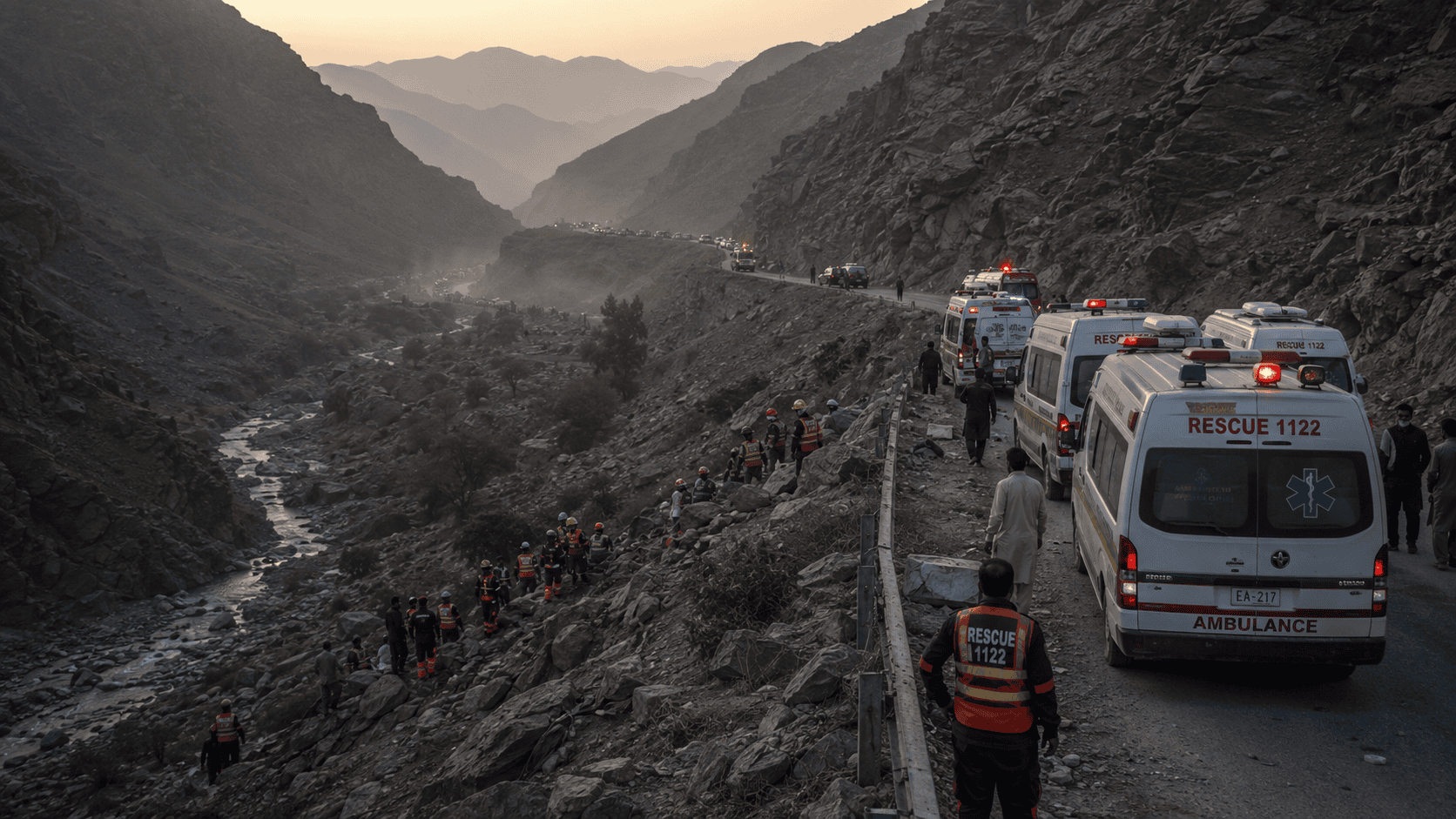
Emergency response to the Pakistan bus ravine tragedy was immediate but heavily hampered by the region’s rugged mountainous landscape. Teams from Rescue 1122, the Frontier Corps, local police, district administration, and Khyber Pakhtunkhwa rescue services all converged on the remote crash site to assist in recovery efforts.
Officials confirmed that six ambulances, a dozen emergency medical technicians, and multiple light transport vehicles were deployed to the scene. Despite the challenging conditions, rescue crews worked for hours to pull bodies and survivors from the wreckage. The deceased were first taken to a nearby rural health facility before being transferred to the district headquarters hospital in Zhob, while the eight injured passengers received treatment at a trauma centre in the same city.
Health authorities declared a medical emergency at hospitals across Sherani and Dera Ismail Khan to manage the sudden surge of casualties, placing considerable strain on local medical infrastructure that is not typically equipped for disasters of this scale.
National Leaders React to the Pakistan Bus Ravine Tragedy
The scale of the Pakistan bus ravine tragedy prompted swift reactions from Pakistan’s top leadership. President Asif Ali Zardari and Prime Minister Shehbaz Sharif both expressed deep grief over the loss of life and directed authorities to ensure the injured received the best possible medical treatment.
Balochistan Chief Minister Sarfraz Bugti also conveyed condolences on the Pakistan bus ravine tragedy to the bereaved families and instructed relevant departments to expedite rescue operations. Khyber Pakhtunkhwa Chief Minister Sohail Afridi echoed similar sentiments, directing rescue teams and local administration to continue relief work without delay and stressing that no negligence would be tolerated in the emergency response.
A Recurring Crisis on Pakistan’s Highways
This latest Pakistan bus ravine tragedy is far from an isolated incident. Mountainous highways connecting Balochistan and Khyber Pakhtunkhwa have long been flagged by transport safety experts as some of the most hazardous routes in the country, largely due to the absence of guardrails, poor road maintenance, and inadequate enforcement of vehicle capacity limits.
Overloading remains a persistent and largely unregulated problem across Pakistan’s commercial passenger transport sector. In this case, officials confirmed the coach was carrying passengers beyond its original capacity after absorbing travellers from a broken-down vehicle, a common but risky practice on long-distance routes.
Investigation and Accountability
Authorities have launched a formal investigation into the crash to determine its exact cause. The probe is expected to examine multiple factors, including the reported overloading of the vehicle, driver conduct, and the broader condition of road infrastructure along the Sherani-Zhob corridor.
Public scrutiny over Pakistan’s transport regulation has intensified in the aftermath of the disaster, with many questioning why known high-risk routes continue to operate without adequate safety barriers or stricter oversight of passenger vehicle capacity.
For broader context on road safety standards, the World Health Organization’s global road safety data highlights how underinvestment in infrastructure and lax enforcement contribute significantly to preventable road fatalities in developing regions.
Impact and the Road Ahead
The human toll of the Pakistan bus ravine tragedy extends far beyond the immediate casualties. Dozens of families across Balochistan and Khyber Pakhtunkhwa are now grappling with sudden loss, while survivors face long recoveries from injuries sustained in the crash.
The incident is likely to renew pressure on federal and provincial governments to introduce stricter regulations on passenger vehicle capacity, improve highway infrastructure in mountainous regions, and strengthen emergency response capacity in remote areas where hospitals are often under-resourced for mass casualty events.
Read Also: ENG vs IND 1st T20I Abandoned After Rain Denies England Chase in Durham
Conclusion
The Pakistan bus ravine tragedy stands as a grim reminder of the risks embedded in the country’s transport infrastructure, particularly along remote mountain highways lacking basic safety measures. As investigations continue and rescue operations wind down, attention now turns to whether authorities will translate public outrage into lasting reforms that could prevent similar disasters in the future.