

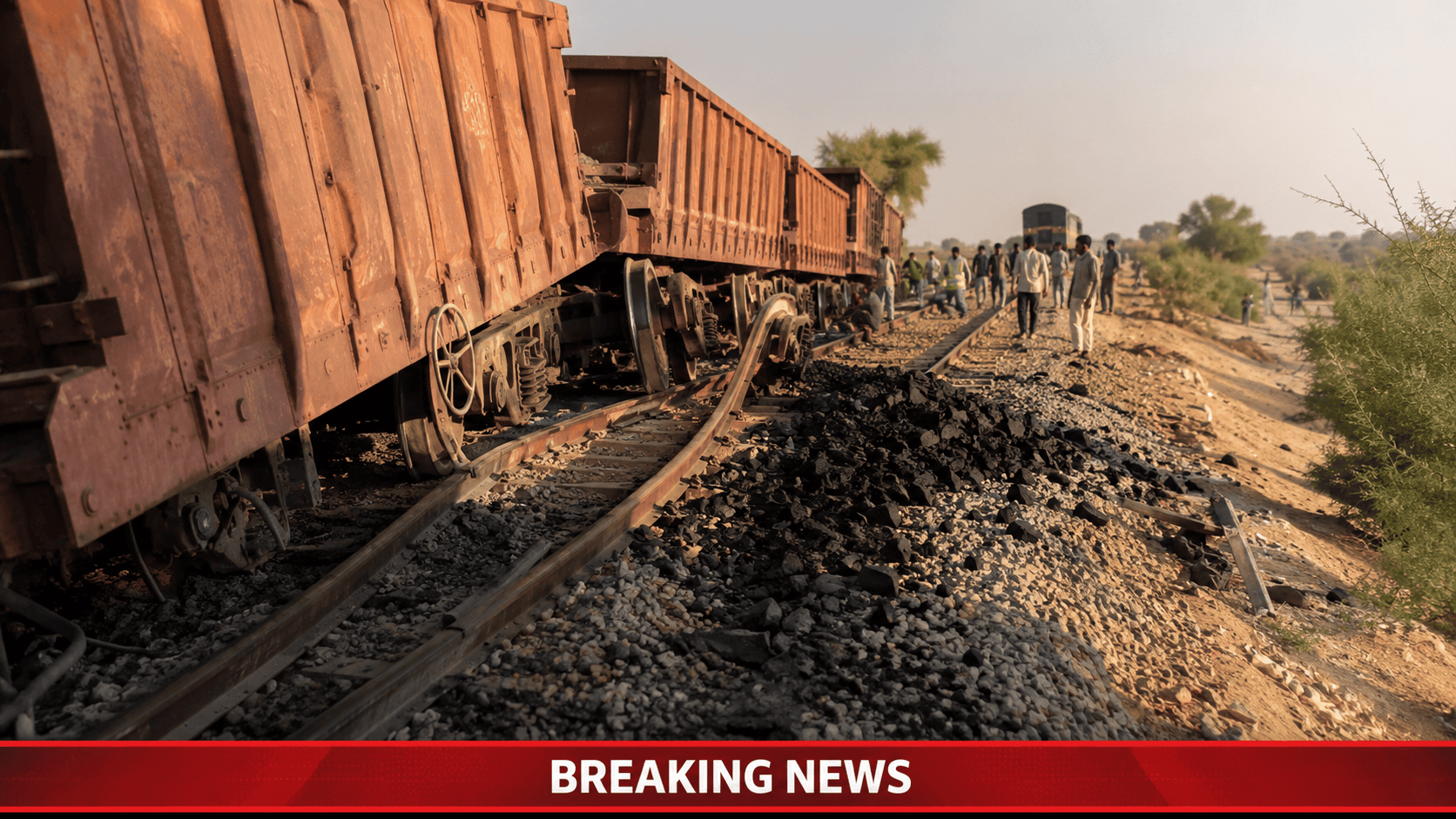
Rail operations across a major stretch of southern Pakistan ground to a halt on Sunday after a significant Sindh train derailment disrupted one of the country’s busiest freight corridors. According to railway officials, seventeen wagons of a coal-carrying freight train went off the tracks near Wahab Shah railway station in Matiari district, forcing the closure of both the up and down lines and triggering a cascade of delays for passenger services across the province.
Thank you for reading this post, don't forget to subscribe!The incident has once again drawn attention to the state of Pakistan’s aging rail infrastructure, a system that has repeatedly struggled with maintenance backlogs, funding shortfalls, and safety concerns in recent years.
How the Sindh Train Derailment Unfolded
Officials from Pakistan Railways confirmed that the coal hopper train was travelling from Karachi toward Yousafwala when several of its wagons left the rails near Wahab Shah station. The derailment damaged a considerable portion of the track, complicating restoration efforts and forcing authorities to shut down both directions of travel through the affected section.
The Divisional Commercial Officer of Pakistan Railways in Karachi confirmed the scale of the disruption, noting that the damage was severe enough that full restoration could take up to a full day. Railways Sukkur Divisional Superintendent Farman Ghani told local media that relief trains were being dispatched from both Rohri and Kotri to assist with clearing the wreckage and repairing the track.
“The track has been affected over a considerable portion and restoration will require time,” Ghani said, adding that engineering and rescue teams were working to reopen both lines as quickly as possible.
Fortunately, early reports from the scene indicated no casualties, a relief given the scale of past derailments on this same stretch of Sindh’s rail network.
Passenger Trains Stranded Across the Province
The Sindh train derailment near Matiari had an immediate ripple effect on passenger travel. With both tracks blocked, several long-distance trains were forced to halt at stations along the route rather than proceed toward the affected zone.
Among the services affected:
- The Karakoram Express was held at Hyderabad station
- The Allama Iqbal Express stopped at Kotri
- The Pakistan Express was halted at Landhi
- The Tezgam Express was stopped at Drigh Road
- The Millat Express and Fareed Express were held at Cantonment station in Karachi
Additional services were stopped at Tando Adam, Hyderabad, Karachi, and Rohri as railway control rooms worked to reroute or delay trains scheduled through the corridor over the following 24 hours. For thousands of commuters and long-distance travelers, the disruption meant extended waits, missed connections, and last-minute changes to travel plans during what is typically a busy travel period in the region.
A Railway System Under Strain
This latest Sindh train derailment does not exist in isolation. It comes against the backdrop of a broader, well-documented crisis within Pakistan Railways, one marked by chronic financial constraints, staff shortages, and aging infrastructure that has struggled to keep pace with the demands of a growing population.
on Sindh train derailment Reports have repeatedly highlighted how a lack of adequate funding has forced authorities to keep both passenger and freight services running under strained conditions, with insufficient resources allocated toward maintaining locomotives, coaches, wagons, and the tracks themselves. This resource gap has, over time, been linked to a heightened risk of accidents across the network, raising ongoing concerns among transport safety experts and the traveling public alike.
Pakistan’s railway network has seen several serious incidents in recent years. In 2023, a passenger train derailment in Nawabshah killed dozens of passengers and injured many more, according to international wire reports. In 2021, a nighttime collision near Daharki in northern Sindh left dozens dead after one train derailed and was struck by another shortly afterward. These past tragedies underscore why even a freight derailment without casualties, like the one near Matiari, draws close scrutiny from both regulators and the public.
For readers interested in broader international rail safety standards, organizations such as the International Union of Railways and the World Bank’s transport division publish regular assessments on infrastructure investment and safety benchmarks that offer useful context for developing rail networks like Pakistan’s.
Economic and Logistical Impact on Sindh train derailment
Beyond passenger inconvenience, a Sindh train derailment of this scale carries real economic consequences. Freight rail remains a critical artery for moving bulk commodities such as coal, cement, and agricultural goods between Karachi’s port facilities and inland markets. A 24-hour suspension on a key corridor can delay shipments, disrupt supply chains for industries reliant on rail freight, and add pressure to an already congested road transport network as goods are temporarily rerouted.
Local businesses and logistics operators dependent on predictable freight schedules are likely to feel knock-on effects in the days following the incident, particularly if restoration work extends beyond the initial 24-hour estimate given by railway officials.
What Happens Next Sindh train derailment
Sindh train derailment, Railway engineering teams are expected to work around the clock to clear the wreckage, repair damaged track sections, and restore both up and down line operations. Once the corridor reopens, authorities will likely conduct a formal investigation into the cause of the derailment, a routine step following such incidents that helps identify whether equipment failure, track conditions, or other factors contributed to the accident.
Given the broader context of Pakistan Railways’ ongoing infrastructure challenges, incidents like this one are likely to reignite calls from transport analysts and opposition lawmakers for increased federal investment in rail modernization. Sindh train derailment Historically, upgrade plans linked to initiatives such as the China-Pakistan Economic Corridor have been proposed to address some of these systemic issues, though implementation has often lagged behind announced timelines.
Read Also:Petrol Price Hike Pakistan 2026: Govt Revises Rates for Next Week
Conclusion
The Sindh train derailment near Matiari serves as the latest reminder of the pressures facing Pakistan’s rail network. While the absence of casualties in this incident is a positive outcome, the disruption to both freight and passenger services highlights the everyday operational risks tied to an infrastructure system in need of sustained investment. As relief trains work to restore the affected tracks, passengers, businesses, and policymakers alike will be watching closely to see whether this latest disruption prompts renewed attention to long-term rail safety reforms.
Get updates like this on WhatsApp before anywhere else — join our Channel [https://whatsapp.com/channel/0029Vb8fffCKrWQzEVBQ6v00]