

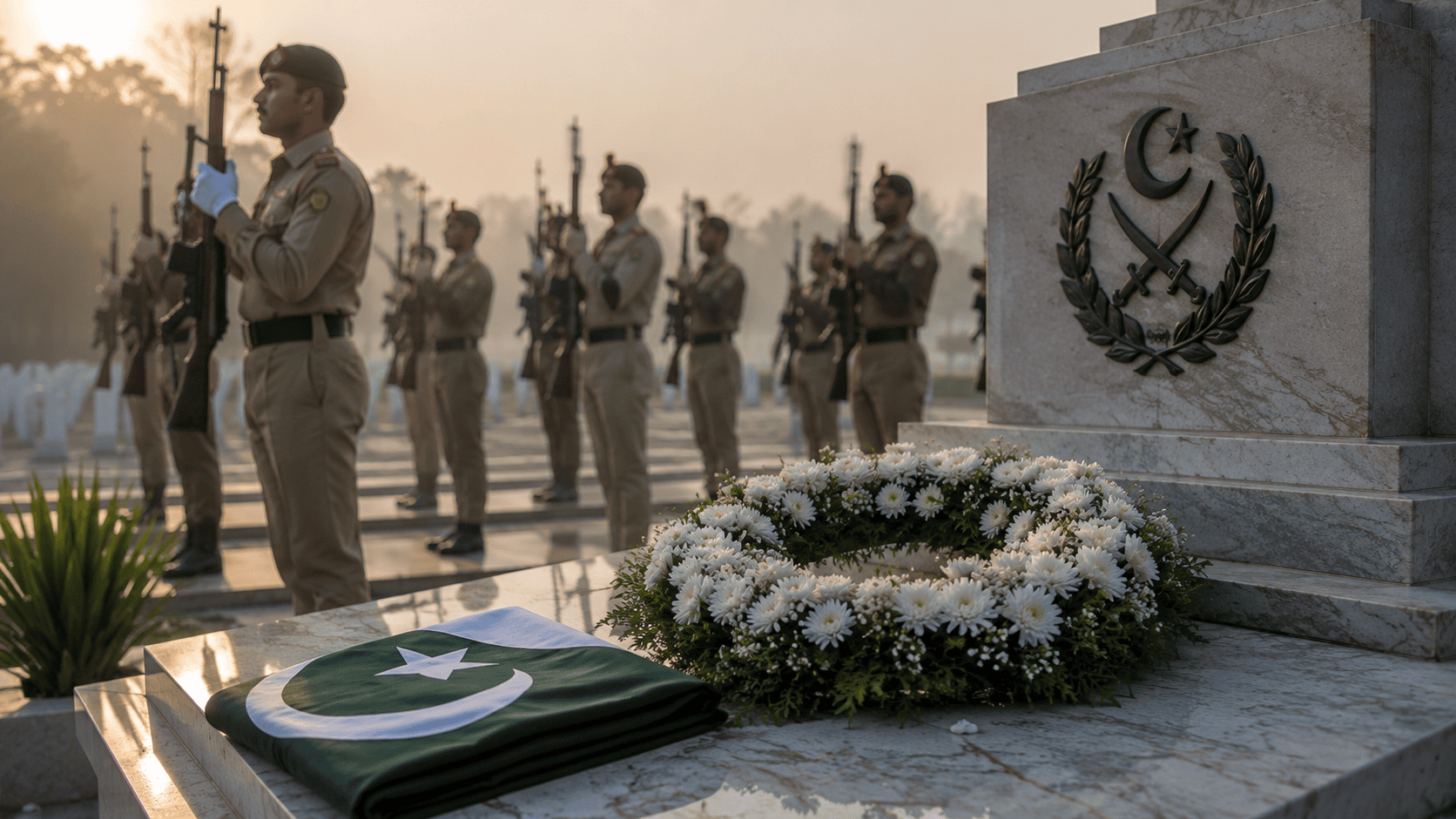
Pakistan paused on Sunday to remember one of its most celebrated soldiers, as the 27th martyrdom anniversary of Captain Karnal Sher Khan Shaheed was observed across the country. From the halls of government to military garrisons and the streets of his native Swabi, tributes poured in for a man whose final stand at Gultari, more than two decades ago, continues to define courage for a new generation of Pakistanis.
Thank you for reading this post, don't forget to subscribe!Captain Karnal Sher Khan Shaheed, a recipient of the Nishan-e-Haider — Pakistan’s highest military gallantry award — remains one of only a small number of soldiers to receive this honour since the country’s independence. His story, rooted in the icy heights of the Kargil conflict, is retold every July with the same reverence it received in 1999.
Who Was Captain Karnal Sher Khan Shaheed
Born in 1970 in a village in Swabi district, Khyber Pakhtunkhwa, Captain Karnal Sher Khan Shaheed joined the Pakistan Army and was commissioned into the 27th Sindh Regiment in 1994. He was later attached to the 12th Northern Light Infantry during the Kargil War, one of the most difficult and high-altitude conflicts fought in modern military history.
Deployed at Gultari, at an altitude of roughly 17,000 feet, Captain Karnal Sher Khan Shaheed and his men established five strategic posts overlooking the Line of Control. What followed was a sustained defence against repeated assaults, carried out in brutal weather conditions that tested endurance as much as bravery.
The Final Battle That Defined a Legacy
On July 5, 1999, Indian forces launched a major assault backed by two battalions and managed to seize part of one Pakistani post. Rather than retreat, Captain Karnal Sher Khan Shaheed led a determined counterattack, personally engaging in close combat to reclaim the lost ground. Military accounts describe how he carried out daring raids against enemy positions, inflicting heavy losses before being fatally struck by machine-gun fire later that day.
His actions that day were later recognized with the Nishan-e-Haider, placing Captain Karnal Sher Khan Shaheed alongside a small and revered group of Pakistani military heroes who have received the honour since 1948, including Captain Muhammad Sarwar, Major Muhammad Tufail, Major Aziz Bhatti, and Major Shabbir Sharif.
National Leadership Pays Tribute to Captain Karnal Sher Khan Shaheed
This year’s anniversary saw tributes from the highest levels of Pakistan’s civilian and military leadership. According to a statement issued by the Inter-Services Public Relations (ISPR), Field Marshal Syed Asim Munir, Chief of Army Staff and Chief of Defence Forces, joined Admiral Naveed Ashraf, Chief of the Naval Staff, and Air Chief Marshal Zaheer Ahmed Baber Sidhu, Chief of the Air Staff, in collectively honouring the fallen officer’s legacy.
The ISPR statement described his sacrifice as a lasting example of courage, selflessness, and devotion to Pakistan’s sovereignty and territorial integrity. President Asif Ali Zardari and Prime Minister Shehbaz Sharif also issued separate messages recognising his bravery. The prime minister noted that defending the country remains a sacred responsibility, and that the sacrifices of soldiers like Captain Karnal Sher Khan Shaheed continue to safeguard the nation’s peace and independence.
Why Captain Karnal Sher Khan Shaheed Still Matters Today
More than a quarter-century after his martyrdom, Captain Karnal Sher Khan Shaheed continues to occupy a central place in Pakistan’s military memory. Institutions named in his honour, including a cadet college in Swabi, a motorway interchange, a toll plaza, and roads in cantonments across the country, ensure that his name remains part of everyday public life rather than confined to history books.
Religious scholars and community leaders also marked the occasion this year, describing the sacrifices of martyrs like Captain Karnal Sher Khan Shaheed as a collective national trust. Their statements emphasized that such sacrifices are not only military history but a continuing source of national identity and pride.
Regional and Historical Context of the Kargil War
The Kargil War of 1999 was fought at extreme altitudes along the Line of Control in the Kargil district, involving intense combat under some of the harshest terrain conditions faced by any modern army. The conflict produced several accounts of extraordinary individual bravery, with Captain Karnal Sher Khan Shaheed frequently cited as one of its defining figures due to the scale of his final counterattack and the leadership he displayed under fire.
For readers seeking further verified background on the conflict and Pakistan’s military honours system, resources such as the Inter-Services Public Relations (ISPR) and international outlets like Al Jazeera and Reuters provide additional historical and contemporary context.
Impact and Analysis: A Legacy Beyond the Battlefield
The annual commemoration of Captain Karnal Sher Khan Shaheed serves a purpose beyond remembrance. In a region where military history remains closely tied to national identity, such anniversaries reinforce a shared narrative of sacrifice that spans generations. For Pakistan’s armed forces, publicly renewing tribute to figures like Captain Karnal Sher Khan Shaheed also serves to reaffirm institutional values of duty and service to new recruits and the broader public.
At a societal level, the continued recognition of Captain Karnal Sher Khan Shaheed by senior civilian leadership alongside military chiefs signals a rare point of unified national sentiment, cutting across political and institutional lines. This unity itself carries symbolic weight, particularly during a period when Pakistan continues to navigate complex regional security dynamics.
Read AlPM Shehbaz Turkiye Visit Strengthens Pakistan-Turkey Bilateral Tiesso:
Conclusion
Twenty-seven years after his martyrdom at Gultari, Captain Karnal Sher Khan Shaheed remains a defining symbol of courage within Pakistan’s military history. This year’s tributes, spanning the President, the Prime Minister, the armed forces leadership, and communities across the country, reflect how deeply his story continues to resonate. As Pakistan continues to honour the legacy of Captain Karnal Sher Khan Shaheed, his example of leadership under extreme adversity remains a touchstone for the values the nation seeks to uphold in its armed forces and beyond.