

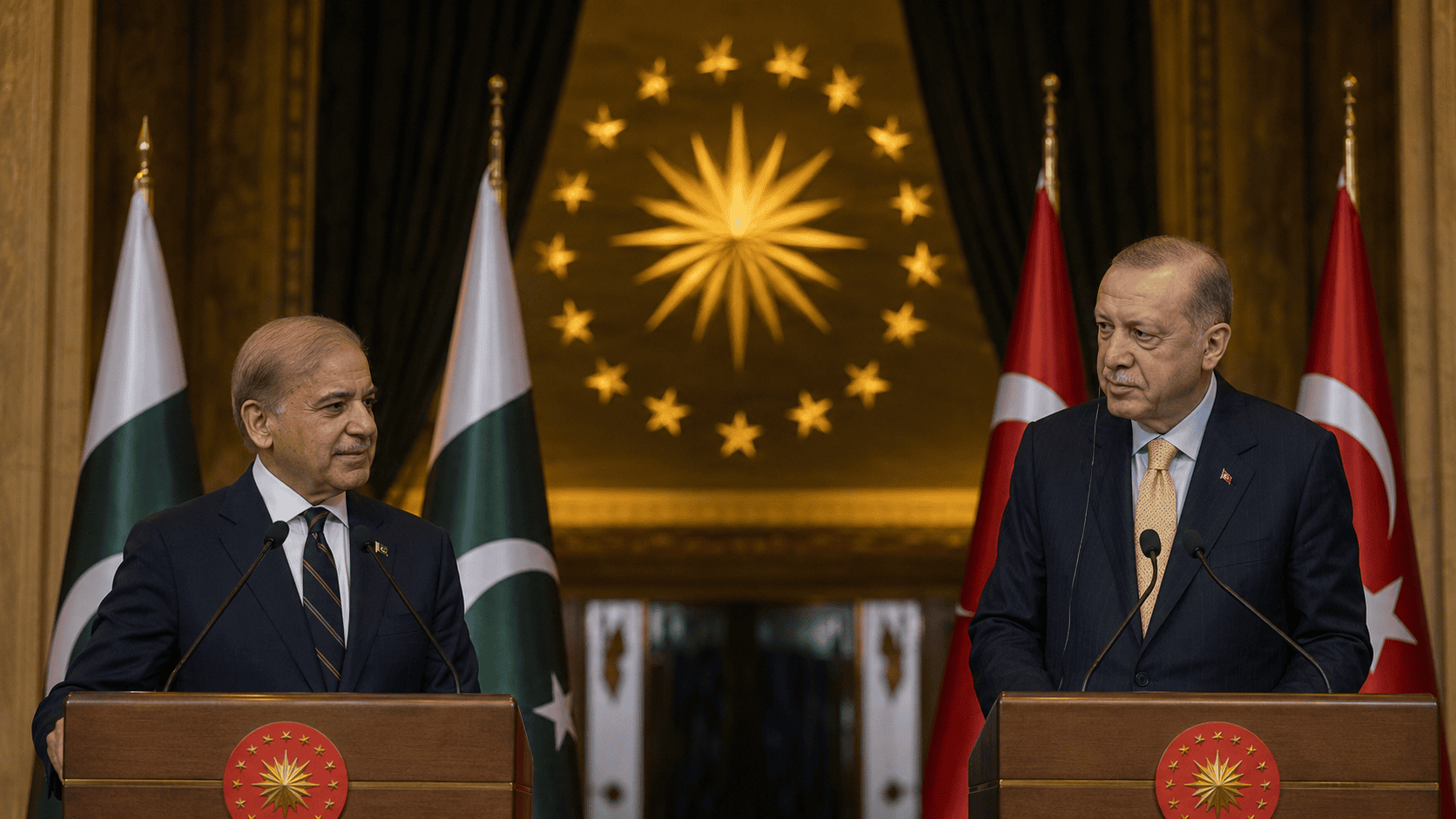
The Pakistan Turkiye economic partnership has reached a defining moment this week, as Prime Minister Shehbaz Sharif and Turkish President Recep Tayyip Erdogan held wide-ranging talks in Istanbul aimed at transforming decades of political friendship into concrete economic gains. Meeting at the historic Vahdettin Palace on the banks of the Bosphorus, the two leaders used the occasion to reaffirm their shared ambition of lifting bilateral trade to $5 billion, while unveiling fresh initiatives spanning energy, technology, defence and regional diplomacy.
Thank you for reading this post, don't forget to subscribe!For a relationship long described in emotional terms — brotherhood, solidarity, shared faith and history — this summit marked an attempt to translate sentiment into substance. The Pakistan Turkiye economic partnership now carries measurable targets, sector-specific investment pledges, and an expanding institutional framework designed to keep momentum going long after the cameras leave Istanbul.
Why the Pakistan Turkiye Economic Partnership Is Gaining Global Attention
Pakistan’s outreach to Türkiye comes at a moment when Islamabad is actively courting foreign direct investment to stabilize its economy and diversify trade beyond traditional partners. Türkiye, meanwhile, has been expanding its economic footprint across South Asia and the Gulf as part of a broader strategy to strengthen ties with fellow Muslim-majority nations.
Officials from both governments have described the Pakistan Turkiye economic partnership as “entering a new phase,” a phrase that captures the shift from ceremonial diplomacy toward action-oriented cooperation. According to statements issued by the Prime Minister’s Office, the visit was extended at President Erdogan’s personal invitation and formed part of a broader push to institutionalize trade and investment channels between the two nations.
Key Outcomes From the Istanbul Summit
The leaders’ joint press conference following their closed-door meeting outlined several concrete steps:
- Trade Target Reaffirmed: Both sides recommitted to the long-standing goal of raising bilateral trade volume to $5 billion, a figure first proposed in 2022 and formally endorsed in 2024.
- Special Economic Zone in Karachi: Trade ministries from both countries are working on a dedicated Special Economic Zone for Turkish investors, with a proposed site offering 1,000 acres at Port Qasim’s industrial zone.
- Energy and Mining Cooperation: Pakistan’s energy ministry highlighted that Turkish Petroleum has already secured offshore and onshore concessions through recent bidding rounds, signaling growing interest from Turkish energy firms.
- Digital Corridor Initiative: Prime Minister Sharif proposed a Pakistan-Türkiye Digital Corridor to support cross-border data flows, 5G deployment, and local manufacturing of telecom equipment.
- Regional Security Dialogue: The two leaders also discussed regional stability, with Erdogan commending Pakistan’s diplomatic role in easing recent regional tensions.
This combination of trade, technology, and security cooperation illustrates how the Pakistan Turkiye economic partnership is being designed as a multi-layered relationship rather than a single trade agreement.
Business Community Response to the Pakistan Turkiye Economic Partnership
Alongside the government-to-government talks, Prime Minister Sharif addressed the Pakistan-Türkiye Business Conference in Istanbul, where he invited Turkish companies to expand their presence in Pakistan’s energy, mining, infrastructure, maritime, telecommunications and agriculture sectors. Senior Pakistani officials, including advisers on privatization and energy, presented investment models designed specifically for Turkish firms, including reduced land-rental rates for companies committing to high export volumes.
Executives from major Turkish conglomerates, including telecom and holding groups, met separately with the Pakistani delegation to explore partnerships in digital infrastructure, manufacturing, and long-term commercial ventures. This business-to-business engagement is seen as a critical complement to the political commitments made at the presidential level, since it is often the private sector that determines whether trade targets are actually achieved.
Background: A Long History Behind the Pakistan Turkiye Economic Partnership
Pakistan and Türkiye have maintained close diplomatic, defence and cultural ties for decades, often describing their bond using terms like brotherhood rather than mere alliance. However, economic ties have historically lagged behind the political warmth between Islamabad and Ankara. Trade volumes between the two countries have remained modest compared to their broader diplomatic engagement, prompting officials on both sides to repeatedly set — and reset — ambitious trade targets.
The current push builds on frameworks established in previous years, including a free trade agreement under negotiation and joint economic councils tasked with identifying priority sectors. Analysts note that the renewed focus on the Pakistan Turkiye economic partnership reflects broader shifts in Pakistan’s foreign economic policy, which has increasingly emphasized attracting investment from Gulf and Muslim-majority nations as part of its economic stabilization strategy.
Regional and Strategic Dimensions
Beyond economics, the Istanbul talks touched on wider regional dynamics. Pakistan and Türkiye are both members of a diplomatic framework launched earlier this year alongside Egypt and Saudi Arabia to coordinate positions on regional crises. President Erdogan used the joint press conference to praise Pakistan’s diplomatic efforts in helping ease recent regional tensions, while both leaders stressed that dialogue remains the only sustainable path to lasting peace.
This regional coordination adds a strategic dimension to the Pakistan Turkiye economic partnership, suggesting that economic cooperation and geopolitical alignment are increasingly viewed by both capitals as mutually reinforcing rather than separate tracks of policy.
Potential Impact and Analysis
If implemented as outlined, the initiatives announced in Istanbul could meaningfully reshape the Pakistan Turkiye economic partnership over the coming years. The proposed Special Economic Zone at Port Qasim could attract manufacturing investment tied to export incentives, potentially creating jobs in Pakistan’s industrial sector. Expanded energy exploration by Turkish firms could support Pakistan’s efforts to reduce its energy import bill, while the proposed Digital Corridor could accelerate much-needed investment in telecom infrastructure.
However, past experience suggests that translating high-level trade targets into realized figures requires sustained follow-through from both bureaucracies. Trade volume targets between the two countries have been announced before without being fully met, and analysts will be watching whether the institutional mechanisms discussed this week — from the SEZ to sector-specific investment models — are implemented on a practical timeline.
For Pakistan, deepening the Pakistan Turkiye economic partnership also fits into a broader strategy of diversifying economic partnerships at a time when the country is working to rebuild investor confidence and stabilize its macroeconomic position.
What Comes Next
Officials from both countries indicated that technical-level talks on the Special Economic Zone and the broader trade agreement will continue in the coming months. Business delegations are also expected to follow up on the commitments made during the Istanbul conference, with several Turkish firms reportedly exploring formal partnership agreements in the energy, telecom and manufacturing sectors.
Read Also: Pakistan Bus Ravine Tragedy: 40 Killed in Balochistan Highway Disaster
Conclusion
The Istanbul summit has given fresh momentum to the Pakistan Turkiye economic partnership, moving the relationship beyond symbolic gestures toward tangible economic commitments. With a $5 billion trade target, a proposed Special Economic Zone, and new cooperation in energy and digital infrastructure, both Islamabad and Ankara appear determined to match their historic political friendship with equally strong economic ties. Whether these ambitions translate into measurable results will depend on the follow-through from both governments — but for now, the direction of travel for the Pakistan Turkiye economic partnership points firmly toward deeper integration.
For more verified updates on this developing story, readers can follow official coverage from Reuters, Dawn, and Arab News.