

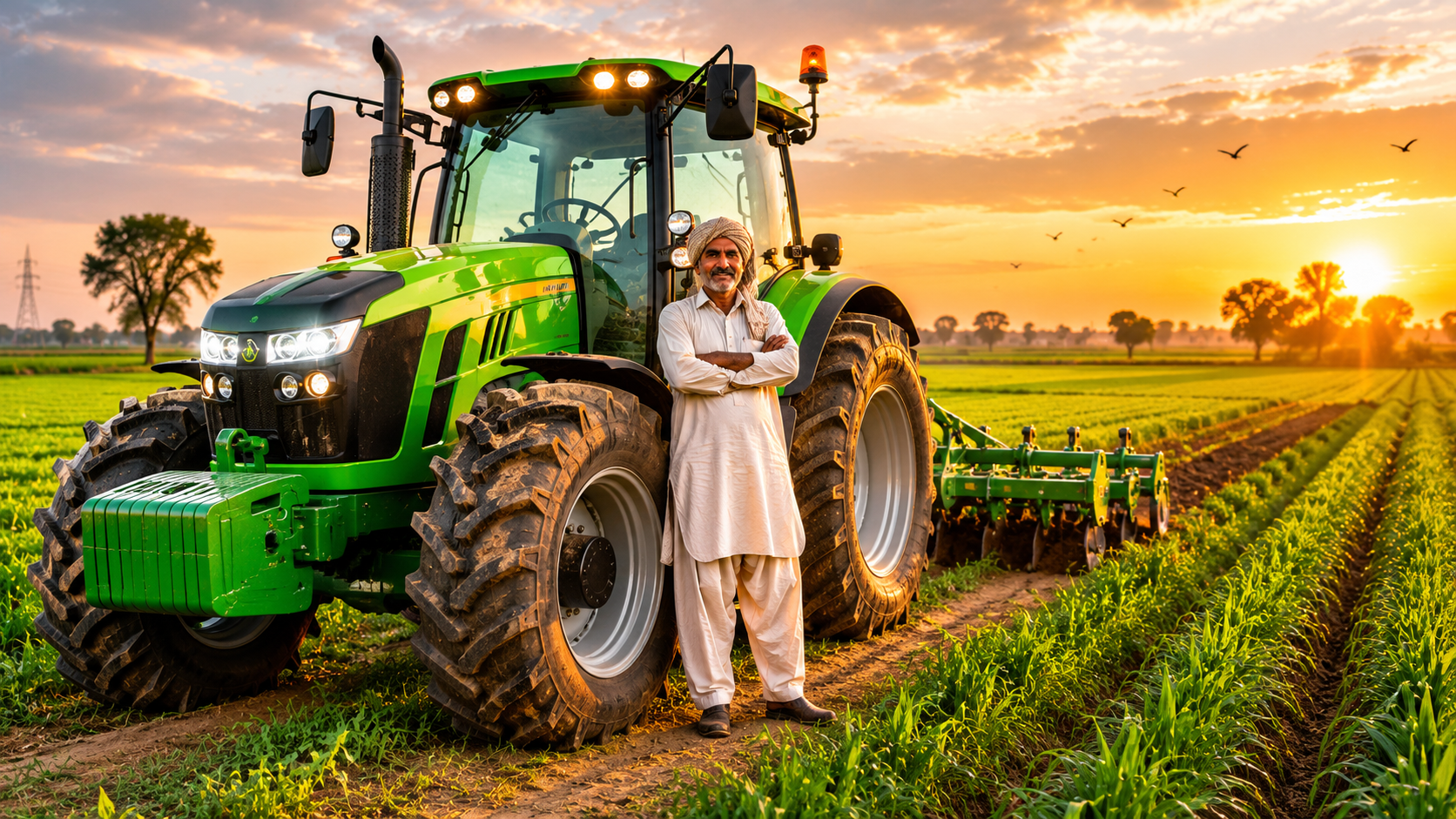
LAHORE — Punjab Green Tractor Scheme — these four words are being celebrated across Punjab’s agricultural heartland today as Chief Minister Maryam Nawaz officially announced one of the most significant and ambitious direct support programmes for Pakistani farmers in recent memory. The Punjab Green Tractor Scheme will provide a subsidy of Rs1 million per tractor to eligible farmers across the province, with a total of 20,000 tractors earmarked for distribution in the next fiscal year — a commitment that signals the Punjab government’s determination to modernise the province’s agricultural sector and deliver tangible, life-changing support to the farming communities that form the backbone of Pakistan’s economy.
Thank you for reading this post, don't forget to subscribe!The Punjab Green Tractor Scheme announcement has been confirmed by multiple credible Pakistani news sources simultaneously, including Radio Pakistan, The Express Tribune, The News International, and Pakistan Today — a convergence of reporting that underscores the significance and scale of the initiative. CM Maryam Nawaz, who has made agricultural development a centrepiece of her administration’s social and economic agenda, personally reaffirmed her commitment to guiding Punjab’s farmers toward innovation and modern agricultural practices through schemes like the Punjab Green Tractor Scheme.
What Is the Punjab Green Tractor Scheme?
The Punjab Green Tractor Scheme is a direct government subsidy programme designed to make modern agricultural machinery — specifically tractors — financially accessible to Punjab’s farming community. Under the scheme, eligible farmers will receive a subsidy of Rs1 million on the purchase price of a new tractor, dramatically reducing the out-of-pocket cost that has historically placed modern farm machinery beyond the reach of small and medium-scale farmers.
The “Green” in Punjab Green Tractor Scheme carries dual significance. It reflects the agricultural focus of the initiative — green being the colour of farming, growth, and prosperity — but also signals an environmental and sustainability dimension, with the scheme reportedly prioritising more fuel-efficient and environmentally responsible tractor models over older, more polluting alternatives.
The scale of the Punjab Green Tractor Scheme — 20,000 tractors in a single fiscal year — makes it one of the largest single-year agricultural equipment distribution programmes in Pakistan’s history. To put that figure in context, Pakistan’s entire tractor manufacturing sector produces approximately 70,000 to 80,000 tractors annually across all brands and models. The Punjab Green Tractor Scheme will therefore absorb a meaningful share of total national tractor production, with significant implications for the sector’s manufacturers, dealers, and supply chains.
CM Maryam Nawaz: A Personal Commitment to Farmers
The political leadership behind the Punjab Green Tractor Scheme is significant. Chief Minister Maryam Nawaz has been personally associated with this initiative, positioning it as a flagship commitment of her administration and a direct expression of her government’s priorities.
Maryam Nawaz’s public messaging around the Punjab Green Tractor Scheme has emphasised innovation — her stated goal is not merely to distribute equipment but to help Punjab’s farmers transition toward more modern, productive, and technology-driven agricultural practices. The scheme is therefore framed not just as a welfare measure but as an investment in the long-term competitiveness and sustainability of Punjab’s agricultural economy.
This framing matters. Previous tractor subsidy schemes in Pakistan — including the federal government’s yellow tractor scheme and various provincial initiatives — have sometimes been criticised for prioritising political optics over genuine agricultural development impact. The emphasis on innovation and modernisation in the Punjab Green Tractor Scheme messaging suggests an attempt to position this programme as substantively different — as a development initiative with lasting economic rationale rather than a pre-election publicity exercise.
Why Tractors Matter So Much to Punjab’s Farmers
To fully appreciate the impact of the Punjab Green Tractor Scheme, it is important to understand what tractors mean to the agricultural communities of Punjab and why access to modern farm machinery has such profound economic consequences.
Punjab is Pakistan’s agricultural heartland — the province produces the majority of the country’s wheat, cotton, sugarcane, rice, and other staple and cash crops. The agricultural sector is the primary economic activity for tens of millions of Punjab’s rural households, and the productivity of that sector determines not just farm incomes but the food security, inflation, and overall economic performance of the entire country.
Tractors are the single most important piece of farm machinery for Punjab’s agricultural operations. They are used for ploughing, land preparation, planting, harvesting, and transport — essentially every major agricultural activity that happens between seed and market. A farmer with a tractor can cultivate several times more land in a fraction of the time compared to manual or animal-powered methods, dramatically increasing productivity and reducing the physical burden on farming families.
The problem has always been cost. A new modern tractor in Pakistan currently costs between Rs2.5 million and Rs4 million depending on brand, horsepower, and specifications. For the majority of Punjab’s small and medium farmers — who own between 2 and 12 acres of land — this represents a capital investment that is simply unaffordable without financing or subsidy support. The Punjab Green Tractor Scheme’s Rs1 million subsidy therefore cuts the effective purchase price by 25 to 40 percent depending on the model, potentially bringing modern tractor ownership within realistic reach for hundreds of thousands of farming families who have previously relied on rental arrangements or older, less efficient equipment.
Economic Impact: What 20,000 Tractors Mean for Punjab
The economic impact of the Punjab Green Tractor Scheme extends far beyond the 20,000 individual farmers who will directly receive the subsidised tractors in the first distribution round.
Agricultural Productivity
Each tractor distributed through the Punjab Green Tractor Scheme represents a measurable increase in the agricultural productivity of the farm it serves. Farmers who transition from manual or animal-powered cultivation to mechanised farming typically achieve significant increases in yields, reductions in input costs, and improvements in crop timing that further enhance output quality and marketability.
Multiplied across 20,000 farms, the Punjab Green Tractor Scheme has the potential to generate agricultural output gains that contribute meaningfully to Punjab’s overall agricultural GDP — a benefit that flows not just to the individual farmers but to the broader provincial and national economy through lower food prices, higher export earnings, and reduced agricultural imports.
Rural Employment and Supply Chains
The Punjab Green Tractor Scheme also has significant indirect employment and economic multiplier effects. Tractor dealers, mechanics, spare parts suppliers, fuel distributors, and agricultural input retailers all see increased business when farm mechanisation increases. The scheme therefore supports rural economic activity and employment beyond the farming families themselves.
According to Pakistan’s Ministry of National Food Security and Research, agricultural mechanisation is one of the most consistently effective interventions for rural poverty reduction in Pakistan’s farming context — a finding that supports the long-term development rationale for schemes like the Punjab Green Tractor Scheme.
Impact on Pakistan’s Tractor Industry
For Pakistan’s domestic tractor manufacturing sector — which includes major players such as Millat Tractors and Al-Ghazi Tractors — the Punjab Green Tractor Scheme represents a significant demand stimulus. A government commitment to purchase or subsidise 20,000 tractors in a single fiscal year provides manufacturers with planning certainty that encourages investment in production capacity, workforce expansion, and supply chain development.
According to Millat Tractors Limited, one of Pakistan’s two primary tractor manufacturers, government agricultural support schemes have historically been among the most important drivers of industry growth and stability — making the Punjab Green Tractor Scheme a positive development for the sector as a whole.
Eligibility and Application: How Farmers Can Benefit
While full eligibility criteria and application procedures for the Punjab Green Tractor Scheme are expected to be announced in detail through official Punjab government channels, initial reports suggest that the scheme will prioritise small and medium-scale farmers — those who own land but lack the capital to purchase modern farm machinery independently.
Potential applicants for the Punjab Green Tractor Scheme are advised to monitor official announcements from the Punjab Agriculture Department, the Punjab Information Technology Board’s digital service portals, and Radio Pakistan for confirmed eligibility requirements, application deadlines, and distribution procedures.
The Punjab Agriculture Department manages the province’s agricultural development programmes and is expected to be the primary administrative body through which the Punjab Green Tractor Scheme applications will be processed.
Political Context: A Scheme With Strategic Timing
The Punjab Green Tractor Scheme arrives at a moment of significant political activity in Pakistan. With the Gilgit-Baltistan elections recently concluded and Pakistani politics navigating a complex post-election landscape, major welfare and development announcements from Punjab’s provincial government carry both genuine development significance and political messaging dimensions.
The Punjab Green Tractor Scheme — announced by a Chief Minister who leads Pakistan’s most populous and electorally significant province — will inevitably be read in some quarters as a political initiative designed to build support among rural communities. The scale and substance of the scheme, however, suggests that whatever its political dimensions, it represents a genuine and substantial commitment of government resources toward agricultural development that will produce real benefits for real farming families regardless of its political context.
Read Also: Europe Furious as Israel’s Deepening Lebanon Incursion Draws Global Condemnation
Read Also: Pakistan Abraham Accords Position Unwavering: Foreign Office Firmly Rejects Any Policy Shift
Conclusion
The Punjab Green Tractor Scheme is a landmark initiative that deserves recognition as a serious and substantive agricultural development programme. By committing Rs1 million in subsidy per tractor and distributing 20,000 tractors in a single fiscal year, Chief Minister Maryam Nawaz’s government is making an investment in Punjab’s agricultural productivity, rural livelihoods, and food security that has the potential to generate lasting economic benefits for one of Pakistan’s most vital sectors.
For Punjab’s farming families — who work the land that feeds Pakistan — the Punjab Green Tractor Scheme represents a tangible expression of government commitment to their prosperity and a meaningful step toward the agricultural modernisation that Punjab’s long-term economic development requires.
Pakkhabar.com will provide full coverage of the Punjab Green Tractor Scheme application process, eligibility announcements, and distribution updates as the programme moves forward.