

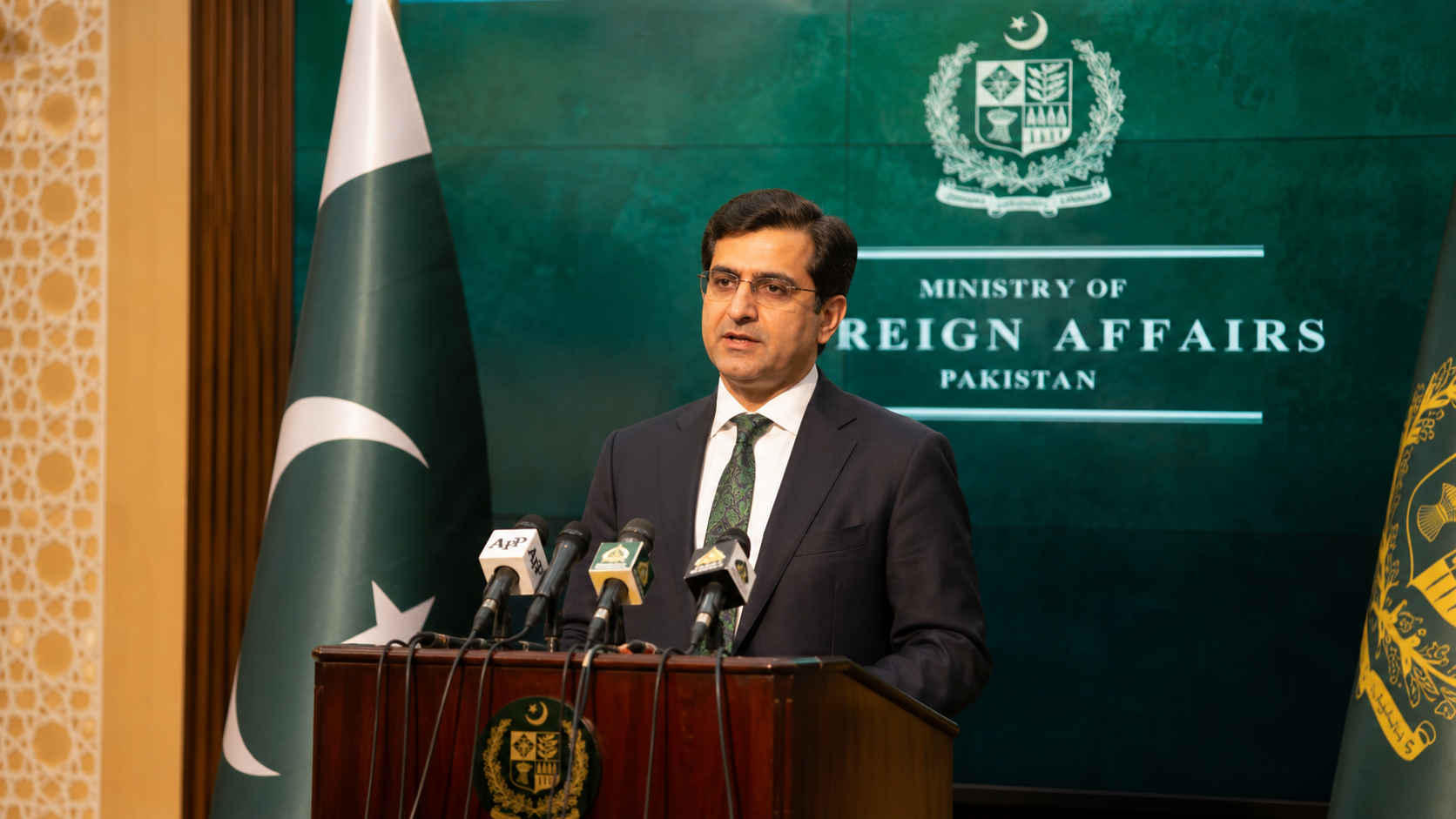
ISLAMABAD — Pakistan Abraham Accords — these three words have once again become the centre of an important diplomatic conversation, and Pakistan’s Foreign Office has responded with characteristic clarity. In a firm and unequivocal statement issued at an official press briefing, Pakistan’s Foreign Office spokesperson reiterated that Islamabad’s position on the Abraham Accords remains completely unchanged — there has been no policy shift, no internal reconsideration, and no movement toward normalising relations with Israel outside of a just, comprehensive, and internationally recognised resolution to the Palestinian issue.
Thank you for reading this post, don't forget to subscribe!The Pakistan Abraham Accords statement comes at a moment of heightened sensitivity in Pakistan’s diplomatic environment. With the Middle East in the grip of its most serious military escalation in years — the ongoing US-Iran conflict, the Israel-Lebanon war, and the intensifying international debate about Israel’s military conduct — questions about Pakistan’s diplomatic positioning have been circulating with renewed intensity both domestically and in international diplomatic circles. The Foreign Office’s reiteration of the Pakistan Abraham Accords position is a direct and deliberate response to that speculation.
What Pakistan’s Foreign Office Actually Said
The Foreign Office spokesperson, speaking at the regular weekly press briefing at the Ministry of Foreign Affairs in Islamabad, was direct and unambiguous on the Pakistan Abraham Accords question. The position, the spokesperson stated, is clear — Pakistan has consistently maintained that it will not normalise relations with Israel until the Palestinian people have achieved their legitimate rights, including the establishment of an independent, sovereign Palestinian state with East Jerusalem as its capital.
This Pakistan Abraham Accords formulation is not new — it reflects a position that has been consistent across multiple Pakistani governments of different political persuasions. What the Foreign Office was doing on this occasion was not announcing a new policy but reiterating an existing one — a reiteration that was clearly considered necessary given the volume of speculation and pressure that had been building around the question.
The fact that the Pakistan Abraham Accords position required active reaffirmation rather than simply resting on existing public record suggests that the pressure on Pakistan to reconsider had reached a level that the Foreign Office deemed warranted an official, on-the-record response.
What Are the Abraham Accords?
For readers unfamiliar with the diplomatic framework at the centre of the Pakistan Abraham Accords discussion, a brief explanation is important.
The Abraham Accords were a series of normalisation agreements brokered by the United States under the Trump administration in 2020, through which the United Arab Emirates, Bahrain, Sudan, and Morocco established formal diplomatic relations with Israel. The accords represented the most significant shift in Arab-Israeli diplomacy since the Egyptian and Jordanian peace treaties of 1979 and 1994 respectively.
The accords were hailed by their architects as a breakthrough that demonstrated that Arab-Israeli normalisation could proceed without waiting for a resolution to the Palestinian issue — a fundamental departure from the longstanding Arab League position that normalisation with Israel was contingent on Palestinian statehood. The Pakistan Abraham Accords debate is therefore rooted in this fundamental question: can and should Pakistan follow the path taken by the UAE, Bahrain, and others?
Pakistan’s answer, reiterated this week and on multiple previous occasions, is an unequivocal no. For Pakistan, the Pakistan Abraham Accords question is not merely a bilateral diplomatic calculation — it is bound up with deep questions of Islamic solidarity, the rights of the Palestinian people, and Pakistan’s identity as a state founded with an explicit commitment to the Palestinian cause.
Why the Question Keeps Being Asked
Given the clarity and consistency of Pakistan’s position, a reasonable question is why the Pakistan Abraham Accords issue keeps returning to the public and diplomatic agenda requiring active reaffirmation.
Several factors drive this recurring dynamic.
US and Gulf Pressure
The United States and several Gulf Cooperation Council (GCC) states that have themselves signed Abraham Accords or moved toward informal normalisation with Israel have, at various points, explored whether Pakistan might be persuaded to move in a similar direction. Pakistan’s size, its significant Muslim population, its strategic importance, and its influence in the Islamic world would make its normalisation with Israel diplomatically meaningful in a way that far exceeds its bilateral economic relationship with the Jewish state.
The Pakistan Abraham Accords pressure from these quarters has been a recurring feature of Pakistan’s diplomatic environment, surfacing most visibly during periods when Pakistan is seeking economic support, IMF programmes, or security cooperation from the United States — moments when Washington’s leverage over Islamabad is at its highest.
Domestic Political Speculation
Within Pakistan, the Pakistan Abraham Accords question occasionally surfaces in domestic political discourse — usually as an accusation levelled by opposition parties against the government of the day, alleging secret negotiations or private compromises on the Palestinian question. The Foreign Office’s periodic reiterations of Pakistan’s position are partly aimed at defusing this domestic political dimension of the debate.
Regional Transformation
The Abraham Accords themselves represent a genuine transformation in the regional diplomatic landscape that Pakistan cannot ignore. Several of Pakistan’s closest partners and most important economic relationships — including the UAE, Saudi Arabia (which, while not a signatory, has been moving toward informal engagement with Israel), and Bahrain — have shifted their Israel positions in ways that create new questions about where Pakistan sits in the evolving Arab-Israeli equation.
The Pakistan Abraham Accords reiteration is therefore also a signal to these Gulf partners that Pakistan’s solidarity with the Palestinian cause remains a non-negotiable feature of its foreign policy regardless of what others in the region have decided.
Pakistan’s Palestine Position: Historical and Strategic Roots
The consistency of the Pakistan Abraham Accords rejection reflects deep historical, religious, and strategic roots that go back to Pakistan’s founding.
Pakistan was one of the first countries to oppose the creation of the State of Israel in 1948, and has never recognised Israeli statehood in the nearly eight decades since. Pakistan’s founder Muhammad Ali Jinnah was an outspoken advocate for Palestinian rights, and support for the Palestinian cause has been woven into Pakistani national identity and foreign policy doctrine across every government and every political era.
Strategically, Pakistan’s Pakistan Abraham Accords position also reflects a calculation about domestic politics. Pakistan’s population of over 230 million people includes a deeply engaged civil society, an influential religious establishment, and a media environment in which the Palestinian cause generates intense emotional investment. No Pakistani government — regardless of its private calculations about geopolitical advantage — has been able to seriously contemplate Israeli recognition without facing a domestic political cost that would be prohibitive.
According to Pakistan’s Ministry of Foreign Affairs, Pakistan’s position on Palestinian statehood is explicitly aligned with UN Security Council resolutions calling for a two-state solution based on pre-1967 borders — a position that places Islamabad firmly within the mainstream of international law on the issue.
The Current Regional Context Makes the Position Even Firmer
If there was ever a moment when Pakistani public opinion on the Pakistan Abraham Accords question might have been open to nuance, the current regional environment is definitively not that moment. With Israel conducting ongoing military operations in Gaza and Lebanon that have generated widespread international condemnation, with civilian casualties mounting, and with the conflict dominating global news coverage including in Pakistan, the political space for any softening of the Pakistan Abraham Accords position is essentially zero.
The Foreign Office’s reiteration this week therefore reflects not just bureaucratic consistency but a genuine reading of the political moment. Islamabad understands that the Pakistan Abraham Accords question is one on which Pakistan’s credibility in the Muslim world and among developing nations is being actively assessed — and that any ambiguity would carry significant diplomatic and domestic costs.
Al Jazeera, which has been providing extensive coverage of the Palestinian issue and regional diplomatic developments, has noted that Pakistan has been among the most vocal Muslim-majority states in international forums calling for accountability for Israeli military conduct — a posture that is directly consistent with the Pakistan Abraham Accords rejection.
What This Means Going Forward
The Foreign Office’s firm reiteration of the Pakistan Abraham Accords position sends clear signals in multiple directions simultaneously.
To Washington and any other parties that may have been probing Pakistan’s flexibility on the issue, it says: the answer is no, and the answer will remain no until Palestinian rights are addressed. To Pakistan’s Gulf partners navigating their own complex relationships with Israel, it signals that Pakistan’s solidarity with the Palestinian cause is genuine and durable — not merely rhetorical. To Pakistan’s domestic audience, it provides reassurance that the government has not made secret compromises on a question that carries deep emotional significance for the Pakistani public.
The Pakistan Abraham Accords position, as the Foreign Office has made clear, is not a negotiating posture or a temporary stance awaiting the right conditions to shift. It is, as the spokesperson said, clear — and it will remain clear until the conditions that Pakistan has consistently identified as prerequisites for any change are actually met.
Read Also: OICCI Survey: Pakistan Business Confidence Plunges Sharply Amid Dangerous Regional War Tensions
Read Also: US Iran Strikes Escalate Dangerously as Ceasefire Negotiations Remain Completely Stalled
Read Also: Gilgit-Baltistan Elections 2026: Political Heavyweights Battle Hard for Crucial Mountain Votes
Conclusion
Pakistan’s Foreign Office reiteration of the Pakistan Abraham Accords position is a statement that is simultaneously simple and profound. Simple because the policy itself is straightforward — no normalisation with Israel without Palestinian statehood. Profound because maintaining that position in the face of sustained diplomatic pressure, regional transformation, and economic leverage from powerful partners requires genuine political will and strategic consistency.
The Pakistan Abraham Accords stance reflects something important about Pakistan’s foreign policy identity — its insistence on being a principled actor on questions of international law and the rights of occupied peoples, even when the pressure to compromise is real and the short-term costs of principled consistency are tangible.
Pakkhabar.com will continue to monitor Pakistan’s diplomatic positioning on the Palestinian issue and the Abraham Accords as the regional situation evolves