

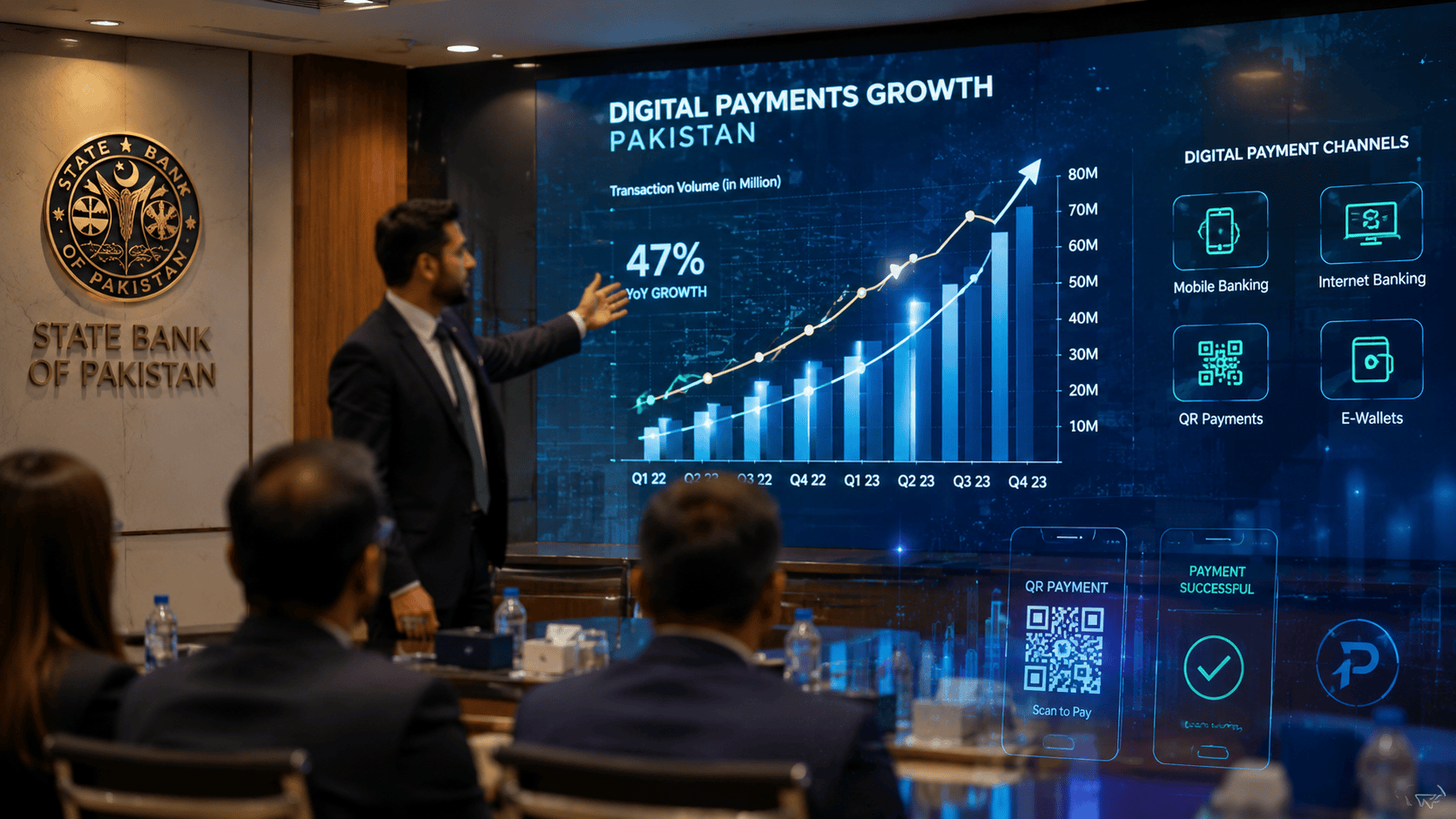
Pakistan cashless economy transformation has taken a significant leap forward after Prime Minister Shehbaz Sharif directed authorities to ensure that all overseas remittances are processed entirely through digital channels. The directive, issued during a high-level review meeting in Islamabad on Tuesday, marks one of the most ambitious steps yet in the government’s broader campaign to modernize the country’s financial infrastructure and reduce reliance on cash.
Thank you for reading this post, don't forget to subscribe!PM Shehbaz Chairs Key Meeting on Digital Payments
Chairing a session dedicated to promoting Pakistan cashless economy and digital payments, the prime minister instructed relevant departments to strengthen public awareness campaigns encouraging merchants to adopt QR code-based payment systems. According to a statement issued by the Prime Minister’s Office, Shehbaz Sharif described the shift toward a cashless economy as directly linked to sustainable economic growth and improved financial transparency across Pakistan.
The meeting was attended by key economic decision-makers, including Finance Minister Muhammad Aurangzeb, Economic Affairs Minister Ahad Khan Cheema, IT Minister Shaza Fatima Khawaja, and State Bank of Pakistan Governor Jameel Ahmad, alongside NADRA Chairman Lt Gen Muhammad Munir Afsar. Their presence underscores how central the cashless economy agenda has become to Pakistan’s broader economic policy direction.
Remittances: A Pillar of the Cashless Economy Strategy
Officials briefed the meeting that 92 percent of remittances sent by overseas Pakistanis during the last fiscal year were already received through digital channels — a figure the prime minister now wants pushed to 100 percent. This is a critical target given that workers’ remittances reached a record $41.6 billion in fiscal year 2025-26, making them one of the most important stabilizing forces for Pakistan’s external account.
Full digitisation of remittance flows is expected to reduce reliance on informal transfer channels, improve traceability of foreign exchange inflows, and strengthen the broader cashless economy framework the government has been building since last year. The push also complements the expansion of the Roshan Digital Account initiative, which has broadened access for overseas Pakistanis and foreign investors to participate directly in the country’s digital financial ecosystem.
Mobile Banking and QR Payments Surge
The cashless economy drive has already produced measurable results. Mobile banking application users jumped from 95 million to 137 million within a single year — a rise the prime minister called a “significant achievement.” Meanwhile, the number of merchants accepting QR code-based digital payments grew by 300 percent, climbing to just over two million between June 2025 and June 2026.
Between July 2025 and June 2026 alone, Pakistan recorded a staggering 11.9 billion digital transactions, reflecting rapid adoption of electronic payment systems by both consumers and businesses. Cash-based transactions, by contrast, have fallen sharply from 71 percent to just 1 percent in certain government payment categories — a dramatic shift that officials say illustrates how quickly the cashless economy vision is taking hold.
Government Welfare Payments Go Fully Digital
One of the more socially significant outcomes of the cashless economy initiative involves the Benazir Income Support Programme (BISP), Pakistan’s flagship social safety net. All payments to the programme’s 10 million beneficiaries are now processed exclusively through digital wallets. The prime minister praised this transition, describing it as more transparent, faster, and more convenient for recipients who previously had to rely on physical disbursement points.
Similarly, 99 percent of payments made by the National Database and Registration Authority (NADRA) have now been digitised, further reinforcing the government’s broader cashless economy ambitions across public service delivery.
Banking Sector Support and the Raast System
To sustain this momentum, the Pakistan Banks’ Association has assigned specific digital payment targets to its member banks, including greater use of the Raast instant payment system — the State Bank of Pakistan’s real-time payment infrastructure designed to enable instant, low-cost transfers between individuals, businesses, and government entities. Analysts view Raast as a foundational pillar for Pakistan’s long-term cashless economy roadmap, given its ability to reduce transaction costs and settlement times compared to traditional banking channels.
Independent Review Underway
Notably, an independent third-party validation of the government’s cashless economy initiative is currently in progress. According to the Prime Minister’s Office, the final report, along with policy recommendations, is expected to be presented in November 2026. This external assessment is likely to offer a more detailed picture of how effectively digital adoption is translating into tangible economic benefits, including reduced corruption risk, improved tax documentation, and stronger financial inclusion for underserved populations.
Why This Matters: Broader Economic Impact
Pakistan’s push toward a cashless economy carries implications well beyond convenience. Greater digitisation of remittances and payments can help formalize a larger share of economic activity, potentially improving tax collection and providing policymakers with better real-time data on financial flows. For a country that has long grappled with a large informal economy, this shift represents a meaningful structural change.
For overseas Pakistani workers, full digitisation of remittance channels could also mean faster, more secure, and more cost-effective ways to send money home, reducing dependence on informal hawala-style networks that operate outside regulatory oversight. This aligns with global trends, as many developing economies pursue similar digital-first financial inclusion strategies, according to institutions such as the World Bank and International Monetary Fund, which have both highlighted digital remittance corridors as a tool for economic resilience.
Read Also: Petrol Price Hike Pushes Pakistan’s Fuel Costs to New Highs
Conclusion
Pakistan’s cashless economy transformation is accelerating at a notable pace, driven by strong growth in mobile banking, QR-based merchant payments, and now a firm government mandate for fully digital remittances. With welfare payments, national identity services, and financial transfers increasingly moving online, the country appears to be laying the groundwork for a more transparent and technology-driven financial system. Whether this translates into lasting structural gains will become clearer once the independent review of the initiative is published later this year — but for now, the momentum behind Pakistan’s digital finance ambitions shows little sign of slowing.
Prime Minister’s Office Pakistan: https://pmo.gov.pk
State Bank of Pakistan (Raast): https://www.sbp.org.pk/raast/index.html
Get updates like this on WhatsApp before anywhere else — join our Channel [https://whatsapp.com/channel/0029Vb8fffCKrWQzEVBQ6v00]