
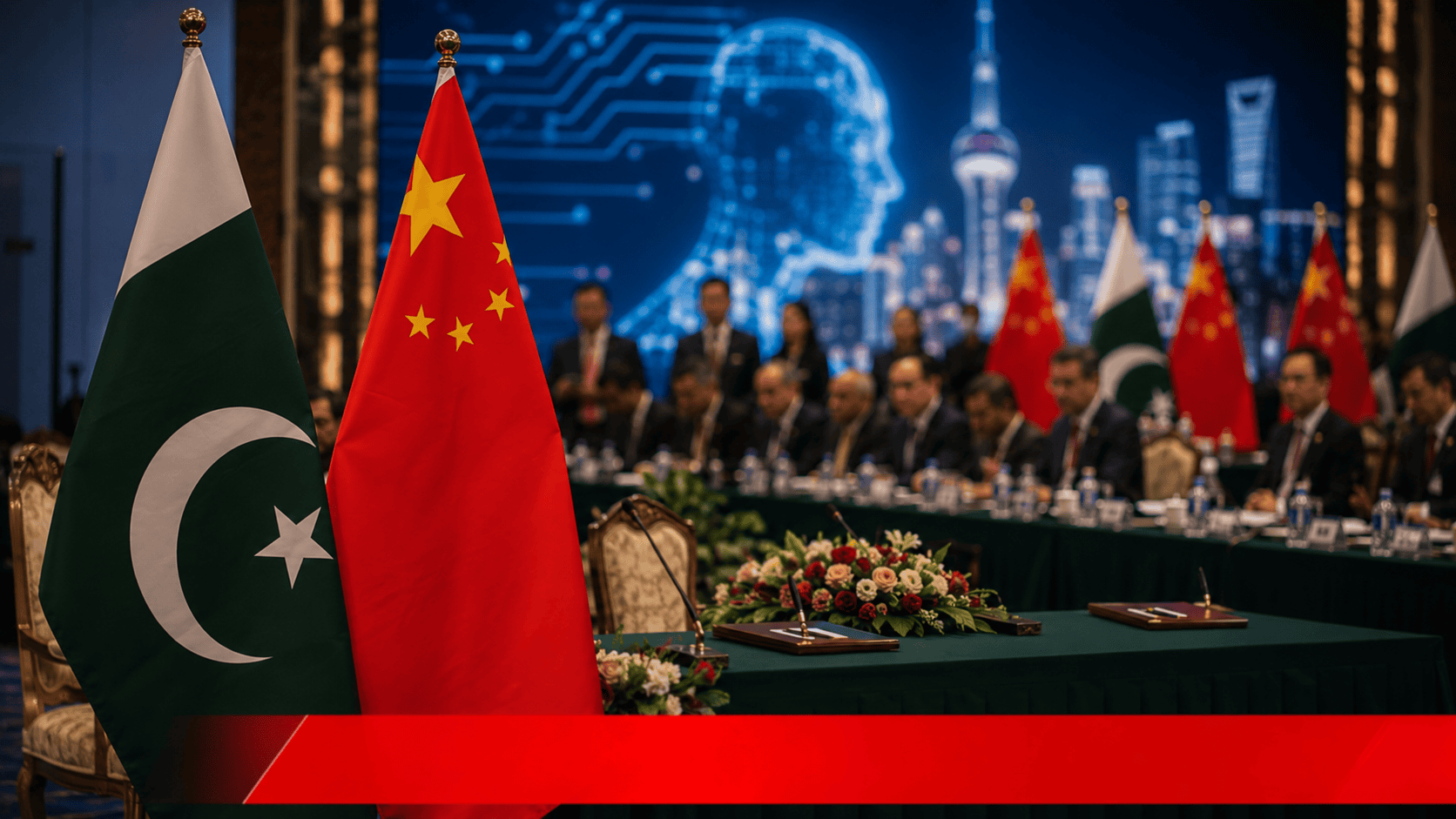
Islamabad/Shanghai: Pakistan has taken a significant step into the global artificial intelligence arena, with Deputy Prime Minister and Foreign Minister Ishaq Dar traveling to Shanghai to formally sign the country’s founding membership of a new Pakistan China-led AI body. The visit, which runs from July 16 to 17, places Islamabad among the first nations to join the World Artificial Intelligence Cooperation Organization (WAICO), an initiative championed by Beijing to reshape how the world governs artificial intelligence.
Thank you for reading this post, don't forget to subscribe!According to Pakistan’s Foreign Office, Dar is traveling with an official delegation at the invitation of Chinese Foreign Minister Wang Yi. He will attend the signing ceremony and put pen to paper on behalf of Pakistan, cementing the country’s status as a founding member of this Pakistan China-led AI body.
Why Pakistan Is Joining This China-Led AI Body
The push toward this Pakistan China-led AI body did not happen overnight. The groundwork was laid last year when Chinese Premier Li Qiang, opening the World Artificial Intelligence Conference (WAIC) in Shanghai, called for stronger international governance and open-source AI development, announcing plans for what would eventually become WAICO.
Pakistan’s involvement deepened earlier this year. During Prime Minister Shehbaz Sharif’s four-day visit to China in May, Islamabad publicly backed China’s plan to establish this new organization, describing it as a concrete step toward developing artificial intelligence “for good and for all.” Pakistan also pledged to work alongside Beijing to advance global AI governance and international cooperation — a commitment that is now being formalized through this Pakistan China-led AI body membership.
What Happens During the Shanghai Visit
Beyond the signing ceremony, Dar’s itinerary is packed with high-level engagements. On July 17, he is scheduled to participate in the opening ceremony of the 2026 World Artificial Intelligence Conference, one of China’s flagship technology gatherings, followed by a high-level meeting on global AI governance.
On the sidelines of the conference, Dar will also hold a bilateral meeting with Wang Yi, along with additional meetings with foreign counterparts to discuss matters of mutual interest. According to the Foreign Office, Dar plans to use these engagements to present Pakistan’s perspective on international AI cooperation, with particular emphasis on the priorities and development needs of the Global South.
“He will underscore the importance of bridging the global AI divide, promoting equitable access to AI technologies, enhancing capacity-building, and ensuring that the benefits of AI contribute to sustainable development and shared prosperity for all,” the Foreign Office noted in its statement.
The Bigger Picture: A Global AI Governance Race and Pakistan China-led AI body
Pakistan’s decision to join this Pakistan China-led AI body comes at a moment when artificial intelligence governance has become a major front in global geopolitics. The World AI Conference in Shanghai has grown into one of the most closely watched tech events globally, drawing government officials, researchers, and industry leaders from dozens of countries.
This year’s conference carries extra weight. It coincides with a High-Level Meeting on Global AI Governance in Shanghai, where further progress on WAICO’s implementation is expected to be announced. Reports indicate that attendees at this year’s WAIC include UN Secretary-General António Guterres, Kazakh President Kassym-Jomart Tokayev, and Thai Prime Minister Anutin Charnvirakul, alongside several Nobel and Turing Award laureates. Notably, there has been limited representation from major US technology firms, reflecting the deepening divide between Washington and Beijing over how AI should be developed and regulated worldwide.
China has used the platform to promote its own AI models and infrastructure as alternatives to Western technology, with domestic chipmakers reportedly showcasing advanced computing systems built without relying on the most powerful US-made processors. Analysts see this as part of a broader effort by Beijing to build a self-sufficient AI ecosystem while positioning itself as a leader on global governance standards.
What This Means for Pakistan China-led AI body
For Pakistan, founding membership in this Pakistan China-led AI body offers several potential benefits. It provides a formal seat at the table in shaping international AI governance standards — an area where developing nations have historically had limited influence. It also strengthens Pakistan’s technological partnership with China at a time when the country is looking to expand its digital economy and attract greater investment in emerging technologies.
Government officials have repeatedly framed digital transformation as a national priority in recent years, and this move signals an intent to formalize that ambition through concrete international partnerships rather than policy statements alone.
At the same time, some observers caution that aligning closely with a Chinese-led framework could complicate Pakistan’s relationships with Western partners, particularly as AI governance increasingly becomes entangled with broader US-China strategic competition. How Islamabad balances these relationships going forward will likely shape its standing in future international tech diplomacy.
Analysis: A Strategic Bet on AI Diplomacy & Pakistan China-led AI body
Joining this Pakistan China-led AI body as a founding member, rather than as a later signatory, gives Pakistan an early voice in how the organization’s rules, priorities, and structures are shaped. For a country often positioned as a recipient of international frameworks rather than a co-architect of them, this is a notable shift.
The emphasis on Global South priorities in Dar’s planned remarks also suggests Pakistan intends to position itself as a bridge between developing nations and major AI powers, advocating for equitable access to AI tools and capacity-building support rather than simply endorsing Beijing’s technological vision wholesale.
Whether this translates into tangible economic or technological benefits for Pakistan will depend heavily on how WAICO evolves in its early years and how actively Islamabad participates beyond the signing ceremony.
Read Also: Historic Shift: Pakistan Bangladesh Commonalities 2026 Stressed
Conclusion
Pakistan’s founding membership in this new Pakistan China-led AI body marks a meaningful step in the country’s technology diplomacy, aligning Islamabad more closely with Beijing’s vision for global AI governance while opening a formal channel to advocate for developing nations in an increasingly consequential policy arena. As the World AI Conference unfolds in Shanghai this week, the coming days will offer the first real signals of how this partnership takes shape.
Ministry of Foreign Affairs of Pakistan: https://mofa.gov.pk
Ministry of Foreign Affairs of China – Shanghai Declaration on Global AI Governance: https://www.mfa.gov.cn/eng/xw/zyxw/202407/t20240704_11448351.html
Get updates like this on WhatsApp before anywhere else — join our Channel [https://whatsapp.com/channel/0029Vb8fffCKrWQzEVBQ6v00]