

WASHINGTON / TEHRAN — US Iran strikes have entered a dangerous new chapter. Both the United States and Iran launched fresh waves of military attacks against each other even as fragile ceasefire negotiations between the two powers remain completely stalled — a simultaneous military and diplomatic crisis that has pushed the Middle East to the most dangerous precipice it has faced in years and sent urgent alarm signals to governments, markets, and security agencies around the world.
Thank you for reading this post, don't forget to subscribe!The latest US Iran strikes exchange, reported by BBC and confirmed through multiple international news sources, reflects a grim paradox at the heart of the current conflict: both sides are fighting and talking simultaneously — or rather, fighting precisely because the talking has broken down. With ceasefire negotiations stalled and no active diplomatic off-ramp in place, the military logic of escalation appears to have taken over, with each round of US Iran strikes making the next round more rather than less likely.
What Happened: The Latest Round of US Iran Strikes
The latest exchange of US Iran strikes unfolded against the backdrop of weeks of mounting tension following Iran’s decision to break off ceasefire talks, a development that Pakkhabar.com has been tracking closely. With direct diplomatic channels now closed and indirect communication through Omani and European intermediaries having apparently failed to prevent escalation, both sides moved to military action.
US forces conducted precision strikes against what Pentagon officials described as Iranian military assets and infrastructure linked to Iran’s regional proxy network. The strikes, conducted using naval and air assets, appear to have targeted facilities assessed by US military planners as posing direct threats to American personnel and allied interests in the region.
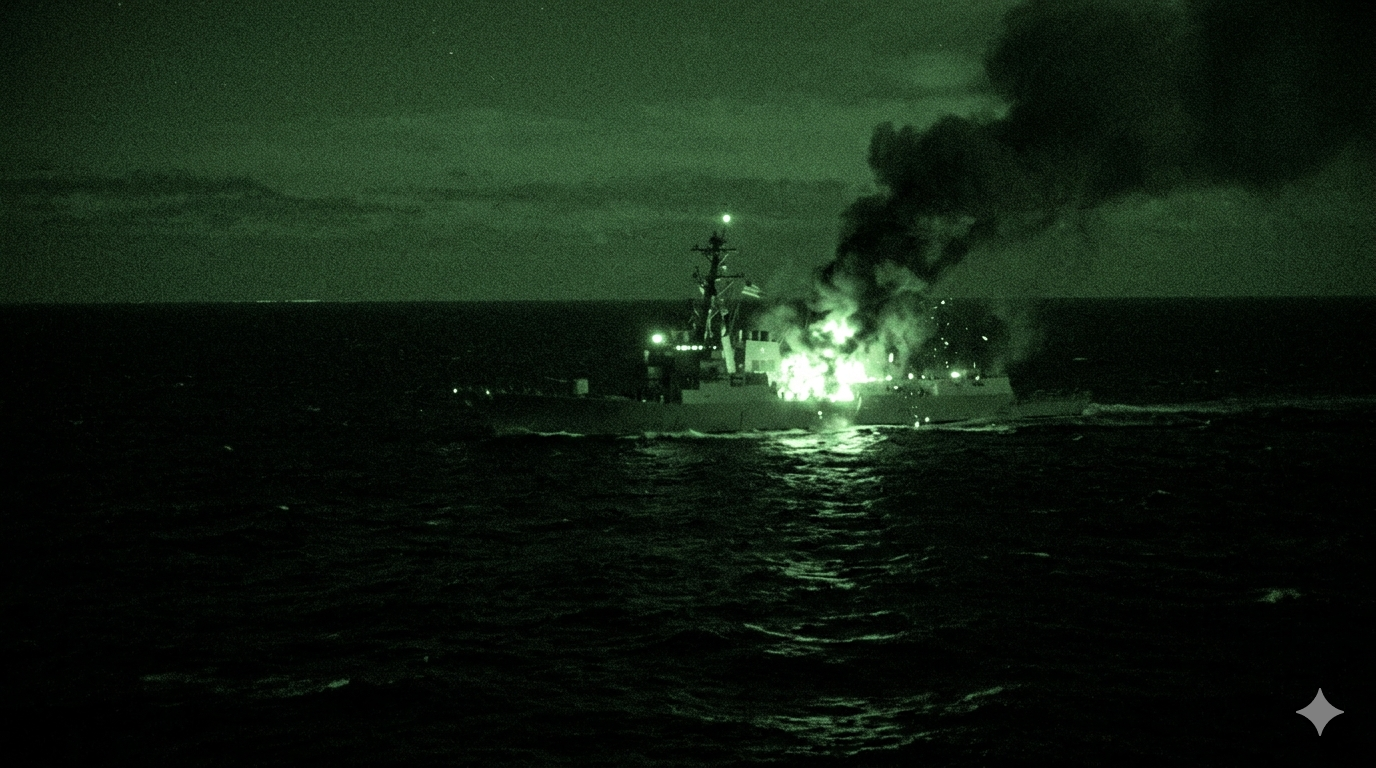
Iran responded with its own wave of US Iran strikes — retaliatory attacks directed at US military positions and allied assets in the region, including what Iranian state media described as strikes on American naval presence in the Persian Gulf. The night-vision surveillance footage that has emerged — showing what appears to be a vessel under attack in dark waters, stamped with the word “UNCLASSIFIED” — offers a stark visual representation of the military intensity of the current US Iran strikes exchange.
How the Ceasefire Negotiations Collapsed
To understand the current US Iran strikes escalation, it is essential to trace how the ceasefire negotiations reached their current state of complete paralysis.
For several weeks prior to the latest escalation, indirect talks between US and Iranian officials — conducted through Omani diplomatic channels and European intermediaries — had been making cautious progress. Both sides had exchanged preliminary frameworks, and cautious optimism had begun to build among diplomats watching the process.
That progress unravelled with devastating speed. Iran announced it was breaking off ceasefire talks, citing continued Israeli military operations in Lebanon as politically incompatible with any negotiated settlement. The US, unwilling or unable to restrain Israeli military conduct in Lebanon, failed to provide the assurances Tehran demanded. The talks stalled, then collapsed entirely.
With the ceasefire negotiations dead in the water and domestic political pressures on both sides pushing toward hardline positions, the US Iran strikes exchange became, in the cold logic of military escalation, the predictable next step. Each side calculated that allowing the other to strike without response would be read as weakness — and so the cycle of US Iran strikes continues.
The Strategic Logic — and Its Dangers
Military strategists watching the US Iran strikes exchange have noted a particularly dangerous dynamic at work. Both Washington and Tehran appear to be operating under the assumption that calibrated, limited strikes will eventually force the other side to negotiate from a position of greater disadvantage. This theory of coercive escalation — the idea that you can bomb your way to a better bargaining position — has a troubled historical track record.
The risk is that the US Iran strikes cycle takes on a momentum of its own. Each strike generates domestic political pressure on the targeted government to respond more forcefully. Each response pushes the other side’s domestic political environment further toward hardline positions. At some point — and that point is difficult to predict in advance — a strike crosses a threshold that triggers a response that crosses another threshold, and the limited conflict becomes an unlimited one.
The International Crisis Group, which monitors conflict escalation globally, has warned repeatedly that the US Iran strikes dynamic contains precisely this kind of escalatory potential — a ratchet mechanism that is much easier to tighten than to loosen.
For the Persian Gulf specifically, the consequences of unchecked US Iran strikes escalation could be catastrophic. The Gulf carries approximately one fifth of the world’s oil supply through the Strait of Hormuz. Any serious disruption to that shipping lane — whether through Iranian mining, US naval blockade, or direct attacks on tankers — would send shockwaves through global energy markets and economies from Tokyo to Berlin to Karachi.
International Reaction: Alarm from All Directions
The international community’s reaction to the latest US Iran strikes exchange has been one of near-universal alarm. Key governments and international organisations have issued urgent calls for restraint, de-escalation, and an immediate return to diplomatic engagement.
The United Nations Secretary-General has called on both Washington and Tehran to exercise maximum restraint and to step back from military confrontation, warning that the US Iran strikes exchange risks triggering consequences that no party can fully predict or control. The UN Security Council is expected to hold emergency consultations as member states grapple with the implications of the escalating military exchange.
European governments — which had been instrumental in facilitating the now-stalled ceasefire negotiations — have expressed deep concern about the US Iran strikes escalation. France, Germany, and the United Kingdom have issued a joint statement calling for an immediate halt to military operations and urging both sides to return to the negotiating table. European officials are reportedly working urgently behind the scenes to establish back-channel communications that might create space for a de-escalation agreement.
China and Russia, both of which have significant relationships with Iran and complex relationships with the United States, have also weighed in. Both governments called for restraint in public statements while using private diplomatic channels to communicate their assessments to the parties directly involved in the US Iran strikes exchange.
For Pakistan — which shares a border with Iran, has deep cultural and economic ties with Tehran, and is itself navigating a complex relationship with Washington — the US Iran strikes escalation is a source of acute concern. Pakistani officials have been quietly active in diplomatic corridors, urging de-escalation and offering Islamabad’s services as a potential mediating channel. Any further escalation of the US Iran strikes conflict would have direct security and economic implications for Pakistan, including potential disruption to the Iran-Pakistan gas pipeline project and increased instability along the western border.
The Nuclear Dimension
Running beneath the surface of every discussion about US Iran strikes is the nuclear question — and it is the dimension that makes this conflict categorically more dangerous than most.
Iran’s nuclear programme, which the International Atomic Energy Agency (IAEA) has confirmed includes uranium enrichment at levels that go significantly beyond civilian energy requirements, represents the deepest structural driver of the US-Iran conflict. Washington’s fundamental strategic objective is to prevent Iran from acquiring nuclear weapons capability. Tehran’s fundamental strategic interest is to maintain its nuclear programme as a deterrent and a negotiating asset.
The US Iran strikes exchange is, at one level, a manifestation of the failure to resolve this underlying tension through the diplomatic process. The collapse of the original JCPOA in 2018, the failure to revive it under the Biden administration, and now the stalling of the latest ceasefire negotiations have left the nuclear issue unaddressed — and the US Iran strikes are the consequence.
According to Arms Control Association, Iran’s current enrichment levels are sufficient to produce weapons-grade material within a matter of weeks if the political decision to do so were made. This timeline has shortened dramatically since the original JCPOA period and represents the most urgent dimension of the US Iran strikes crisis.
What Comes Next
The immediate trajectory of the US Iran strikes conflict will be determined by decisions made in the next 48 to 72 hours in Washington and Tehran. Several scenarios present themselves.
In the most optimistic scenario, back-channel communications succeed in establishing a mutual understanding to pause military operations, creating space for the resumption of ceasefire negotiations under new terms. This would require both sides to accept a face-saving formula — something that is diplomatically possible but politically difficult given the domestic pressures each government faces.
In a more pessimistic scenario, the US Iran strikes cycle continues at its current intensity, with neither side willing to be seen as backing down but neither prepared to escalate to a full-scale conflict. This would produce an extended period of low-to-medium intensity military confrontation with enormous costs for regional stability, global energy markets, and the populations of every country in the wider region.
In the worst scenario, a miscalculation — an accidental strike with high casualties, an attack on a particularly sensitive target, a decision by a proxy force to act beyond its instructions — triggers an escalation to full-scale war. The US Iran strikes would then transform into a conflict with consequences that no modelling exercise has yet fully captured.
Read Also: Gilgit-Baltistan Elections 2026: Political Heavyweights Battle Hard for Crucial Mountain Votes
Read Also: Nvidia RTX Spark AI Chip Unveiled — A Powerful Game Changer for Personal Computing
Read Also: Infinix Note 30 Review: Surprisingly Powerful and an Unbeatable Budget Pick in 2026
Conclusion
The US Iran strikes escalation of June 2026 represents one of the most serious and dangerous moments in the long and turbulent history of US-Iran relations. With military action ongoing and ceasefire negotiations completely stalled, the region is navigating without the diplomatic safety nets that have, in previous crises, prevented conflict from spiralling out of control.
The decisions made in Washington and Tehran in the coming hours and days will determine whether the US Iran strikes remain a contained, if dangerous, military exchange — or become the opening chapter of a conflict that reshapes the Middle East and the global order for decades to come.
Pakkhabar.com will provide continuous live updates on the US Iran strikes, ceasefire negotiations, and regional developments as the crisis evolves.