

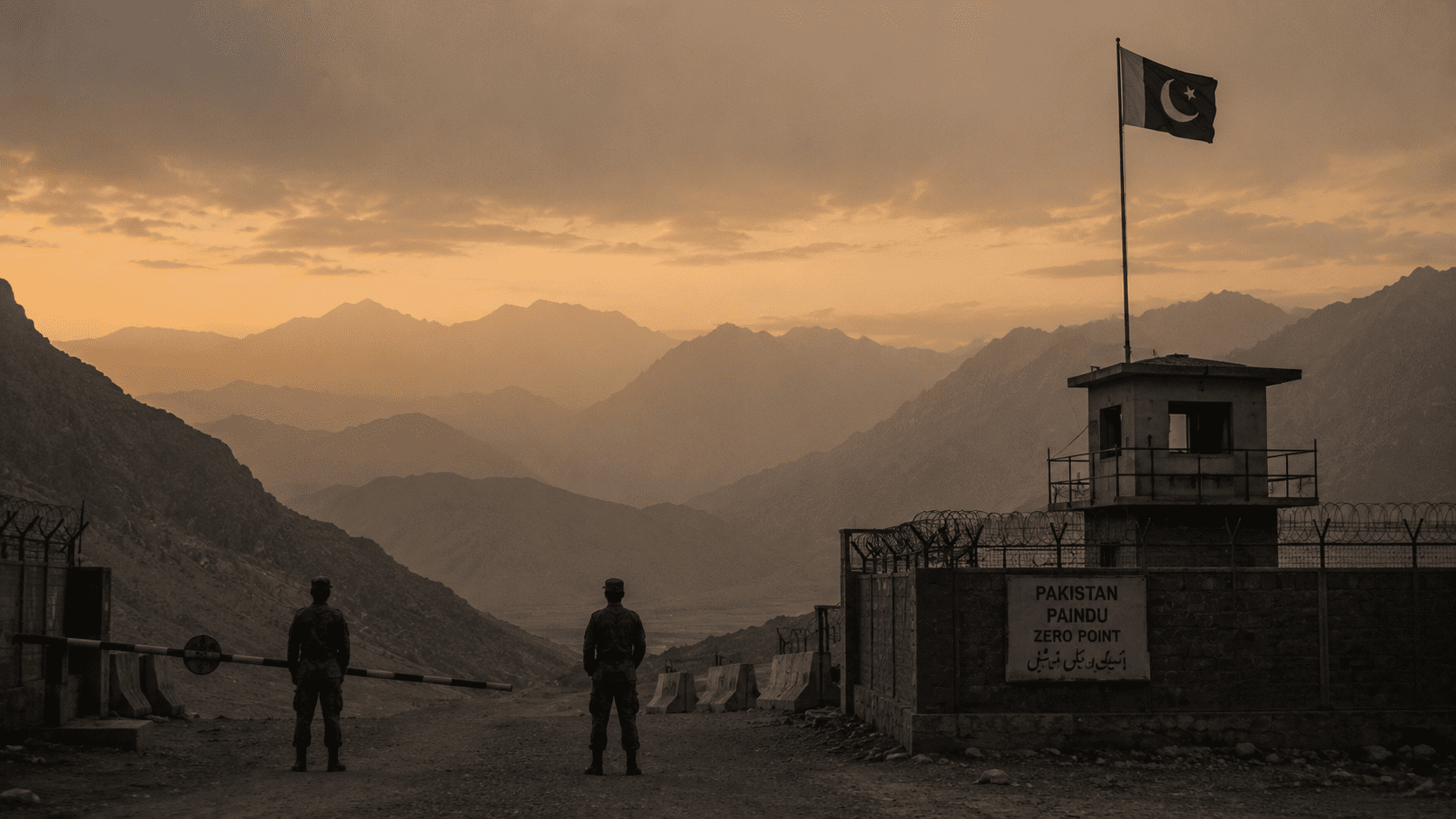
Afghanistan Pakistan tension has flared once again after Kabul’s defence ministry announced that its air force had carried out strikes on what it described as militant hideouts and “hostile intelligence circles” operating inside Pakistani territory. Pakistani officials swiftly rejected the claim as false, marking the latest episode in a months-long cycle of cross-border hostility between the two neighbouring countries.
Thank you for reading this post, don't forget to subscribe!On Afghanistan Pakistan tension the development, reported by Afghanistan’s defence ministry on Friday and said to have occurred the previous night, has once again threatened a fragile ceasefire that has repeatedly broken down since fighting first escalated earlier this year. With mediation efforts led by China yet to produce a lasting settlement, the latest incident underscores how unresolved the underlying dispute between Islamabad and Kabul remains.
What Afghanistan Says Happened
According to Afghanistan’s defence ministry, the overnight strikes targeted bases allegedly used by Islamic State Khorasan Province (ISIS-K) in cooperation with what Kabul described as “hostile intelligence circles” — a phrase widely understood to refer to Pakistani intelligence agencies. The ministry said the targeted sites were located in Pakistan’s Balochistan and Khyber Pakhtunkhwa provinces, both of which border Afghanistan, and that one of the locations struck was allegedly frequented by senior ISIS-K figures.
Afghan officials said preliminary information indicated that “important targets” had been hit during the operation, though independent verification of the claim has not been possible. ISIS-K has claimed responsibility for a series of attacks inside Afghanistan in recent years that have killed civilians, giving Kabul’s stated rationale for the strikes a degree of domestic political resonance.
Pakistan’s Response on Afghanistan Pakistan tension
Pakistani authorities rejected Kabul’s version of events outright, describing the claim as “false propaganda” intended to deflect attention from internal security challenges. Local media reports in Pakistan indicated that several rudimentary drones had been intercepted along the border, though no confirmed casualties or significant damage on Pakistani territory were reported in connection with the incident.
The sharp denial reflects the broader pattern of mutual distrust that has defined Afghanistan Pakistan tension throughout 2026, with each side routinely disputing the other’s account of cross-border incidents.
Background: Months of Escalating Conflict
To understand the significance of this latest flashpoint, it is necessary to look at how Afghanistan Pakistan tension has evolved since the Taliban returned to power. Islamabad has long accused the Afghan Taliban government of harbouring fighters from the Tehreek-e-Taliban Pakistan (TTP), a group responsible for a series of deadly attacks inside Pakistan. Kabul, for its part, has consistently characterised the TTP issue as Pakistan’s internal problem rather than one for which Afghanistan bears responsibility.
Hostilities first intensified in October 2025 following a Pakistani air strike in Kabul targeting a TTP leader, which prompted a retaliatory response from Afghan forces. Tensions escalated sharply again in late February 2026, when Afghan forces launched a cross-border offensive that Pakistan’s Defence Minister, Khawaja Asif, described at the time as putting the two countries in a state of “open war.” Pakistan responded with coordinated air and ground strikes on military installations in Kabul, Kandahar, and other areas.
A ceasefire reached in March 2026 brought a temporary lull, but it collapsed within weeks after both sides accused each other of violations. Since then, sporadic strikes and ground skirmishes have continued along the roughly 2,600-kilometre Durand Line, the contested boundary separating the two countries.
Mounting Civilian Toll
The human cost of the Afghanistan Pakistan tension has been significant. The United Nations reported in May that cross-border fighting had killed at least 372 Afghan civilians and injured 397 others in just the first three months of 2026. Earlier this month, Afghan officials said Pakistani strikes in the eastern provinces of Kunar, Khost, and Paktika killed 13 people, including children, and wounded 14 women and children — a figure Pakistan has disputed, maintaining that its operations were directed at militant targets rather than civilian areas.
Afghan officials have repeatedly reported civilian casualties from Pakistani operations, while Islamabad maintains that its strikes are precision actions against TTP hideouts. The conflicting narratives have made independent verification of casualty figures difficult, a recurring challenge in reporting on this conflict.
Failed Mediation Efforts on Afghanistan Pakistan tension
China has led efforts to mediate between the two governments and secure a durable settlement, but those efforts have so far yielded no breakthrough. The repeated collapse of ceasefire arrangements — first in March and now strained again by the latest strikes — illustrates the structural difficulty of resolving a dispute rooted in decades-old border disagreements and more recent security grievances tied to militant groups operating in the border region.
Possible Impact and Analysis of Afghanistan Pakistan tension
The renewed flashpoint carries several implications for the region:
- Regional stability: Continued cross-border strikes risk further destabilising an already volatile border region, with potential spillover effects for trade, refugee movements, and regional security cooperation.
- Counterterrorism dynamics: Afghanistan’s emphasis on ISIS-K as a target reflects its own security priorities, even as Pakistan continues to focus on the TTP threat — a divergence in priorities that complicates any unified counterterrorism approach between the two governments.
- Diplomatic pressure: Renewed hostilities are likely to intensify calls from regional and international stakeholders, including China, for both sides to return to substantive ceasefire negotiations.
- Humanitarian concerns: With civilian casualties already reported on both sides of the border in recent months, aid organisations and human rights monitors are likely to continue tracking the humanitarian impact of ongoing hostilities closely.
What Happens Next Afghanistan Pakistan tension
Neither Kabul nor Islamabad has signalled an immediate path toward de-escalation following the latest exchange. With China-led mediation efforts stalled and previous ceasefires having collapsed within weeks of being agreed, observers caution that the underlying drivers of Afghanistan Pakistan tension — disputes over militant safe havens and accusations of cross-border harbouring — remain unresolved. Further incidents along the border in the coming weeks cannot be ruled out unless both governments commit to a more durable framework for dialogue.
Conclusion
The latest claimed strikes mark another setback for efforts to stabilise relations between Afghanistan and Pakistan, two neighbours whose shared border has become a recurring flashpoint since the Taliban’s return to power. With both governments offering starkly different accounts of the same events, and mediation efforts yet to deliver lasting results, the Afghanistan Pakistan tension shows no clear sign of easing in the near term. For communities living along the Durand Line, the human cost of this unresolved dispute continues to mount with each new round of hostilities.
Read Also: Pakistan UNSC Speech Exposes India’s Afghanistan Agenda and Vows Strong Action Against TTP