

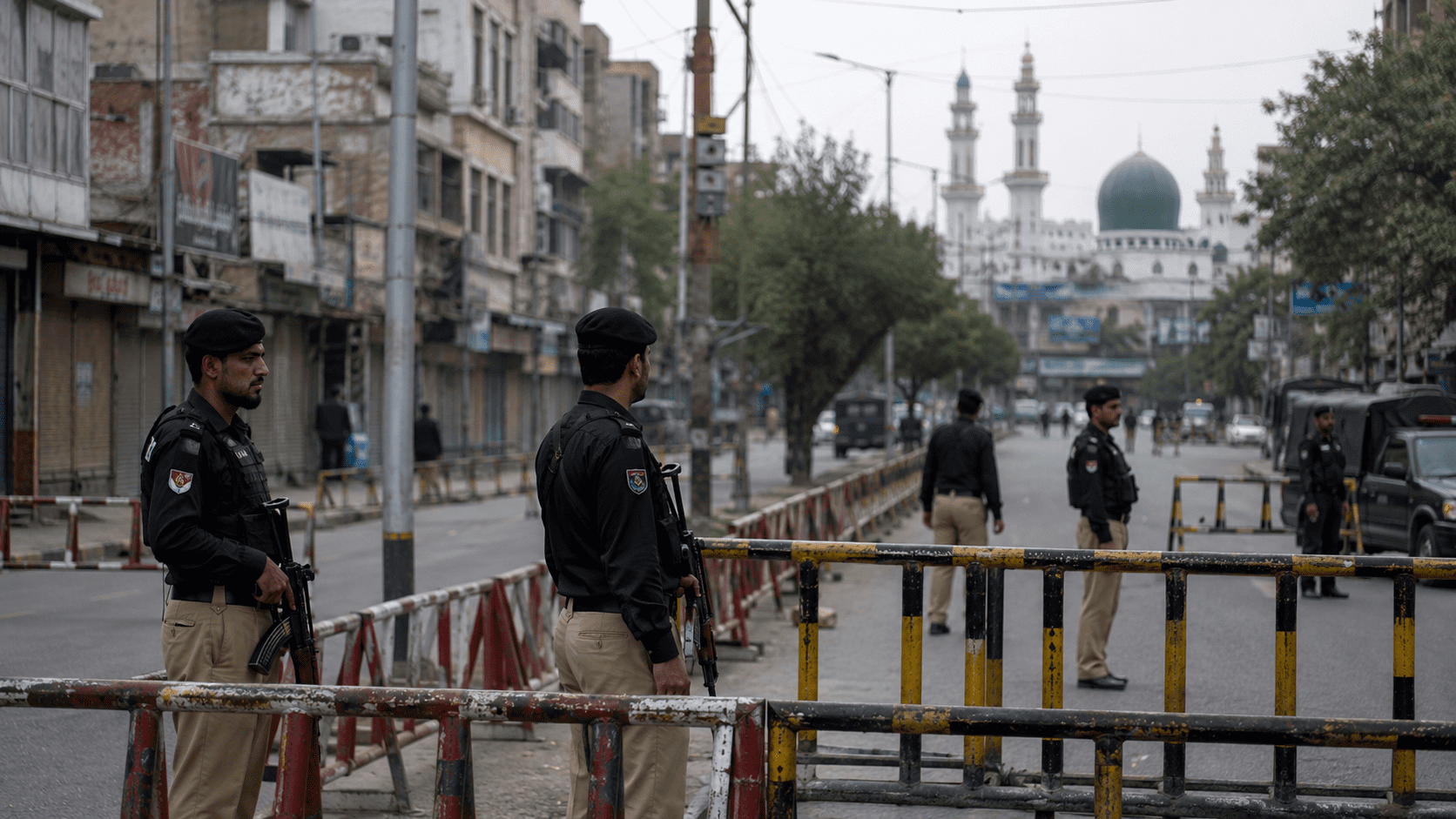
Authorities Step Up Measures as Ashura Approaches
Federal and provincial authorities across Pakistan have finalised detailed Muharram security arrangements ahead of the central processions marking the 9th and 10th of Muharram, widely observed as Ashura. With millions of citizens expected to take part in mourning processions and gatherings nationwide, law enforcement agencies in major cities have deployed thousands of personnel, alongside surveillance technology, to maintain public order during what is considered one of the most sensitive periods on Pakistan’s religious calendar.
Thank you for reading this post, don't forget to subscribe!According to provincial and federal holiday notifications, the 9th and 10th of Muharram fall on Thursday, June 25, and Friday, June 26, 2026, following confirmation by the Central Ruet-e-Hilal Committee. As reported by Dawn, the federal government and the Sindh government have both declared the two days as public holidays, with offices, autonomous bodies, and local councils remaining closed except for essential services.
Karachi Deploys Over 7,500 Personnel
In Karachi, authorities have finalised what officials describe as a comprehensive security plan covering the central processions on the 8th, 9th, and 10th of Muharram. More than 7,500 police and security personnel are being deployed across the city to secure major routes and gathering points, according to The Express Tribune. City police chief AIG Karachi Azad Khan confirmed that the arrangements cover all major procession routes considered sensitive during this period.
The plan followed a detailed inspection by Karachi Commissioner Syed Hassan Naqvi and AIG Khan at Numaish Chowrangi, a key procession point in the city, where senior officers including DIG South Syed Asad Raza and several other ranking police officials reviewed administrative and security arrangements on the ground.
Islamabad Adopts Digital Monitoring and a Four-Tier Security Cordon
In the federal capital, security planning has taken a more technology-driven approach. According to a report by Dawn, more than 170 processions and around 930 majalis are expected to be held across Islamabad during Muharram, all of which will be monitored digitally through drones, with geo-tagging completed for all imambargahs, majalis venues, and procession routes.
Interior Minister Mohsin Naqvi chaired a meeting to review the federal capital’s preparedness, where it was announced that a “four-tier security cordon” would be implemented for the protection of gatherings, alongside strict checking at entry and exit points. A central control room has also been established at the Safe City facility, and authorities have launched a mobile application, “Mehfooz Muharram,” allowing citizens to report suspicious activity or inadequate security arrangements in real time.
Naqvi also directed officials to maintain close coordination with religious scholars to preserve law and order, stating that a strict code of conduct would be enforced and that a zero-tolerance policy would apply to any provocative material circulated during the period.
KP and Other Provinces Reinforce Local Plans
In Khyber Pakhtunkhwa, the chief minister has reviewed Muharram security arrangements directly, ordering further steps to protect lives and property during the processions, according to Dawn. Rawalpindi has separately mobilised more than 7,000 police personnel for security duties, with female police officers assigned to women’s gatherings and processions, while Balochistan authorities finalised a security and coordination plan in Quetta that includes rooftop surveillance along sensitive routes.
These province-level efforts reflect a broader pattern seen across the country this Muharram, where local administrations are combining manpower with technology — including CCTV networks, aerial surveillance, and dedicated control rooms — as part of their respective Muharram security arrangements.
Emphasis on Inter-Sect Harmony
Beyond Muharram security physical security, several officials and religious figures have placed emphasis on preserving religious tolerance during the period. Speaking on the role of religious communities, Pakistan Muslim League-N spokesperson Azma Bokhari described the role of all schools of thought in promoting peace and inter-sect harmony during Muharram as commendable, according to Pakistan Today.
Similarly, in Balochistan Muharram security, a coordination meeting attended by senior religious scholars from different schools of thought, along with civil and military officials, resulted in a joint pledge to promote unity and discourage sectarian incitement, with participants agreeing to take action against those spreading provocative content on social media.
Travel and Connectivity Advisories
As part of standard precautionary practice Muharram security, authorities have also announced temporary suspensions of mobile and internet services in select districts on the 9th and 10th of Muharram. According to information compiled from official notifications, these measures are expected to cover several districts in Khyber Pakhtunkhwa, more than a dozen districts in Punjab, and parts of Sindh. Residents and travellers in affected regions have been advised to plan ahead, as such suspensions are routinely applied in designated areas for security purposes during major religious gatherings.
In tourist destinations such as Murree, local police have issued separate travel advisories, confirming that the main Ashura procession will follow a fixed route through the town while other attractions remain open to visitors.
Why These Arrangements Matter
Muharram security processions, particularly those marking Ashura on the 10th day, draw some of the largest public gatherings in Pakistan each year. Given the religious and historical significance of the occasion, security planning typically involves close coordination between law enforcement, religious leaders, and local administrations to prevent disruptions and ensure that observances proceed peacefully. The scale of this year’s Muharram security arrangements — spanning personnel deployment, digital surveillance, and coordinated outreach with religious scholars — reflects the continued priority placed on safeguarding both public safety and religious freedom during the period.
Conclusion
As Pakistan prepares for the 10th Muharram processions, the scale of this year’s Muharram security arrangements underscores the importance authorities continue to place on ensuring a peaceful and secure observance. With thousands of personnel deployed nationwide, modern surveillance tools in place, and continued engagement with religious scholars on maintaining harmony, officials say the focus remains on allowing citizens to mourn and commemorate Ashura without disruption.