

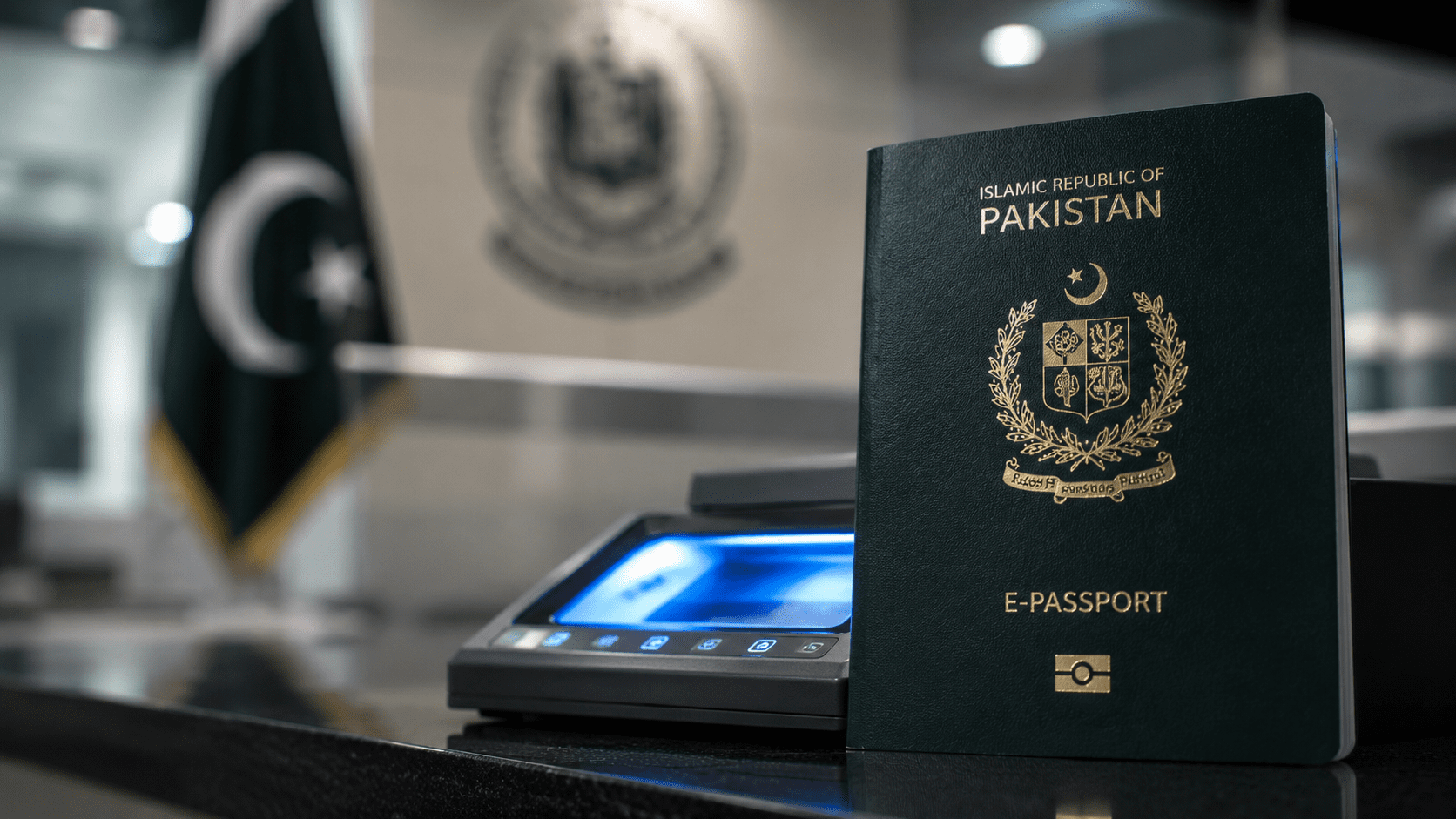
Pakistan has taken a major step toward modernising its travel documentation system, with the government deciding in principle to fully transition to an Pakistan e-passport system. The announcement was made by Interior Minister Mohsin Naqvi during a special meeting at the Passport and Immigration Headquarters in Islamabad, where officials outlined a sweeping reform package designed to phase out machine-readable passports in favour of secure, chip-embedded digital documents.
Thank you for reading this post, don't forget to subscribe!The shift to the Pakistan e-passport system marks one of the most significant overhauls of the country’s travel documentation in years, with officials saying the change will bring Pakistan’s passport infrastructure in line with international standards while curbing fraud and forgery that have long plagued the existing process.
What Is an E-Passport and Why It Matters
An e-passport is a highly secure travel document that contains an embedded electronic chip on one of its pages. This contactless chip uses near-field communication (NFC) technology to securely store a holder’s biometric data, facial details, biographical information, a unique identification number, and a digital signature. Unlike traditional machine-readable passports, e-passports are significantly harder to duplicate or tamper with, making them a preferred standard among countries seeking to modernise border security.
For Pakistan, adopting a nationwide Pakistan e-passport system is expected to align the country more closely with global travel-document standards used across the European Union, the Gulf states, and other major travel corridors, potentially smoothing the path for Pakistani travellers at international airports and immigration checkpoints.
Inside the Reform Meeting
Chairing the special session, Interior Minister Mohsin Naqvi said the complete transition to the Pakistan e-passportsystem would offer advanced security, global compatibility, and a more seamless airport experience for citizens. He stated plainly that the move would help end fraud and forgery linked to passport issuance — a long-standing concern for Pakistani authorities and international travel-security partners alike.
Director General of Passports and Immigration, Muhammad Ali Randhawa, briefed the minister on the broader reform agenda, which extends beyond the Pakistan e-passport rollout itself. According to officials present at the meeting, the session approved several measures in principle, although no firm cutoff date was set for phasing out existing passport formats.
Key Reforms Beyond the E-Passport Shift
The meeting did not focus solely on the Pakistan e-passport transition. Several other citizen-facing reforms were also discussed and approved:
- Home delivery of passports: Officials confirmed that preparatory work for delivering passports directly to applicants’ doorsteps — both within Pakistan and abroad — has already been completed. Naqvi said this service would begin soon, reducing the need for citizens to visit passport offices in person.
- Cashless payments: A move toward cashless payment options for passport-related fees is set to take effect from July 1, simplifying the payment process and reducing administrative friction.
- Pak ID platform migration: Online passport applications are being migrated to the Pak ID platform, a step officials say will streamline submissions and cut overall processing times.
- Revised fee structure: A new fee structure for premium passport services was also approved, under which applicants opting for expedited or premium processing will pay charges based on the actual cost of delivering those services.
Business Travel and Regulatory Coordination
Naqvi directed officials to finalise a dedicated policy for business passports in consultation with the Federal Board of Revenue (FBR). According to officials, this aspect of the reform is intended to facilitate legitimate business travel for Pakistani entrepreneurs and corporate travellers, while ensuring that regulatory compliance requirements are not compromised in the process.
This coordination between the Interior Ministry and the FBR signals that the broader Pakistan e-passport initiative is being designed with economic facilitation in mind, not just document security — an approach officials say reflects the government’s wider push to support trade and business mobility.
Background: A Longer Digitisation Push
The decision to fully adopt the Pakistan e-passport system did not emerge in isolation. Earlier this year, Naqvi had already directed the newly appointed Director General of Passports and Immigration to digitise the department’s operations and convert the existing framework into a fully paperless system. That earlier directive emphasised reducing processing delays, improving transparency, and ensuring faster issuance of passports and immigration documents for citizens nationwide.
Friday’s announcement builds directly on that groundwork, formalising the Pakistan e-passport transition as the centrepiece of a broader digital governance strategy for Pakistan’s passport and immigration apparatus.
Possible Impact and Analysis
Officials and observers point to several likely outcomes from the Pakistan e-passport transition:
- Reduced fraud risk: The embedded biometric chip technology should make forged or duplicated passports significantly harder to produce, addressing a recurring law-enforcement and border-security concern.
- Faster international travel: Many countries already use automated e-passport gates at airports; broader adoption could mean shorter immigration queues for Pakistani travellers abroad.
- Improved public convenience: Combined with home delivery and cashless payments, the reforms are designed to reduce the time and effort citizens currently spend navigating the passport application process.
- Implementation challenges: Without a confirmed cutoff date for phasing out older passport formats, authorities will need to manage a transition period during which both systems may operate in parallel, requiring careful coordination to avoid confusion or service gaps.
Analysts note that the success of the reform will depend heavily on execution — particularly the rollout of supporting infrastructure such as updated passport-printing machines, biometric verification systems, and the Pak ID digital platform.
What Citizens Should Expect Next
While the government has approved the shift to the e-passport system in principle, officials have indicated that detailed implementation timelines, including the eventual phase-out of machine-readable passports, will be finalised in the coming weeks. Citizens applying for passports during the transition period are likely to see incremental changes rather than an overnight shift, as new infrastructure and processes are gradually rolled out across passport offices nationwide.
Conclusion
Pakistan’s move toward a fully digital Pakistan e-passport system represents a significant modernisation effort, combining enhanced document security with practical citizen-facing reforms such as home delivery and cashless payments. With Interior Minister Mohsin Naqvi positioning the initiative as a step toward global compatibility and reduced fraud, the coming months will be critical in determining how smoothly the transition unfolds — and how quickly ordinary travellers begin to feel the benefits of a more secure, more convenient passport process.
Read Also: Pakistan Budget 2026-27 Under Fire: Rs3.6 Trillion Overspending Exposed Despite Austerity Claims