

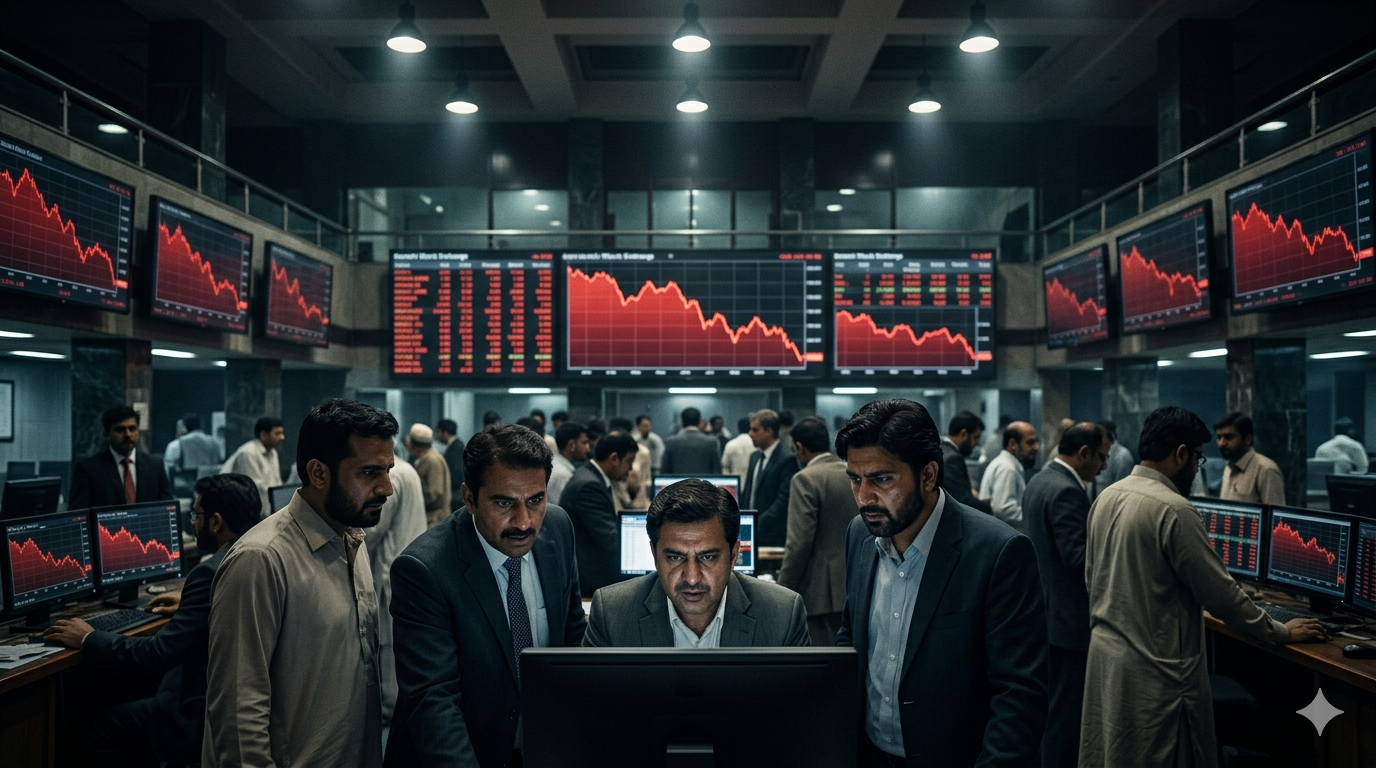
KARACHI / ISLAMABAD — The OICCI survey Pakistan business confidence results are in — and they make for deeply uncomfortable reading. The Overseas Investors Chamber of Commerce and Industry, Pakistan’s most authoritative voice for the foreign investment community, has released survey findings showing a sharp and significant deterioration in business confidence among the country’s most economically consequential investors. The culprit, according to the survey data, is clear: the escalating regional war environment driven by the US-Iran conflict and its cascading effects on Pakistan’s economic operating environment.
Thank you for reading this post, don't forget to subscribe!The OICCI survey Pakistan business confidence decline is not a minor statistical fluctuation or a short-term mood shift. It represents a fundamental reassessment by some of Pakistan’s most sophisticated and informed economic participants of whether the conditions exist for productive, profitable, and predictable business activity in the country. When those participants — representing billions of dollars in foreign direct investment across virtually every major sector of Pakistan’s economy — say confidence is deteriorating, the consequences for jobs, growth, and economic stability are real and serious.
What Is the OICCI and Why Does Its Survey Matter?
Before examining the specific findings of the OICCI survey Pakistan business confidence report, it is worth understanding exactly what the OICCI is and why its assessments carry such weight.
The Overseas Investors Chamber of Commerce and Industry is Pakistan’s oldest and most prestigious chamber of commerce, representing over 200 member companies from more than 35 countries. Its membership includes the Pakistan operations of some of the world’s largest multinational corporations — spanning sectors including energy, banking and financial services, pharmaceuticals, consumer goods, telecommunications, and manufacturing.
These are not speculative investors or portfolio managers who can exit Pakistan at the click of a button. They are companies with physical assets, local employees, supply chains, and long-term commitments to the Pakistani market. When the OICCI survey Pakistan business confidence shows that even these deeply committed investors are losing confidence, it is a signal that demands serious attention from policymakers, economists, and the broader public.
According to OICCI’s official research portal, the chamber has been conducting regular business confidence surveys for over a decade, making its data one of the most consistent and comparable long-term indicators of foreign investor sentiment available in Pakistan. The current deterioration in the OICCI survey Pakistan business confidence index therefore represents a genuine break from the cautious recovery trajectory that had been building over the previous few survey cycles.
The Survey Findings: What the Numbers Show
The OICCI survey Pakistan business confidence findings reveal a multi-dimensional deterioration in sentiment that goes beyond simple pessimism about short-term conditions.
Business confidence among OICCI member companies has declined across virtually all the key metrics that the survey tracks — including assessments of the current business environment, expectations for future business conditions, investment intention over the next six to twelve months, employment outlook, and perceptions of the regulatory and policy environment.
The most dramatic deterioration in the OICCI survey Pakistan business confidence data appears in forward-looking indicators — assessments of what business conditions are likely to look like in the coming months. This is particularly concerning because forward-looking indicators drive actual investment decisions. Companies that are pessimistic about future conditions do not launch new projects, hire additional staff, or expand capacity. They conserve capital, delay decisions, and wait for clarity — behaviour that, if widespread, directly reduces economic activity and growth.
The survey respondents have been explicit about the primary driver of the OICCI survey Pakistan business confidence decline: regional geopolitical tension. The escalating US-Iran military conflict, the ongoing Israel-Lebanon war, and the broader destabilisation of the Middle East security environment are being felt by Pakistan’s foreign investment community as direct threats to the operating conditions they need to run their businesses confidently.
How Regional War Is Hitting Pakistan’s Economy
The connection between the regional security environment and the OICCI survey Pakistan business confidence findings requires explanation for readers who may wonder how wars in distant countries directly impact Pakistan’s business climate.
The mechanisms are multiple and mutually reinforcing.
Energy Price Exposure
Pakistan is a major importer of energy — including oil and liquefied natural gas — much of which transits through or is priced against Middle Eastern markets. Any escalation in the US-Iran conflict that disrupts oil production, refining, or shipping in the Persian Gulf region sends energy prices upward globally. For Pakistan, which already struggles with high energy costs that directly affect industrial competitiveness, rising oil prices are a direct economic blow. The OICCI survey Pakistan business confidence decline reflects this energy vulnerability clearly.
Exchange Rate and Current Account Pressure
Higher energy import costs worsen Pakistan’s current account balance — the difference between what the country earns from exports and what it spends on imports. A deteriorating current account puts downward pressure on the Pakistani rupee, increases the cost of debt servicing for dollar-denominated borrowings, and raises the cost of imported raw materials for Pakistani manufacturers. All of these factors directly affect the operating environment that the OICCI survey Pakistan business confidence survey is measuring.
Investor Risk Perception
Pakistan already carries a risk premium in global investor assessments — a reflection of its history of macroeconomic volatility, currency instability, and political uncertainty. Regional war dramatically increases that risk premium. When international investors conduct their global capital allocation exercises, a Pakistan located in or near an active war zone is assessed as significantly riskier than a Pakistan in a stable neighbourhood. The OICCI survey Pakistan business confidence decline reflects this reassessment of Pakistan’s risk profile by the international business community.
Supply Chain Disruption
Several of Pakistan’s most important export industries — including textiles, pharmaceuticals, and food processing — rely on raw material imports and finished goods exports that move through regional shipping lanes. Any serious disruption to Persian Gulf shipping would affect these supply chains directly. The OICCI survey Pakistan business confidence findings suggest that foreign investors operating in Pakistan’s export sectors are factoring precisely this risk into their planning.
Pakistan’s Economic Context: A Warning at a Critical Moment
The OICCI survey Pakistan business confidence deterioration comes at a particularly sensitive moment in Pakistan’s economic trajectory. The country has been working its way through a demanding IMF stabilisation programme, implementing painful fiscal adjustments — including energy subsidy rationalisation, tax broadening, and public expenditure restraint — in exchange for the financial support needed to stabilise its external accounts and restore macroeconomic sustainability.
That programme has been showing results. Pakistan’s inflation rate had been declining, its foreign exchange reserves had been gradually rebuilding, and the current account had moved toward balance. The economic narrative, while still fragile, had been cautiously improving — a trajectory reflected in gradually recovering business and consumer sentiment.
The OICCI survey Pakistan business confidence plunge threatens to disrupt that fragile recovery narrative. If foreign investors respond to declining confidence by deferring or cancelling investment decisions, the economic growth that Pakistan needs to generate employment and improve living standards will be harder to achieve. If the survey findings trigger wider negative sentiment — feeding into Pakistani stock market performance, currency pressures, or credit rating assessments — the economic stabilisation effort could face serious setbacks.
According to the State Bank of Pakistan, foreign direct investment is one of the key variables in the central bank’s medium-term economic outlook modelling. A sustained decline in the OICCI survey Pakistan business confidence index would therefore feed directly into the SBP’s forward assessments and potentially affect monetary policy decisions.
Government Response and Policy Challenges
Pakistan’s economic managers face a difficult challenge in responding to the OICCI survey Pakistan business confidence findings. The primary driver of the decline — regional geopolitical tension — is largely outside Pakistan’s direct control. Islamabad cannot single-handedly resolve the US-Iran conflict or end the Israel-Lebanon war.
What the government can do is work to insulate Pakistan’s economic environment from the worst effects of regional instability, and to signal clearly to the foreign investment community that Pakistan remains open for business, committed to its reform programme, and actively managing the risks that the regional environment creates.
The Ministry of Finance Pakistan and the Board of Investment will need to engage proactively with OICCI member companies in the wake of the OICCI survey Pakistan business confidence findings — offering reassurances about policy continuity, addressing specific regulatory concerns that may be amplifying the broader geopolitical anxiety, and demonstrating that Pakistan’s economic reform programme remains on track regardless of external turbulence.
Pakistan’s diplomatic establishment also has a role to play. Islamabad’s traditional positioning as a bridge between competing regional powers — its relationships with both the United States and Iran, its influence in the Gulf, and its role in multilateral forums — give it potential leverage to contribute to de-escalation efforts that, if successful, would directly benefit Pakistan’s own economic environment and help reverse the OICCI survey Pakistan business confidence deterioration.
What Investors Are Watching
Based on the OICCI survey Pakistan business confidence findings and the broader context, the factors that foreign investors will be watching most closely in the coming weeks and months include the trajectory of the US-Iran conflict and whether ceasefire negotiations can be revived, the stability of global oil prices and their impact on Pakistan’s import bill, the continuation of Pakistan’s IMF programme and its next review, the performance of the Pakistani rupee and foreign exchange reserves, and any specific policy measures the Pakistani government takes to address investor concerns raised by the OICCI survey Pakistan business confidence report.
Read Also: Trump Says US to Pause Operation to Guide Vessels Through Strait of Hormuz
Read Also: Gilgit-Baltistan Elections 2026: Political Heavyweights Battle Hard for Crucial Mountain Votes
Read Also: Infinix Note 30 Review: Surprisingly Powerful and an Unbeatable Budget Pick in 2026
Conclusion
The OICCI survey Pakistan business confidence plunge is a serious and credible warning that demands an urgent policy response. Pakistan’s foreign investment community — one of the most informed and analytically rigorous audiences that evaluates the country’s economic prospects — is telling policymakers clearly that regional war tensions are creating real damage to the business environment.
Addressing the concerns reflected in the OICCI survey Pakistan business confidence findings will require both short-term reassurance measures and sustained commitment to the structural reforms that make Pakistan a genuinely attractive long-term investment destination. The alternative — allowing confidence to deteriorate further without a credible response — risks undermining the economic progress that Pakistan has worked so hard and paid such a high price to achieve.
Pakkhabar.com will continue to provide detailed coverage of Pakistan’s economic developments, business confidence indicators, and the regional factors shaping Pakistan’s investment environment in 2026.