

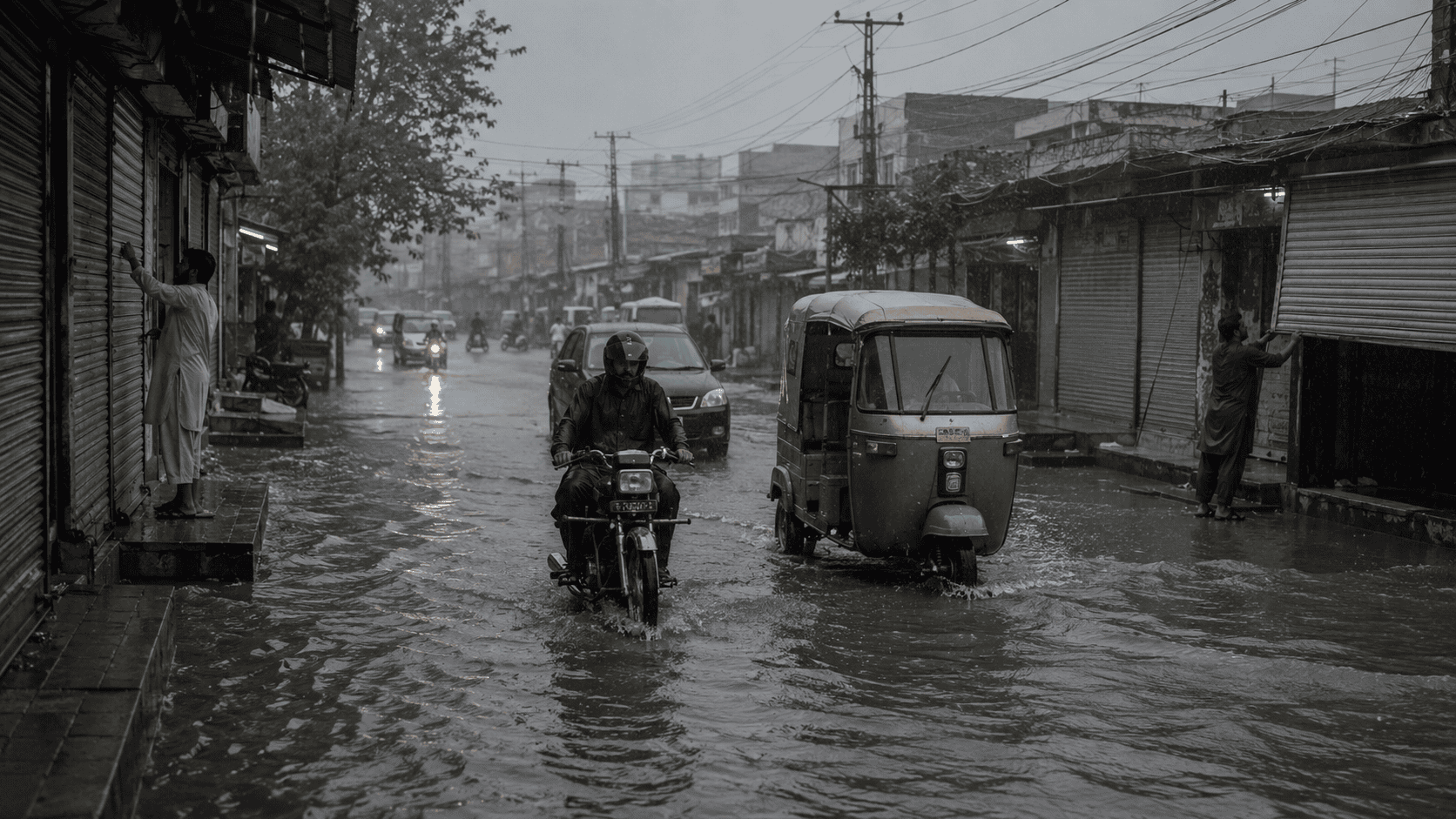
Pakistan is bracing for another bruising round of Pakistan monsoon rains, with disaster management authorities warning that a fresh, eight-day weather system will sweep across the country beginning July 29 and lasting through August 5. The Provincial Disaster Management Authority (PDMA) in Punjab has issued a province-wide advisory, calling it the fourth major monsoon spell of the season and cautioning that most districts should prepare for heavy downpours capable of triggering urban flooding, flash floods and landslides.
Thank you for reading this post, don't forget to subscribe!The warning follows a similar advisory from the Pakistan Meteorological Department (PMD), which said monsoon currents pushing in from the Arabian Sea and the Bay of Bengal are expected to penetrate the upper and central parts of the country starting July 29, with a westerly wave over northern areas likely to intensify from August 1 onward. Officials say the combination could produce scattered heavy to very heavy rainfall across Kashmir, upper and central Punjab, Islamabad, Khyber Pakhtunkhwa and Gilgit-Baltistan.
Cities identified as being at particular risk of urban flooding between July 30 and August 4 include Islamabad, Rawalpindi, Peshawar, Nowshera, Gujranwala, Gujrat, Sialkot, Lahore, Multan and Faisalabad. Authorities have flagged a similar window of vulnerability, from July 31 to August 2, for parts of Sindh, including Nawabshah, Sukkur, Hyderabad, Thatta, Badin, Sanghar, Khairpur, Mirpur Khas, Umerkot and the Tando districts.
PDMA Punjab Director General Umar Mela has directed all commissioners and deputy commissioners across the province to remain on high alert and ensure emergency preparedness is in place before the spell arrives. The department has also renewed its public safety guidance, urging parents to keep children away from waterlogged low-lying areas, electric wires and utility poles, and advising residents to avoid standing in open spaces during thunderstorms. Citizens facing an emergency have been directed to the PDMA helpline at 1129.
Flash flood risk is not confined to the plains. The advisory warns that local streams and nullahs in Kashmir, Murree, the Galliyat hills, northeastern Punjab, Islamabad, Khyber Pakhtunkhwa, Gilgit-Baltistan and the hill torrents of Dera Ghazi Khan could all swell rapidly once the rains intensify. Landslides remain a separate concern in the same mountainous belt, with upper Khyber Pakhtunkhwa, Murree, the Galliyat, Gilgit-Baltistan and Kashmir all named as vulnerable zones.
Pakistan Monsoon Rains: What the Fourth Spell Means for an Already Battered Country
This latest alert does not arrive in isolation. The National Disaster Management Authority (NDMA) told Prime Minister Shehbaz Sharif this week that the nationwide death toll from monsoon-related incidents since late June has reached 110, with roughly 360 people injured and nearly 800 houses damaged. Most fatalities so far have been reported in Khyber Pakhtunkhwa, followed by Punjab — a pattern consistent with earlier weeks of the season, when flash flooding and structural collapses accounted for the bulk of casualties.
The NDMA has also flagged a longer-term hazard: rapidly melting glaciers in the country’s northern areas could trigger glacial lake outburst floods (GLOFs) over the coming month, compounding the risk already posed by the monsoon rains themselves. In response, the prime minister has ordered authorities to deploy all available resources, including early warning systems, to reduce the impact of the coming spell.
For readers tracking official guidance directly, the Pakistan Meteorological Department publishes real-time advisories on rainfall forecasts and river conditions, while the National Disaster Management Authority maintains updated casualty and relief figures throughout the monsoon season. Residents in flood-prone districts can also consult the Punjab government’s official disaster response portal for local evacuation and helpline information.
Analysis: A Season That Keeps Testing Pakistan’s Flood Defenses
What makes this eighth-day spell notable is not just its length but its timing. It arrives while relief and repair efforts from earlier July flooding are still underway in several districts, meaning drainage systems, riverbanks and temporary embankments have had little time to recover before facing renewed pressure. Punjab’s decision to route this alert through commissioners and deputy commissioners — rather than treating it as a routine weather bulletin — signals that provincial authorities view the coming week as a genuine stress test for urban infrastructure, not simply a forecast to monitor.
The geographic overlap between this spell’s flood-risk zones and the areas that have already recorded the season’s highest casualty counts, particularly Khyber Pakhtunkhwa and northern Punjab, is a further concern. Emergency planners will likely be watching river gauge readings on the Chenab and its tributaries closely in the coming days, since even moderate additional rainfall on already-saturated catchments can produce disproportionate downstream flooding.
The NDMA’s warning about glacial lake outburst floods adds a longer horizon to the risk picture. Unlike rainfall, GLOF events are harder to forecast precisely, and their damage tends to be concentrated in mountain communities with limited evacuation infrastructure. If this pattern continues, expect provincial authorities to expand pre-positioning of relief supplies and rescue teams beyond the immediate eight-day window, and for federal-provincial coordination meetings, of the kind PM Sharif has already convened, to become a more regular fixture through the rest of the season.
https://pakkhabar.com/ndma-flood-alert-pakistan-rain-forecast-june-2026/
https://pakkhabar.com/pakistan-russia-counterterrorism-strategy-mou/
https://pakkhabar.com/pakistans-four-year-hajj-policy-2027-2030-approved/
What Residents Should Do Now
Officials are repeating advice that has become familiar this monsoon season but remains critical: avoid unnecessary travel during the alert period, stay away from riverbanks and low-lying areas, and keep emergency contact numbers accessible. Farmers have been urged to take preventive measures to protect standing crops, while tourists heading to northern areas have been advised to check the latest weather updates before travelling.
As the eight-day spell begins, the coming days will show whether Pakistan’s disaster response machinery — tested repeatedly this season — can keep pace with a monsoon pattern that shows little sign of easing before September.
Get updates like this on WhatsApp before anywhere else — join our Channel [https://whatsapp.com/channel/0029Vb8fffCKrWQzEVBQ6v00]