

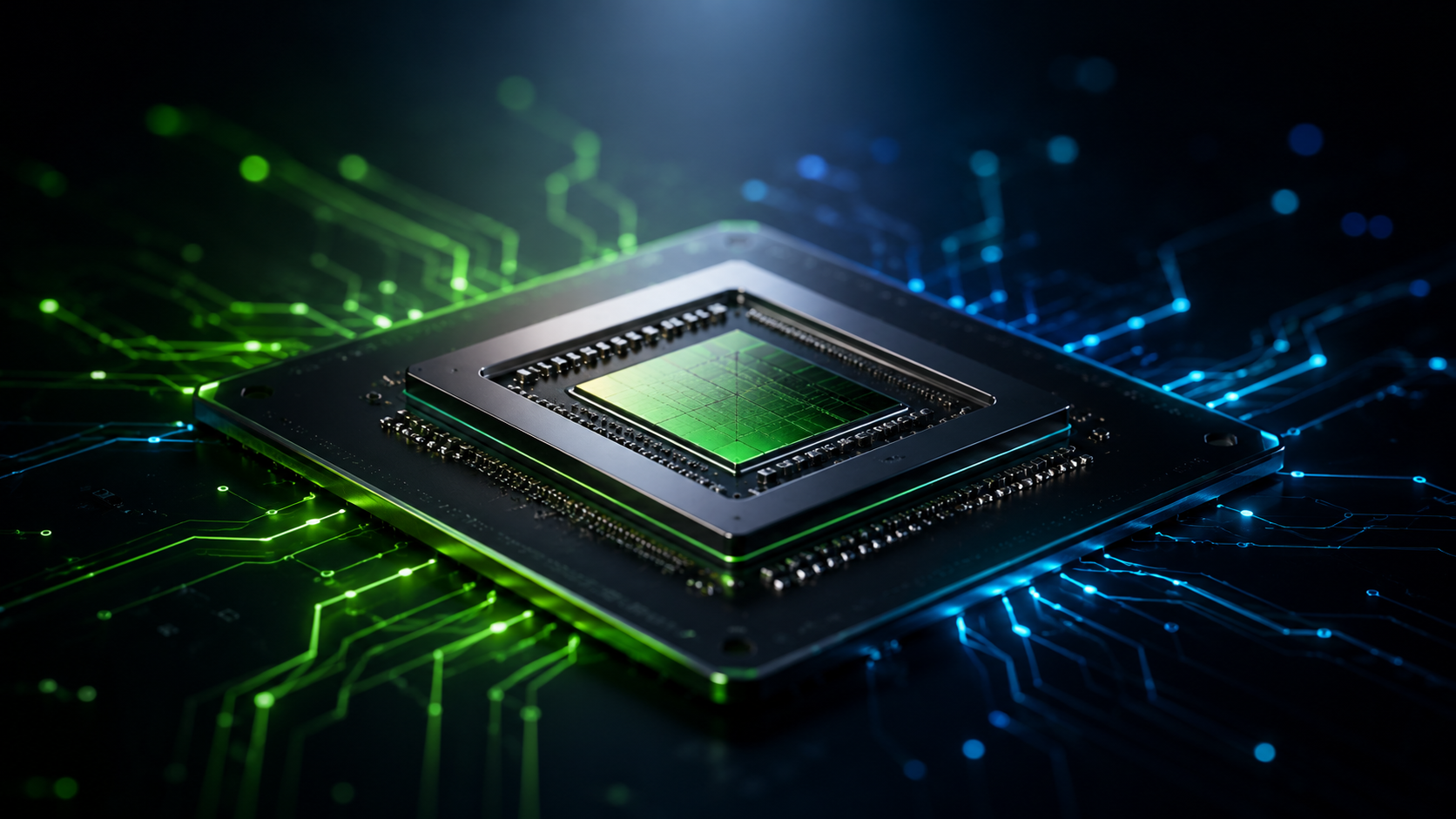
SAN JOSE / LONDON — The world of personal computing is on the verge of a fundamental transformation. Nvidia — the company that has already reshaped the artificial intelligence industry through its data centre GPU dominance — has now turned its sights squarely on the consumer market, unveiling the Nvidia RTX Spark AI chip, a purpose-built processor designed to bring serious, on-device artificial intelligence performance to everyday personal computers.
Thank you for reading this post, don't forget to subscribe!The announcement of the Nvidia RTX Spark AI chip represents one of the most significant moments in consumer computing in years. For the first time, the kind of AI processing power that until recently required expensive cloud subscriptions, internet connectivity, or access to enterprise-grade hardware may soon be available to anyone with a modern personal computer — running locally, privately, and at speed.
What Is the Nvidia RTX Spark AI Chip?
The Nvidia RTX Spark AI chip is a new addition to Nvidia’s RTX product family, specifically engineered to accelerate artificial intelligence workloads on personal computers rather than in data centres. While Nvidia’s flagship H100 and Blackwell chips power the vast majority of the world’s AI training and inference infrastructure, the Nvidia RTX Spark AI chip is designed for a very different purpose: democratising AI for the individual user.
According to reports from BBC Technology, the Nvidia RTX Spark AI chip is optimised for what the industry calls “edge AI” or “on-device AI” — processing artificial intelligence tasks locally on a user’s machine rather than sending data to a remote cloud server. This distinction matters enormously for several reasons: speed, privacy, cost, and accessibility.
The chip is designed to accelerate a wide range of AI-powered applications that are rapidly becoming standard features of modern software — from intelligent image editing and real-time video enhancement to AI-powered writing assistants, voice recognition, and productivity tools that can understand and respond to natural language commands without requiring an internet connection.
Jensen Huang Takes the Stage
The announcement of the Nvidia RTX Spark AI chip was made by Nvidia’s founder and CEO Jensen Huang, one of the most recognisable and influential figures in the global technology industry. Huang — instantly identifiable in his trademark black leather jacket — presented the chip while holding two devices, one in each hand, visually demonstrating the compact, consumer-friendly form factor that the Nvidia RTX Spark AI chip is designed to enable.
Huang’s presentation style has become legendary in the technology world. His ability to translate deeply technical concepts into accessible, exciting narratives for a broad audience has made Nvidia’s product launches some of the most watched events on the technology calendar. The unveiling of the Nvidia RTX Spark AI chip followed this tradition — positioning the announcement not merely as a product launch but as a defining moment in the democratisation of artificial intelligence.
Jensen Huang has previously stated that his vision for Nvidia extends far beyond the data centre, describing a future where AI capabilities are embedded throughout every layer of computing — from the world’s largest supercomputers down to the personal devices used by billions of people every day. The Nvidia RTX Spark AI chip is the clearest expression yet of that consumer-facing ambition.
Why This Matters: The Shift to On-Device AI
To understand why the Nvidia RTX Spark AI chip is such a significant announcement, it helps to understand the current landscape of consumer AI computing and why on-device processing represents a major step forward.
Today, most consumer AI applications — from voice assistants to image generators to AI writing tools — rely on cloud computing infrastructure. When you ask an AI assistant a question or generate an image, your request travels to a remote server farm, is processed using powerful hardware, and the result is sent back to your device. This model works, but it has real limitations.
Cloud-based AI requires a reliable internet connection, meaning it fails when connectivity is poor or unavailable. It introduces latency — a small but perceptible delay between your request and the response. It raises privacy concerns, since your data is being sent to and processed by third-party servers. And it costs money, either through direct subscription fees or through the energy and infrastructure costs absorbed by service providers.
The Nvidia RTX Spark AI chip addresses all of these limitations simultaneously. By processing AI tasks locally on a user’s personal computer, it enables AI applications to work offline, respond instantaneously, keep user data on the device, and eliminate the ongoing cost of cloud compute. According to Nvidia’s official developer documentation, this local AI processing capability is central to Nvidia’s vision for the next generation of personal computing.
Technical Architecture and Performance
While full technical specifications of the Nvidia RTX Spark AI chip continue to emerge following the announcement, what is already clear is that the chip represents a significant architectural evolution from standard consumer graphics processing units.
The Nvidia RTX Spark AI chip incorporates dedicated tensor core processing units — the same technology that underlies Nvidia’s enterprise AI chips — scaled and optimised for the power envelope and thermal constraints of a personal computer. This means the chip can run large language model inference, image generation workloads, and real-time AI enhancement tasks at a performance level that previous consumer hardware simply could not match.
The chip also integrates with Nvidia’s CUDA computing platform and the broader Nvidia AI software ecosystem, meaning that the enormous library of AI models, tools, and frameworks that developers have built for Nvidia hardware will be compatible with the Nvidia RTX Spark AI chip from launch. This software ecosystem advantage is one of Nvidia’s most powerful competitive moats and gives the new chip immediate access to a vast range of real-world applications.
Implications for the AI Industry
The announcement of the Nvidia RTX Spark AI chip sends a clear message to the broader technology industry: the AI revolution is moving from the cloud to the edge, and Nvidia intends to lead that transition just as it led the data centre AI buildout.
For competitors — including AMD, Intel, Qualcomm, and Apple, all of which have been investing in their own on-device AI processing capabilities — the Nvidia RTX Spark AI chip raises the competitive bar considerably. Nvidia’s brand recognition among PC users, its dominant software ecosystem, and its manufacturing scale give it structural advantages that will be difficult for rivals to match quickly.
For software developers, the Nvidia RTX Spark AI chip opens up an entirely new category of application experiences that were not previously feasible on consumer hardware. Real-time AI video generation, fully local AI assistants with no cloud dependency, professional-grade image and audio enhancement tools accessible to everyday users — all of these become realistic possibilities with the performance headroom the chip provides.
The MIT Technology Review has noted that the move toward on-device AI processing is one of the defining technology trends of the mid-2020s, driven by growing consumer awareness of data privacy, frustration with cloud latency, and the desire for AI tools that work reliably in all conditions.
What This Means for Consumers
For everyday PC users, the most tangible impact of the Nvidia RTX Spark AI chip will be felt through the software experiences it enables. Creative professionals will gain access to AI-powered tools for photo editing, video production, and 3D rendering that respond in real time without cloud overhead. Knowledge workers will benefit from AI assistants embedded directly in their workflow that can process and respond to complex requests instantly and privately.
Gamers — Nvidia’s original core customer base — will also benefit significantly. The Nvidia RTX Spark AI chip is expected to supercharge AI-driven frame generation, resolution upscaling through DLSS technology, and real-time NPC behaviour sophistication in games, delivering experiences that push the boundary of what interactive entertainment can look like.
Read Also: Europe Furious as Israel’s Deepening Lebanon Incursion Draws Global Condemnation
Read Also: Good News for Millions: Pakistan’s Electricity Subsidy for Protected Consumers to Continue
Read Also: Hesson Defends Ruthless Pakistan World Cup Selection Calls
Conclusion
The unveiling of the Nvidia RTX Spark AI chip is a landmark moment for personal computing and for artificial intelligence as a technology accessible to ordinary people. By bringing the power of on-device AI to personal computers, Nvidia is not merely releasing a new product — it is reshaping the fundamental architecture of how humans will interact with computers in the years ahead.
For consumers, developers, and the broader technology industry, the Nvidia RTX Spark AI chip is the clearest signal yet that the AI era has well and truly arrived at the personal computing level — and that the company that built the engines powering the world’s AI revolution intends to power its next chapter too.
Pakkhabar.com will bring you full coverage of the Nvidia RTX Spark AI chip release date, pricing, benchmark performance, and availability as details continue to emerge.