
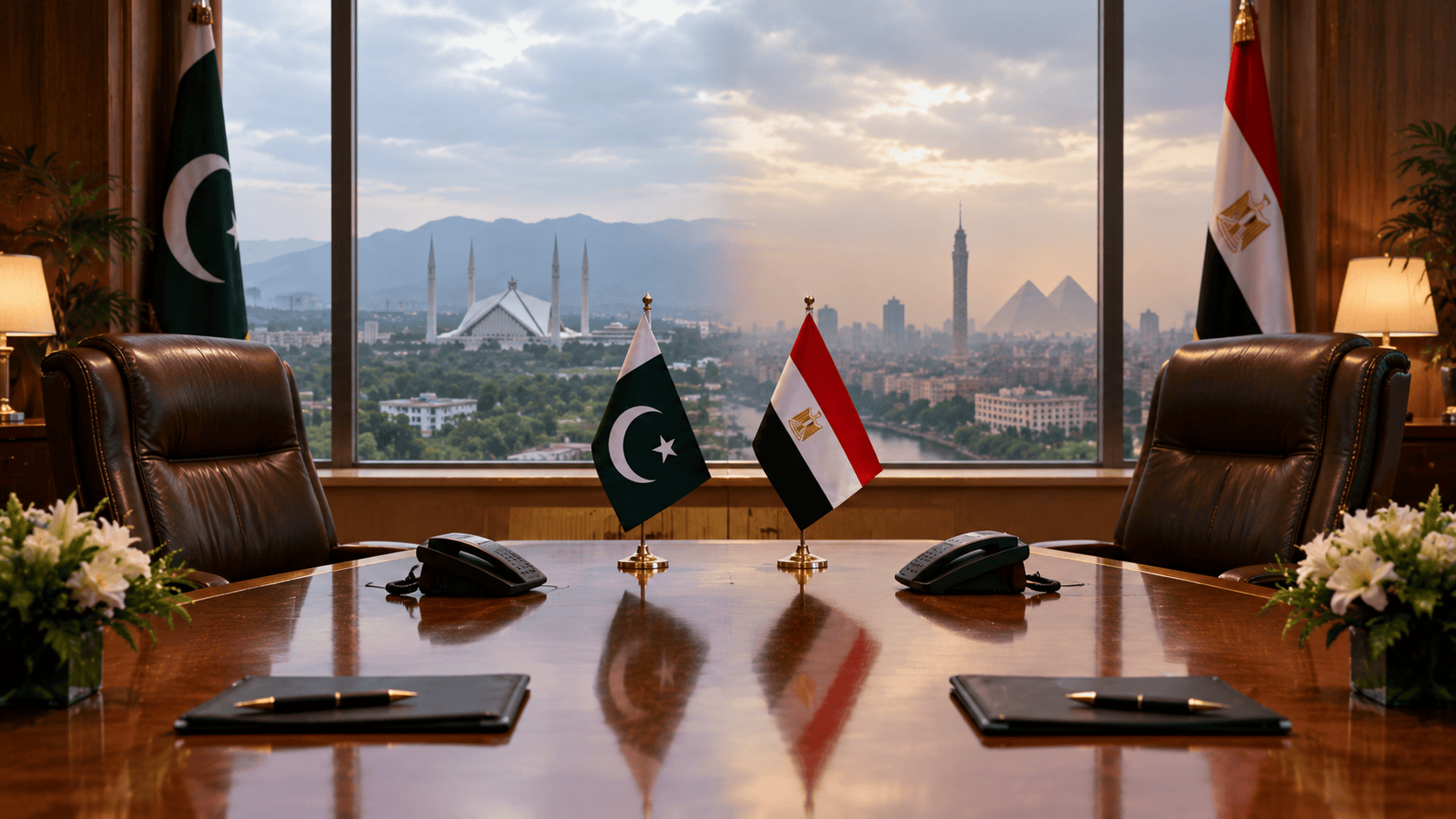
The Pakistan Egypt dialogue has moved forward this week. The foreign ministers of both countries held a telephone conversation about the latest regional developments and ways to ease tensions. The call was short on public detail, but its timing and message made it one of the more closely read diplomatic stories of the week. Both sides stressed that talking, not escalation, is the only practical way through a crowded and fragile regional situation.
What Happened in the Pakistan Egypt Dialogue
Egypt’s Foreign Minister Badr Abdelatty announced the call on Wednesday, 14 October, in a post on social media. He said he had discussed regional developments, ways to calm tensions and joint coordination with his Pakistani counterpart. Pakistani reports on the conversation followed. They described it as a telephone exchange between Deputy Prime Minister and Foreign Minister Mohammad Ishaq Dar and Dr Abdelatty.
According to those accounts, the two ministers agreed that “dialogue and diplomacy” remain the way forward. They reaffirmed support for efforts to promote de-escalation and agreed to stay closely engaged on matters of mutual interest. The wording of the Pakistan Egypt dialogue was careful and general. Neither side publicly listed specific proposals, which is common in calls of this kind.
Why the OIC Meeting Matters
Egyptian statements linked the call to the coming meeting of the Council of Foreign Ministers of the Organisation of Islamic Cooperation (OIC). Reports say it is scheduled for Baghdad on 17 and 18 October. The OIC brings together Muslim-majority states, and both Pakistan and Egypt are members. Pre-meeting calls like this one help governments compare positions before they sit down at a larger table. You can read about the organisation’s work on the OIC website.
Why the Pakistan Egypt Dialogue Matters Now
The call did not happen in isolation. A conflict involving the United States, Israel and Iran began in late February and has reshaped diplomacy across West Asia. Pakistan has taken a prominent mediating role. It hosted the Islamabad Talks between American and Iranian delegations in April, and the Islamabad Memorandum of Understanding was signed on 17 June. That agreement aimed to stop military operations, ease restrictions on shipping through the Strait of Hormuz and open negotiations on a wider settlement.
Progress has been uneven. Earlier this month, the United Nations Secretary-General visited Islamabad and publicly praised Pakistan’s mediating role. Pakistan’s Foreign Office said last week that Washington and Tehran were discussing seven points. It also said Islamabad stood ready to resume mediation if needed. On 13 October, an Iranian official said the United States had not honoured its obligations under the memorandum. This is why the Pakistan Egypt dialogue is closely watched. Egypt has also been active in regional mediation, including on Gaza, so Cairo and Islamabad share a practical interest in keeping channels open. Official statements from both governments are available through Pakistan’s Ministry of Foreign Affairs and Egypt’s Ministry of Foreign Affairs.
Background: A Long-Standing Diplomatic Relationship
Pakistan and Egypt have maintained diplomatic relations for decades. They meet regularly at the United Nations and within the OIC. Their foreign ministers also speak often. They held a similar call in April, when a second round of US-Iran talks in Islamabad was being discussed. That pattern shows consultation is routine and not a one-off reaction. The two countries also cooperate on economic and cultural matters, and the Ministry of Commerce of Pakistan publishes information on trade policy for readers who want more detail.
Analysis/What This Means for the Pakistan Egypt Dialogue
Diplomatic Weight
Pakistan’s mediation has given it more visibility than it has had in years. Egypt adds experience from its own mediation work and its standing in the Arab world. When the two coordinate, they can present a shared message at forums such as the OIC. That message is simple: lower tensions, protect civilians and return to negotiation. The Pakistan Egypt dialogue helps both governments show that they speak with other regional capitals and not only with Washington or Tehran.
Possible Impact of the Pakistan Egypt Dialogue
The practical effect will probably be seen first in the language of the OIC meeting. A coordinated approach could shape how the final statement describes the conflict, shipping safety and humanitarian concerns. It may also encourage other member states to support quieter, behind-the-scenes mediation. For Pakistan, the benefit is credibility. Its foreign ministry can point to consistent consultation with a major Arab partner.
Risks and Limits
The Pakistan Egypt dialogue is not a peace plan, and readers should not read it as one. A phone call between two foreign ministers cannot settle a conflict between other parties. The main obstacles are the disagreements between Washington and Tehran over obligations under the June memorandum. Statements about “de-escalation” also mean different things to different governments. Real change will depend on whether the parties that are actually fighting or negotiating are willing to compromise.
What to Watch Next
- The outcome of the OIC meeting in Baghdad, including any joint statement.
- Whether Pakistan is asked to resume formal mediation.
- Any response from Washington and Tehran to the seven-point discussions.
- Further calls or visits between Islamabad and Cairo.
How to Follow the Pakistan Egypt Dialogue
Official statements are the most reliable source. Readers can check the foreign ministries of both countries. The Prime Minister’s Office of Pakistan publishes official announcements. For wider context on international peace and security efforts, the United Nations website provides public statements and documents. It is wise to treat unverified social media claims about “secret deals” with caution until governments confirm them.
Read More:Bilawal PTI Warning: Change Course or Lose K-P
PPP Wins GB Elections 2026: Emerges as Largest Party With Decisive 10-Seat Victory
Conclusion
The Pakistan Egypt dialogue is a modest but meaningful signal. Two influential Muslim-majority countries have chosen to speak directly, restate a shared preference for diplomacy and prepare for a major regional meeting. It does not end the conflict, and its real value will be judged by what follows in Baghdad and beyond. For now, it shows that diplomatic channels remain open at a time when many people want to see tensions fall. This report will be updated as officials release more verified information.
Get updates like this on WhatsApp before anywhere else — join our Channel [https://whatsapp.com/channel/0029Vb8fffCKrWQzEVBQ6v00]
Recent News
- AJK Election Results Trigger Coalition Rift as PPP Alleges Rigging, PML-N Claims Sweeping Win NEW
- AJK Police Say Banned JAAC Has Become an Armed Group Attacking Police and Security Forces NEW
- AJK Protest Spirals: Four Police Officers Martyred in Violent Clashes NEW
- AJK Security Forces Request Signals Deepening Unrest Ahead of Elections NEW
- Allama Nasir Madni Heart Attack Rumours Denied: What Really Happened NEW
- Apna Ghar Scheme 2026: Pakistan’s Biggest Housing Dream Is Finally Being Unlocked for Millions NEW
- Armed Forces Committed to Eradicating All Forms of Terrorism: Field Marshal NEW
- Asim Munir Turkey Visit Strengthens Pakistan-Turkiye Defence Partnership NEW
- Ashura 2026 Pakistan Confirmed for June 26 — Moon Not Sighted, KP Declares Holiday NEW
- Avengers Doomsday Trailer Sends Marvel Fans Into a Frenzy NEW





1 thought on “Pakistan Egypt Dialogue: Urgent Push to Ease Tensions”