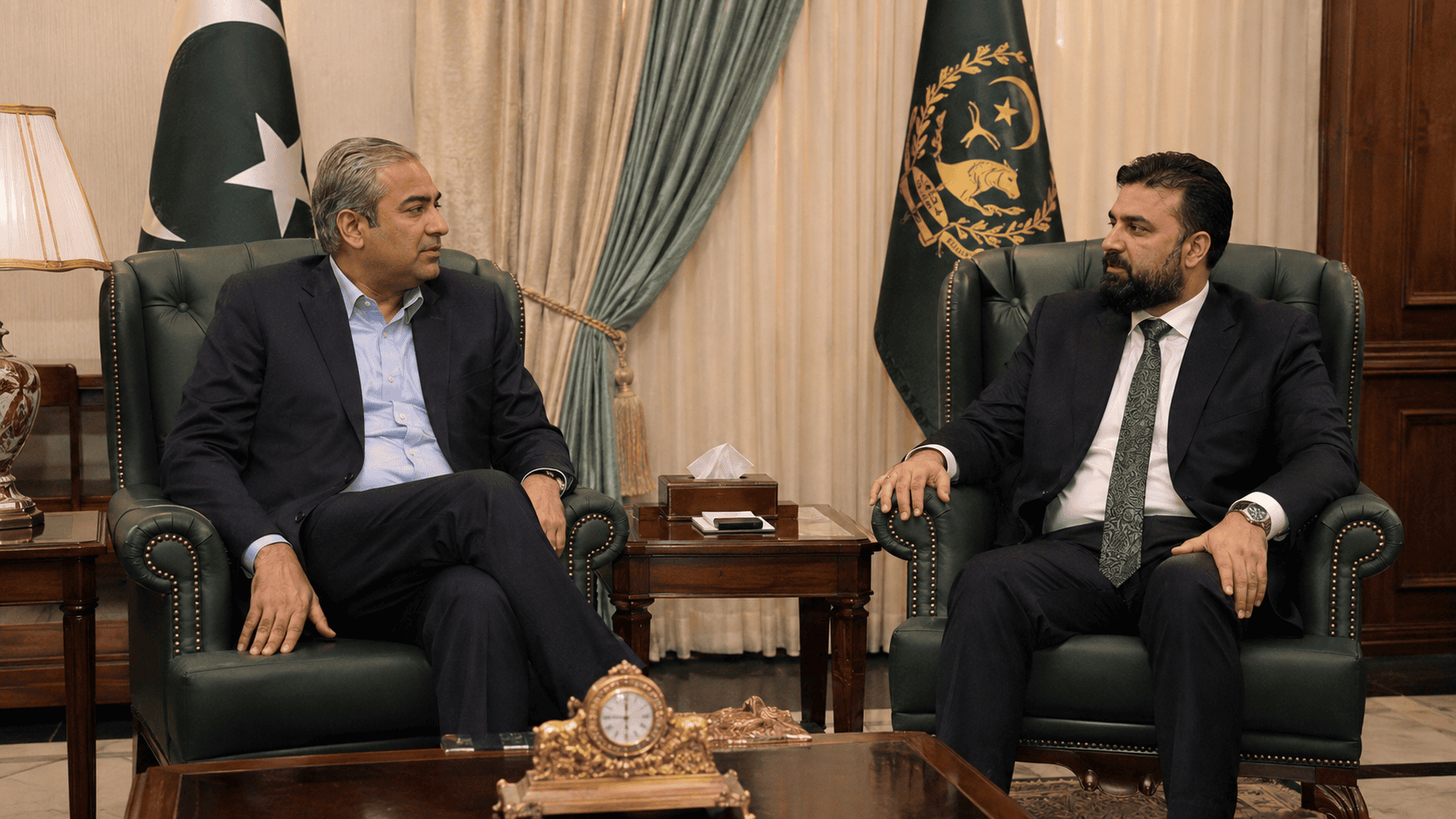
Federal Interior Minister Mohsin Naqvi travelled to Quetta on Saturday to co-chair a high-level Balochistan security review with provincial Chief Minister Sarfraz Bugti, as authorities moved to reassure a province rattled by one of its deadliest stretches of militant violence this year. The meeting, held at a moment when public confidence in day-to-day security has been visibly shaken, produced a set of concrete commitments rather than broad reassurances alone.
According to a statement from the Ministry of Interior, Bugti opened proceedings with a detailed briefing on the province’s overall law-and-order situation, walking participants through measures already under way and outlining the provincial government’s forward strategy. The session came against the backdrop of coordinated militant attacks earlier this month that killed dozens of security personnel, triggering large-scale military and intelligence-driven operations across southwestern Balochistan, according to Arab News.
Concrete Steps From the Balochistan Security Review
Beyond the customary statements of solidarity, the Balochistan security review yielded specific operational decisions. Participants agreed to enhance the professional capacity of the province’s Counter-Terrorism Force (CTF) and the wider Balochistan Police, while accelerating previously approved measures aimed at strengthening the force more broadly, according to a readout carried by Geo News. Naqvi framed the effort around three pillars — modern technology, improved intelligence, and coordinated operational planning — describing them as indispensable to sustaining any real gains against militant networks.
The interior minister also said the federal government intended to draw on the experience of former Balochistan police chiefs to help shape the province’s ongoing law-and-order strategy, according to The Express Tribune. That detail suggests officials are looking beyond immediate deployments toward institutional knowledge that has accumulated over previous counter-insurgency campaigns in the province.
For his part, Bugti struck a defiant tone, telling the meeting that the provincial government would stay “a step ahead” of militant elements and would not bow to pressure. He reiterated that the state’s writ would be enforced “at all costs,” language he has used consistently since taking office amid the province’s ongoing security challenges.
A Province Under Strain
Balochistan has faced a particularly difficult stretch of violence this month, with coordinated attacks against security forces prompting an intensified military response. The scale of the recent bloodshed — described by multiple officials as among the deadliest outbreaks the province has seen this year — has placed the Naqvi-Bugti security meeting under closer public scrutiny than similar reviews held in previous months. Both leaders emphasised that federal and provincial authorities were operating in “complete unity,” a phrase intended to counter any perception of disjointed decision-making between Islamabad and Quetta at a sensitive moment.
The meeting also touched on Balochistan’s broader development priorities, with Bugti stressing that economic opportunity for the province’s youth — through merit-based hiring, technical training and education — remains linked to any durable security gains. That framing reflects a long-standing argument among Balochistan officials that military and policing measures alone cannot resolve the province’s instability without parallel investment in local livelihoods.
https://pakkhabar.com/operation-shaban-four-more-terrorists-killed/
https://pakkhabar.com/operation-shaban-balochistan-death-toll-terrorists/
https://pakkhabar.com/ihc-seeks-reports-on-anti-drug-measures/
What This Means
This latest Balochistan security review signals that Islamabad views the province’s current violence as serious enough to warrant direct ministerial involvement rather than delegating the response entirely to provincial authorities. The emphasis on capacity-building for the Counter-Terrorism Force, rather than announcing a fresh large-scale operation, suggests officials are prioritising sustained institutional strengthening over a purely reactive military surge — though that could shift quickly if attacks continue.
The real test will lie in implementation. Pakistan’s security apparatus has a long history of announcing “master plans” and capacity-building drives for Balochistan that struggle to translate into measurable reductions in violence, partly because the province’s insurgency draws on deep-rooted grievances around resource distribution, political representation and local governance that outlast any single security initiative. Analysts who track the region have repeatedly noted that technology and intelligence-sharing improvements, while necessary, tend to yield results only when paired with sustained political engagement — something Saturday’s meeting gestured toward but did not detail in concrete terms.
In the near term, expect further announcements on CTF funding, equipment and personnel numbers, along with continued military operations in the areas most affected by this month’s attacks. Whether public confidence in Balochistan improves will likely depend less on this single Quetta meeting than on whether the security situation visibly stabilises over the coming weeks.
Get updates like this on WhatsApp before anywhere else — join our Channel [https://whatsapp.com/channel/0029Vb8fffCKrWQzEVBQ6v00]
Recent News
- AJK Election Results Trigger Coalition Rift as PPP Alleges Rigging, PML-N Claims Sweeping Win NEW
- AJK Police Say Banned JAAC Has Become an Armed Group Attacking Police and Security Forces NEW
- AJK Protest Spirals: Four Police Officers Martyred in Violent Clashes NEW
- AJK Security Forces Request Signals Deepening Unrest Ahead of Elections NEW
- Allama Nasir Madni Heart Attack Rumours Denied: What Really Happened NEW
- Apna Ghar Scheme 2026: Pakistan’s Biggest Housing Dream Is Finally Being Unlocked for Millions NEW
- Armed Forces Committed to Eradicating All Forms of Terrorism: Field Marshal NEW
- Asim Munir Turkey Visit Strengthens Pakistan-Turkiye Defence Partnership NEW
- Ashura 2026 Pakistan Confirmed for June 26 — Moon Not Sighted, KP Declares Holiday NEW
- Avengers Doomsday Trailer Sends Marvel Fans Into a Frenzy NEW